Figure 1. NAEP Math Scores for Puerto Rio at grade 4, by content area: 2007
Figure 2. NAEP Math Scores for Puerto Rio at grade 8, by content area: 2007
Blame for these results should be ascribed to:
The Puerto Rico Schools of Education which, in preference to mathematical content, have slavishly followed the pernicious ideologies of John Dewey, Jean Piaget, Lev S. Vygotsky, and last, if not least, Pablo Freire.
The Puerto Rico Department of Education for disseminating nonsense such as the following:
“The brain houses and integrates dissimilar functions in much the same way that the house has rooms for different daily activities. Draw a house with a room plan and yard. Draw lines (preferably of different colors) to connect rooms and areas with integrated functions [sic]. (For example: Food prepared in the kitchen is eaten in the dining room. After sweating in the yard you take a bath and get dressed in your room. [sic]) Imagine one of the rooms being destroyed. What would be the impact on the family? Think of another model you can make that shows how things interact with each other.” —Tips for Mathematics Teachers, San Juan Star, March 19, 1996
A continuing strike [4] by students at the University of Puerto Rico (UPR) has now closed the institution for more than a month at a cost of over 100 million dollars. Nominally, the strike is about tuition costs, but political interests are clearly exacerbating the situation. At a more fundamental level the strike can be viewed as a minor skirmish in a developing inter-generational competition for resources fueled by demographic collapse.
In 1968, Paul Ehrlich published The Population Bomb predicting that by the year 2000, hundreds of millions would die of starvation due to a population explosion. Indeed, millions of intellectuals believed this simplism and today in Puerto Rico, as elsewhere, the myth of a population explosion is a dominant narrative in schools and universities.
However, the evidence (see [1], [2], [5]) suggests that the earth is rapidly approaching a catastrophic population implosion. The problem today is not overpopulation but underpopulation. For a population to reproduce itself, the fertility rate (as explained in the video in Fig 1. below) must average 2.1 children per woman.
Figure 1. A Necessary Condition for a Stable Population
Many nations already have rates significantly less than the critical replacement level of 2.1 and most are falling rapidly. For example, the population of Russia (fertility 1.36 in 2010) dropped by over 12 million between 1992 and 2008. Japan’s population of 128 million is predicted to fall to about 89 million by 2050 at which point, around 40% of the population will be over 65. By 2050, median age is expected to increase to 55 in Germany and 58 in Italy. With few exceptions (see figure Fig 2), similar gerontological shifts are occurring worldwide.
Fig. 2. Global Fertility Decline
Such demographic trends are not easily reversed. Russia and China have found to their chargrin, that once fertility rates drop below replacement, not even financial incentives can raise them significantly. In Shanghai, labor shortages have forced the government to relax its draconian population control measures —but to no avail. Many Chinese no longer even want children, especially girls, and rates of abortion and infanticide remain high. Forced abortions continue at a rate of about 35,000 per day under that country’s coercive one-child policy. The strongly anti natalist policies of the United Nations, USAID, International Planned Parenthood, NGO’s such as Amnesty International, Oxfam and Christian Aid, as well as major philanthropists such as George Soros have wrought worldwide cultural changes. These changes including increased rates of abortion, contraception and breakdown of the traditional family have had a devastating effect on fertility and health. The number of common sexually transmitted diseases has increased from essentially 5 to more than 30, effecting up to a quarter of the population in some US cities. Paradoxically, the promotion of condoms has actually increased the rate of HIV and other infections [8]. According to Dr. Edward C. Green (director of the AIDS Prevention Research Project at the Harvard Center for Population and Development Studies)
“There is a consistent association shown by our best studies, including the U.S.-funded ‘Demographic Health Surveys,’ between greater availability and use of condoms and higher (not lower) HIV-infection rates,”
Countries undergoing demographic decline inevitably suffer severe and prolonged economic downturns. The productive segment of the age spectrum is reduced from above by aging and from below by low birth rates. As the political power of the elderly increases in proportion to their numbers and propensity to vote, spending on health and pensions rises. Rather than risk opposing this trend politicians prefer to play safe by reducing spending on education, defense, and transport. As in the current strike at the UPR, the younger segment of the population naturally reacts to the rising costs of tuition. The outcome is an intergenerational conflict over limited resources.
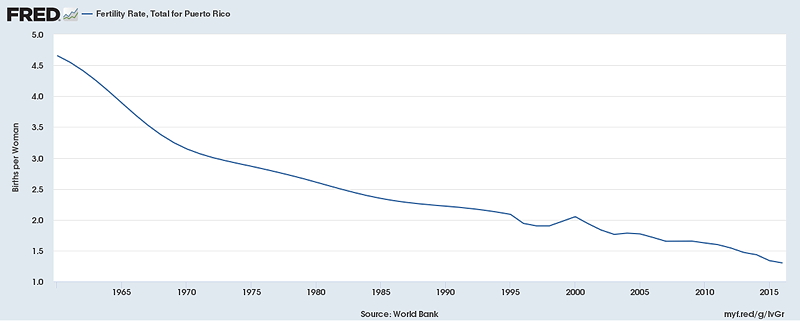
Puerto Rico Total Fertility Rates
Year
Total Fertility Rate
Percentage Change
Rank
1960
4.55
2003
2.02
142
2004
1.91
-5.45%
147
2005
1.75
-8.38%
166
2006
1.75
0.00%
167
2007
1.77
1.14%
158
2008
1.76
-0.56%
160
2009
1.71
-2.84%
170
2010
1.60
-3.54%
176
2015
1.341
2023
0.89
1CDC Data
4-2-1 Population Distribution
The above global trends are already reflected in the demographic profile of Puerto Rico, and projections point to a declining and ageing population. The median age of females has risen steadily reaching 37.9 years in 2009. According to CIA data, the total fertility rate has fallen steadily from 2.02 in 2003 to an estimated 1.65 in 2010, an average change of about -0.04 per year. In 1960 it was 4.55. Puerto Rico’s birthrate now ranks 176 out of a survey of 200 countries in the world. The current fertility level of 1.65 means, roughly speaking, each generation will be 18% smaller than the preceding. Moreover, if the current rate of decrease in fertility is maintained, then by 2020, total fertility will be close to one child per woman -the point at which the population will be reduced by one half in each succeeding generation. The population will then trend towards, what is known in demography as, a 4-2-1 distribution. One adult child will have to provide support for his two parents and four grandparents.
Historically, the decline in fertility in Puerto Rico can be attributed to a population control regime started by USAID and other organizations. In the fifties, Puerto Rico women were the victims of a mass sterilization program[3] masquerading as an anti-poverty campaign. Many were not even informed of the consequences. By 1970 approximately 30% of Puerto Rico’s female population of childbearing age had been sterilized -the highest rate in the world. In the sixties’s Puerto Rico women were used as guinea pigs in the mass testing of unproven contraceptive hormones [6] and by 1963, dozens had died. At that time it was not well known that oral contraceptives, apart from their abortifacient propensity by causing death of the fertilized ovum, also caused blood clots, heart attacks, and pulmonary embolisms, cancer, pelvic inflammatory disease, depression and other conditions (see: (https://thepillkills.org/). In 1973, the demographic decline accelerated as a consequence of the US Supreme Court ruling Roe v. Wade legalizing abortion. If the abortion rate, estimated at .68 in 2001, were reduced in half, the fertility level of Puerto Rico would be above replacement.
Measures of legal abortion in Puerto Rico1
Measures of legal abortion in Puerto Rico1
Country
Year
No.*
Ratio‡
Total abortion rate§
Puerto Rico
1991
19,200
23
0.68
1Guttmacher Institute ‡Abortions per 100 known pregnancies. §The number of abortions that would be experienced by the average woman during her reproductive lifetime, given present age-specific abortion rates. *Worldwide, about one-fourth of the approximately 180 million pregnancies are terminated by abortion.
UPR facilities used to violate blockade of Cuba
The likely economic consequences of this population decline for Puerto Rico are well described by Alexander F. Díaz, in his article Demographic storm [2]. In fact, the decline in fertility is already being experienced in the closing of schools and the diminishing enrollment in post secondary education. The Puerto Rico Department of Education is planning for a reduction of 14,000 students in the public schools in 2010 and at least 40 schools are in danger of closing. The University of Puerto Rico has experienced an estimated 14% drop in enrollment at its main campus in Rio Piedras from 21,561 students in 2000 to 18,653 in 2010. To date, this fall in enrollment has gone largely uncommented. There is a tendency among educators to hide the decline. The UPR Department of English website still proclaims a total enrollment in 2010 of 22,000 students. Many professors are wedded -apparently without the possibility of divorce- to the long discredited narrative of population explosion and continue to teach this in their courses. The decline in enrollment, and concurrent loss of revenues, has contributed to the UPR’s 300 million dollar deficit and is a contributing cause of the current five week student strike. However, unlike in previous strikes, not all of the student’s demands are likely to be met. The government does not have the luxury of robbing the already weakened general economy to bale out an institution which has long been a black hole for money: where tenure is a sinecure; where students regularly take more than 8 years to graduate; where professors of postmodern stripe dedicate time to propagating the discredited ideologies of Freud, Marx, and Freire or the lunacy of gender theory; where many students, ignorant of communist atrocities, proudly wear Che t-shirts and, in violation of Federal laws, participate in brigades to visit Cuba; where student unrest receives the endorsement of dictators such as Castro and Chavez; where Literature professors devote class time to showing triple x movies; where Body Art has supplanted Western Civilization in the curriculum. When a large percentage of the population is unemployed and lacks health care or an adequate pension and revenue is limited, there is no political incentive for a government, with dwindling revenues, to divert additional resources to a dysfunctional institution [7]. Better to adopt a politically expedient solution such as converting the main campus in Rio Piedras into a graduate research facility. With the fall in student numbers, the remaining students could be easily accomodated in other campuses in Puerto Rico or the US.
Prospects for the independence of Puerto Rico are also impacted by current demographic realities. The economic advantages of the relationship with the US are such that there is little imperative for Puerto Ricans to seek full independence and it is unsurprising that at least 40% of the population favor statehood. In fact, during the 2008 elections, the Puerto Rico Independence Party (PIP) lost official recognition obtaining only 2.04% of the vote.
An obvious necessary requisite for independence is a successful and growing economy for only in such an economy would independence be viable. A healthy and expanding economy requires a young and growing population. Demographic and economic decline in Puerto Rico can be expected to translate into an outmigration to the US mainland. Since it is generally young people who leave, a feedback loop is formed leading to a spiral of further decline. Already, almost half of all Puerto Ricans live on the mainland. For this reason, it is clearly in the interests of parties seeking independence for Puerto Rico to encourage population growth and strong stable families.
By embracing “diversity” in a desperate search for members, the Puerto Rico Independence Party, the Refundacion Comunista, the Frente Socialista, and other groups supporting independence, have fallen into the trap of adopting radical feminist agendas which promote abortion and population control, and which have contributed to the breakdown of the traditional family. The antinatalist stance adopted by these organizations is agravating the demographic decline which has already made political independence for Puerto Rico a virtual impossibility. Holding two contradictory beliefs simultaneously is a hallmark of incompetence or psychiatric disorder. Unless the various Puerto Rican pro independence parties cease promoting a “culture of death” and adopt rational policies, in accord with their principal objective, the prospects for Puerto Rican independence would seem, at best, bleak.
Puerto Rico birthrates fell by 3.8 percent in 2009 and marriages dropped by 13.2 percent from 2007 to 2008. According to the 2010 Census, Puerto Rico’s population fell by 2.2 percent from 3,808,610 in 2000 to 3,725,789 in 2010. Since no US state has shown a comparable population decrease, Puerto Rico’s share of more than $400 billion in annual federal aid will be correspondingly reduced with disastrous consequences for the local economy. There are already more than 500,000 non-Puerto Ricans residing on the island Puerto Rican. Unless abortion is halted and the contraceptive mentality changed. Puerto Rican culture remains in serious danger of dissapearing along with any prospects of independence. Meanwhile the perpetual unrest at the UPR continues —added 12/27/2010
Some course descriptions by A. K. Kelmans, proposed for the Discrete Mathematics option of the PhD in Mathematics at the University of Puerto Rico, Río Piedras.
Three credits. Three hours of lecture per week. Prerequisites: MATH 5CCC (Graph Theory).
Review of elementary graph theory. Trees. Matrix-tree theorem. Enumerating spanning trees of a graph. Graph decompositions. Connectivity and k–connectivity of graphs. Disjoint paths and connectivity of graphs. Menger’s and Whitney’s theorems. Graph assembling and disassembling of 3–connected and quasi 4-connected graphs. Various Euler problems. Hamiltonian cycles. The k–closure of a graph. Bondy–Chvátal’s theorem. Long cycles in a graph. Dirac’s theorem. Factors. Maximum and perfect matchings. Tutte’s and Edmonds–Gallai’s theorems. Berge–Tutte duality theorem. Perfect graphs. Lovász’ theorem. Edge colorings. Vising’s theorem. Independent sets and cliques. Vertex colorings. Brook’s theorem. Embeddings of graphs in the plane. Kuratowski’s, Whitney’s, MacLane’s and Kelmans’ planarity criteria. Five-colour and four-colour theorems on planar graphs. On the hamiltonicity of planar graphs.
Justification
It is difficult to overestimate the importance of graph theory in contemporary mathematics and its applications. Deep and elegant in itself, graph theory contains many wonderful ideas and results. Methods and ideas of graph theory are widely used in many other areas of mathematics. Graph theory has a tremendous number of applications. It would not be an exaggeration to say that graph theory is one of the most applicable areas of mathematics. It serves as a theoretical basis for a great variety of applied areas such as computer science, operations research, management science, electrical and mechanical engineering, chemistry, biology, etc. This course will be useful to the students who are planning to pursue doctoral studies in mathematics and its applications.
Syllabus
Historical remarks. Interrelations between graph theory and other areas of mathematics and some areas of science.
The main concepts of graph theory (review).
Trees. Spanning trees of a graph, and their algebraic and geometric interpretations.
Enumerating spanning trees of a graph (Matrix–tree theorem. Coding of spanning trees of a graph. The number of spanning trees of decomposable graphs).
Graph decompositions (Decomposition of graphs on components, edge blocks and vertex blocks (review). Decomposition of 2–connected graphs on 3–connected blocks).
Graph assembling and disassembling (Ear–decompositions of 3–connected, cyclically 4–connected and quasi–4-connected graphs).
Disjoint paths in a graph (Vertex and edge cuts, and connectivity of graphs. Menger’s and Whitney’s theorems. The Ford–Fulkerson theorem.).
Euler problems (A criteria for a graph and digraph to have an Euler tour or Euler trail (review). Euler trail set with at most one odd trail. Arborescences and Euler tours in digraphs.).
Hamiltonian problems (Hamiltonian cycles and paths. k–stable properties and k–closure of graphs. Bondy–Chvátal theorem. Sufficient conditions for graph hamiltonicity.).
Long cycles in a graph. Dirac’s theorem. Cycles through a given subset of elements in a graph. Kelmans–Lomonosov’s theorems.
Factors. Matchings and coverings in bipartite graphs (review). Stable marriage problem.
Matchings in a graph (Maximum and perfect matchings. Tutte’s theorem. Berge–Tutte duality theorem. Edmonds–Gallai structure theorem.).
Edge colorings. Vising’s theorem.
Independent sets and cliques.
Vertex colorings (2–coloring and odd cycles (review). Brook’s theorem (review). Coloring of special graphs. Perfect graphs. Lovász’ theorem. Strong perfect graph conjecture.).
Cycle and cocycle spaces of a graph (Combinatorial duality of graphs. Whitney’s cycle isomorphism theorem and its strengthenings and generalizations. Kelmans’ cycle semi–isomorphism and semi–duality theorems.).
Graph planarity (Various embeddings of a graph into a plane. Geometrical duality of graphs. Euler’s formula (review). Kuratowski’s, Whitney’s, MacLane’s and Kelmans’ planarity criteria.)
Coloring of planar graphs (Five–colour and four-colour theorems on planar graphs and related topics).
Hamiltonicity of planar graphs.
Text
D.B. West, Introduction to Graph Theory, Prentice Hall, 1996.
J.A. Bondy and U.S.R. Murty, Graph Theory With Applications, North Holland, Amsterdam, 1976.
Bibliography
B. Bollobás, Extremal Graph Theory, Academic Press, London, New York, San Francisko, 1978.
M. Behzad, G. Chartrand, and L. Lesniak, Graphs and Digraphs, Wadsworth International Group, 1991.
A.K. Kelmans, A New Planarity Criterion for 3-connected Graphs, J. Graph Theory, 5 (1981) 259–267.
Three credits. Three hours of lecture per week. Prerequisites: MATH 5CCC (Graph Theory).
Branch and bound strategy. Dynamic programming principle. Optimal paths in graphs. Optimal spanning trees in graphs. 2–coloring and odd cycles in a graph. Depth–first search in a graph and its applications. Properties of depth–first search tree. Graph decomposition algorithms. Graph assembling algorithms. Graph planarity algorithms. Euler problems. Hamiltonian problems. Some packing and covering problems for graphs. Metric problems on graphs. Set transformation algorithms. Search trees of different type. Various sorting algorithms. The main ideas of the NP–theory (the theory of problem complexity).
Justification
Many problems in mathematics and its applications are of a discrete nature. Usually the number of feasible solutions to such a problem increases very rapidly with its size and therefore, it is impossible to find a required solution by searching all alternatives, even with the fastest computers. Accordingly, it is imperative to seek efficient algorithms for solving discrete problems. This course will be very useful to the students studying mathematics and of particular interest to those students who are planning to pursue doctoral studies in discrete mathematics and its applications.
Syllabus
Branch and bound strategy.
Dynamic programming principle.
Optimal paths in graphs (Shortest path in a graph or digraph with nonnegative or arbitrary edge-weights. k–shortest paths. Min-max paths).
Optimal trees in graphs (A spanning tree and a minimum spanning tree in a graph, and a minimum directed tree in a digraph. Min–max and dynamic min–max spanning trees. Steiner trees in graphs. Enumerating spanning trees of graphs. Description of all minimum spanning trees of a graph.).
2–coloring and odd cycles in a graph.
Depth–first search in a graph and its applications. Properties of depth–first search tree.
Graph decomposition algorithms (Finding components, edge and vertex blocks of a graph, and strongly connected components of digraphs).
Graph assembling algorithms (Ear–decompositions for connected, edge and vertex 2–connected, and 3–connected graphs).
Graph planarity algorithms.
Euler problems (Finding an Euler trail and Euler cycle in a graph or digraph, Fleury’s algorithm. Euler trail set with at most one odd trail. Labyrinth problem. De Bruijn sequences and graphs. The Chinese postman problem.)
Hamiltonian problems (Finding a Hamiltonian path and cycle in a graph. Travelling salesman problem.).
Packing and covering problems for graphs (Matching problems. Disjoint paths. Various generalizations and related problems).
Metric problems on graphs (Radius, diameter, center, and median of a graph. Optimal center location problems for weighted graphs).
Set transformation algorithms. Search trees of different type. Permutations and various sorting algorithms.
The main ideas of the NP–completeness theory.
Text
S. Even, Graph Algorithms, Computer Science Press, 1979.
N. Christofides, Graph Theory. An Algorithmic Approach, Academic Press, 1975.
Bibliography
A.V. Aho, J.E. Hopcroft, J.D. Ulman, The Design and Analysis of Computer Algorithms, Addison-Wesley, 1976.
A.V. Aho, J.E. Hopcroft, J.D. Ulman, Data Structures and Algorithms, Addison-Wesley, 1983.
D.E. Knuth, The Art of Computer Programming. Vol.1. Fundamental Algorithms, Addison-Wesley,, 1973.
D.E. Knuth, The Art of Computer Programming. Vol.3. Sorting and Searching, Addison-Wesley, 1973.
Three credits. Three hours of lecture per week. Prerequisite MATH 8005.
Computers, problems, algorithms, and complexity. Polynomial time algorithms and intractable problems. Provably intractable problems. NP-complete problems. Deterministic Turing machines and the class P. Nondeterministic computation and the class NP. The relation between P and NP. Polynomial transformations and NP-completeness. The Cook–Levin theorem. Basic NP-complete problems. Applying NP-completeness to approximation problems. The structure of NP. The polynomial hierarchy. The complexity of enumeration problems.
Justification
Many problems in mathematics and its applications are of a discrete nature. Usually the number of feasible solutions to such a problem increases very rapidly with the its size and therefore, it is impossible to find a required solution by searching all alternatives, even with the fastest computers. Accordingly, it is imperative to seek efficient algorithms. Unfortunately for most problems, efficient algorithms are not known, and it is not even clear whether such algorithms exist. NP-theory provides an approach for classifying problems according to their complexity (i.e. the degree of their intractability to computers). The theory considers a very rich class of problems (the so called class NP containing most “real” problems. One of the main results of the theory is the fact that there exists a “most complicated” problem in this class. The theory provides a long list of “real” problems that are most complicated. Moreover, most of the problems arising in applications turn out to be “most complicated”. In fact it is very difficult to find a nontrivial problem which can be solved efficiently. Actually the finding of such a “good” problem is a kind of discovery. Typically such results are based on intrinsic properties of the problem and contain deep and non–trivial mathematical ideas. Various “good” problems and main ideas and approaches providing efficient algorithms are discussed in the courses “Discrete Algorithms” and “Combinatorial Optimization I”. The strategy for solving a problem depends on its complexity status. This course provides students with the main ideas, approaches and results concerning the classification of problems by their compexity. This course will be of particular interest to those students who are planning to pursue doctoral studies in discrete mathematics and theoretical computer science.
Syllabus
Computers, Complexity, and Intractability: Problems, algorithms, and complexity. Polynomial time algorithms and intractable problems. Provably intractable problems. NP–complete problems.
The Theory of NP-Completeness: Decision problems, languages, and encoding schemes. Deterministic Turing machines and the class P. Nondeterministic computation and the class NP. The relation between P and NP. Polynomial transformations and NP-completeness. The Cook–Levin theorem.
Proving NP-Completeness Results: Basic NP-complete problems. Some techniques for proving NP-completeness.
Using NP-Completeness to Analyze Problems: Analyzing subproblems. Number problems and strong NP-completeness. Time complexity as a function of natural parameters.
NP-Hardness: Turing reducibility and NP-hard problems.
Coping with NP-Complete Problems: Performance guarantees for approximation algorithms. Applying NP-completeness to approximation problems.
Beyond NP-Completeness: The structure of NP. The polynomial hierarchy. The complexity of enumeration problems. Polynomial space completeness. Logarithmic space. Proofs of intractability and P vs. NP.
Text
M.G. Garey and D.S. Johnson, Computers and Intractability. A Guide to the Theory of NP-completeness, W.H.Freeman and Company, San Francisko, 1979.
Bibliography
S. Even, Graph Algorithms, Computer Science Press, 1979.
A.V. Aho, J.E. Hopcroft, J.D. Ulman, Data Structures and Algorithms, Addison-Wesley, 1983.
Three credits. Three hours of lecture per week. Prerequisites: MATH 8001, MATH 6201, MATH 6150
Review of elementary combinatorics. Outline of the main problems and approaches of enumerative combinatorics. Enumerating trees. Matrix–tree theorem. Coding of trees. Counting Euler cycles in a digraph. Counting and listing of nonisomorphic trees of different types. Generating function method in enumerative combinatorics. Enumerating graphs of different types. Pólya’s counting theory of nonisomorphic objects. Enumerating nonisomorphic graphs of different types. Principle of inclusion and exclusion. Lattices, their Möbius functions and Möbius algebras. Asymptotic results in enumerative combinatorics.
Justification
Enumerative combinatorics is an important area of discrete mathematics that concerns the problems of counting and/or listing of objects of different types. It contains many interesting ideas and results that are useful not only in itself but also in various areas of mathematics (analysis, probability, queuing theory, random structures, etc.) and in many applications (physics, chemistry, computer science, network reliability, statistics, electrical circuits, etc.). On the other hand, enumerative combinatorics uses concepts, ideas and results from different areas of mathematics (analysis, group theory, theory of posets and lattices, etc.).
This course will be very useful to the students who are planning to pursue doctoral studies in mathematics and its applications.
Outline of main problems and approaches of enumerative combinatorics (Counting and listing. Enumeration problem of different objects and their isomorphism classes.).
Enumerating trees. Matrix–tree theorem. An algorithm for finding formulas of the number of spanning trees of decomposable graphs. Coding of trees of a complete graph and its generalizations. Counting Euler cycles in digraphs. Counting and listing of nonisomorphic trees of different types.
Generating function method in enumerative combinatorics. Enumerating graphs of different types (graphs and digraphs of given size, connected and 2–connected graphs, rooted graphs, Eulerian graphs, tournaments, orientations of a graph, etc.).
Pólya’s counting theory of nonisomorphic objects (Groups and graphs. The cycle index of a permutation group. Burnside’s theorem. Pólya’s theorem.). Enumerating nonisomorphic graphs of different types.
Principle of inclusion and exclusion. Partially ordered sets and their Möbius functions (Posets of different types. Lattices. Möbius functions and Möbius algebras. The Möbius inversion formula). Enumeration of permutations of certain types.
Asymptotic results in enumerative combinatorics.
Text
F. Harary, E.M. Palmer, Graphical Enumeration, Academic Press, New York and London, 1973.
R. Stanley, Enumerative Combinatorics, Volume I, Wadsworth and Brooks/Cole, Monterey, California, 1986.
A. Tucker, Applied Combinatorics, 3rd. ed.,Wiley, 1995.
Bibliography
I.P. Goulden and D.M. Jackson, Combinatorial Enumeration, Wiley, 1983.
D.E. Knuth, The Art of Computer Programming, Vol. I, Addison-Weseley, 1973.
Three credits. Three hours of lecture per week. Prerequisites: MATH 6881, MATH 8001.
Elements of linear and integer programming: branch and bound method and its application to combinatorial optimization problems. Network flow theory and its generalizations: statical maximal flow, feasibility theorems and combinatorial applications, minimal cost flow problems, multi–terminal maximal flows, multi–commodity flows. Matching theory and its generalizations: matchings in bipartite graphs, size and structure of maximum matchings, bipartite graphs with perfect matchings, general graphs with perfect matchings, some graph–theoretical problems related to matchings, matchings and linear programming, matching algorithms, the f–factor problem, vertex packing and covering, some generalizations of matching problems.
Justification
Optimization problems arise in various areas of mathematics as well as in applications (computer science, management science, operations research, physics, engineering, statistics, etc.). The main feature of combinatorial optimization problems is that feasible solutions are of a discrete nature, and therefore the classical methods of optimization based on “small” variations of a feasible solution cannot be applied. Typical examples are integer programming problems which are in general very difficult (NP-hard). Nevertheless efficient algorithms can be found for some natural combinatorial optimization problems. The main approaches, ideas and results along these lines will be discussed in this course. This course will be of particular interest to those students who are planning to pursue doctoral studies in Discrete Mathematics and Theoretical Computer Science.
Syllabus
Elements of linear and integer programming. Branch and bound method and its application to combinatorial optimization problems.
Network flow theory and its generalizations.
Statical maximal flow: Networks. Flows in networks. Cuts. Maximal flow. Multiple sources and sinks. The labelling method for solving maximal flow problems. Dinitz–Tarjan’s and Karzanov’s algorithms for maximal flow problems. Flows in undirected and mixed networks. Node capacities and other extensions.
Feasibility theorems and combinatorial applications: Supply–demands theorems. Circulation theorem. The König–Egerváry and Menger graph theorems. Construction of a maximal independent set of admissible cells. A bottleneck assighnment problem. Unicursal graphs. Dilworth’s chain decomposition theorem for partially ordered sets. Minimal number of individuals to meet a fixed schedule of tasks. Set representatives. Matrices composed of 0’s and 1’s.
Minimal cost flow problems: The Hitchcock problem. The optimal assignment problem. Equivalence of Hitchcock and minimal cost flow problems. The minimal cost supply–demand problem. Maximal dynamic flow. Minimal cost circulations.
Matchings in bipartite graphs: The theorems of Konig and P. Hall. A bipartite matching algorithm. Matchings, flows and measures.
Size and structure of maximum matchings: Tutte’s and Berge’s min-max theorems. Edmonds–Gallai structure theorem.
Bipartite graphs with perfect matchings: Elementary graphs and their ear structure. Minimal elementary bipartite graphs. Decomposition into elementary bipartite graphs.
General graphs with perfect matchings: The canonical partition G. Saturated graphs. Ear structure of 1-extendable graphs. Factor-critical and bicritical graphs. Lovász theorem on ear–decompositions of factor–critical graphs.
Some graph-theoretical problems related to matchings: 2–matchings and 2–covers. Matchings, 2-matchings and the König property. Hamiltonian cycles and 2-matchings. The Chinese postman problem. Optimum paths, cycles, joins and cuts.
Matchings and linear programming: Linear programming and matchings in bigraphs. Matchings and fractional matchings. The matching and fractional matching polytopes. Chromatic index. The dimension of the perfect matching polytope.
Matching algorithms: The Edmonds matching algorithm. Weighted matchings. An algorithm based upon the Edmonds–Gallai theorem. A linear programming algorithm for matchings.
The f–factor problem: Reduction principles. A structure theory for f–factors. Realization of degree sequences.
Vertex packing and covering: Critical graphs. Vertex packing polytopes. Hypergraph matching. Vertex packing in claw-free graphs.
Some generalizations of matching problems: Optimal packing of special subgraphs of a graph. Kelmans’ min-max and structure theorems on induced stars in a graph. Packing paths, cycles, joins and cuts.
Text
M. Plummer and L. Lovász, Matching Theory, North-Holland, 1986.
L.R. Ford and D.R. Fulkerson, Flows in Networks, Princeton University Press, Princeton, New Jersey, 1962.
Bibliography
E. L. Lawler, Combinatorial Optimization; Networks and Matroids, Holt Rinehart and Winston, New York, 1976.
A. Schrijver, Theory of Linear and Integer Programming, John Wiley and Sons, Chichester, New York, Brisbane, Toronto, Singapore, 1987.
G.L. Nemhauser and L.A. Wolsey, Integer and Combinatorial Optimization, Wiley, Chichester, 1988.
Three credits. Three hours of lecture per week. Prerequisites: MATH 6150, MATH 8001.
Fundamental concepts and axioms of matroid theory. Duality in matroids and matroid operations. Vector representation of matroids. The matroid of a graph and graph planarity. Greedy algorithms on matroids. The union of matroids and its rank function. Efficient algorithms for some combinatorial optimization problems (packing, covering, intersection etc.) on matroids with applications to a variety of combinatorial objects (e.g. graphs, matrices, algebraic dependencies, transversals).
Justification
It is difficult to overestimate the importance of matroid theory in contemporary applied and theoretical mathematics. It provides a common basis for understanding and solving a variety of problems in a wide range of areas including graph theory, linear algebra, geometry, transversal theory, block design, combinatorial lattice theory and algebraic geometry. Matroid theory serves as a link between combinatorics and other mainstream areas of mathematics. It plays an extremely important role in combinatorial optimization where it can be used to find combinatorial structures for which the corresponding optimization problems can be solved in polynomial time. Moreover, it provides efficient procedures (described in rather general terms) for solving those problems and for designing the corresponding polynomial time algorithms. This course will be of particular interest to those students who are planning to pursue doctoral studies in either pure or applied mathematics.
This course will be of particular interest to those students who are planning to pursue doctoral studies in either pure or applied mathematics.
Syllabus
Fundamental concepts and axioms of matroid theory.
Independent sets and bases of a matroid.
Circuits and the rank function of a matroid.
Examples of matroids.
Duality in matroids.
Operations on matroids and submatroids (truncation, restriction, contraction, etc.).
The closure operator, closed sets = flats = subspaces, and hyperplanes of a matroid.
The lattice of a matroid.
Vector representation of matroids, the matroid of a linear subspace, special matroids.
Matroid connectivity. The matroid of circuits of a graph, circuit isomorphisms and semi-isomorphisms of graphs.
Geometrical and matroid dualities of graphs, a planarity criterion of a graph in terms of its matroid.
The greedy algorithm, the “greedy” characterization of matroids.
Minimax and dynamic minimax problems for matroids.
A description of the matroid of the minimum bases of a matroid.
The union of matroids and its rank function.
Efficient algorithms for finding a base of the union of matroids, and for covering, packing and intersection problems for matroids.
This little paper is an example of epistemology (theory of knowledge). It will make you real smart. Your roommates, family, friends, and even passersby who hear you yacking to yourself will think you’re a genius, –definitely not worthless, sorry, unskilled.
Hang on! Here we go.
We usually focus on texts we are reading; words we are hearing, speaking, or writing; and activities we are engaged in.
Ms. Bronzedagger: “We’re working on geography–about the northern vs. southern hemisphere.”
But this is superficial, –on the surface. The northern and southern hemispheres are examples of something larger –namely, the concept of hemisphere. Does Ms. Bronzedagger know that? Does she teach that our planet is merely oneexample of things with hemispheres?
In fact, everything you USE when you teach is an example of something larger. For instance, when you show your students how to solve 10 equations having one unknown (x = 3 + 12; 6 x 5 = y) do not think you are teachingthe strategy for solving those 10 particular equations. Know that you are teaching the general strategyfor solving all equations of that TYPE. The 10 problems and their solutions are examples of the general type of problem and its solution. That (the general, –the idea) is what you really want students to learn. (Otherwise, how can they generalize to new examples?)
The classical role of teacher is to educate, —to lead students out of the cave of illusion (superficial knowledge of particular and changing things) to knowledge of what is general–universal, stable, and enduring. You teach about the Revolutionary War, Civil War, First and Second World Wars, and Cold War, –not so your students can think and talk about these particular wars only, but so they can think and talk about concepts, rules, and theories of war generally. Likewise, you teach students to sound out slip, slim, man, rim, lip, lamp, and ram, not so they can read these words only, but so they learn the general strategy for sounding out all words.
But we can’t teach the general itself.We can’t see the concept red, –only red things that are examples of the concept red. The concept is in the head.]
It is cognitive. It is an idea abstracted from(taken out of) the examples. We can’t teach or learn the sounding out strategy itself, –without words to sound out. We can’t see a rule relationship. We can only abstract a rule from examples of the rule relationship.
We are stuck in the here and now of particular, concrete events (objects, problems). These particular, concrete events (examples) are the only means to reveal–or to help students to grasp or to induce (discover, construct, say), –the general IDEAS that are behind, woven through, revealed, or embedded in the examples.
The question is How do you get students’ minds to move from concrete things (examples) to cognitive knowledge of general ideas revealed by or embedded in the things, –and how do you do this in the surest and fastest way? The answer is, Logically precise design of communication.
Believe me or believe me not, your true project as an educator is philosophy.
Fortunately, there are only four kinds of general ideas, or cognitive knowledge that can be revealed by examples. In fact, there are four and ONLY four kinds of cognitive knowledge that human beings can think and communicate.
These four forms of cognitive knowledge (ideas) are (a) verbal associations (simple facts, verbal chains, verbal discriminations), (b) concepts, (c) rule relationships (propositions), and d) cognitive strategies.
Each form of cognitive knowledge (see above) is a LOGICAL FORM, or has a LOGICAL STRUCTURE. And each form involves certain LOGICAL OPERATIONS, —mental steps, you might say. For example, you have to perform certain logical operations or mental steps in order to move from seeing examples to getting (grasping, understanding, knowing) and then using (applying, generalizing) a concept.
Following is the logical structure and the logical operations (mental steps) involved in getting and using (applying) the four forms of COGNITIVE knowledge, –i.e., these are the mental/logical steps in moving from examples (things) to ideas (cognitions), –from the superficial to knowledge.
The logical structure of a verbal association
The logical structure of a verbal association is THIS ONE THING GOES WITH THAT ONE THING. To “get” a verbal association means to get THAT THIS ONE THING goes with THAT ONE THING. Therefore, the most effective and fastest way to teach a verbal association is simply to say that THIS ONE THING goes with THAT ONE THING.
“That (point) is blue …. What is that?… blue …. Yes, point to blue.”
“The six New England states are Maine, New Hampshire, Vermont, Massachusetts, Rhode Island, Connecticut …. Your turn. Name the six New England states …. What are Maine, New Hampshire, Vermont, Massachusetts, Rhode Island, and Connecticut?… Where are they?” …
The logical structure of a concept
The logical structure of a concept is ALL OF THESE EXAMPLES HAVE SOMETHING(S) IN COMMON. THEY SHARE A SAMENESS in their features.
So, to get a concept (a general) means to get the sameness that is common to the examples (particulars) but that is NOT found in the NONEXAMPLES. The mental steps for moving from examples to the general idea (concept) are:
Identifying (locating, pointing out) and recognizing (“This …”) the features of examples (in all examples labeled “crystalline”) and the features of nonexamples (all called “not crystalline”). The features of each piece of rock might be color, size, hardness, and molecular structure.
Comparing and contrasting the identified features of labeled examples (“This IS crystalline”) to find the features that are common to them, –i.e., molecular structure is the same in all examples named crystalline, but other features (size, color) vary from sample to sample. Therefore, we hypothesize, it may be that molecular structure is the feature that makes the examples crystalline.
Comparing and contrasting the labeled examples and labeled nonexamples (“This is NOT crystalline”) to find the common features that are in the examples but are not in the nonexamples, –i.e., there is a different molecular structure in the nonexamples. Therefore, we conclude (induce, infer, generalize), that a certain molecular structure is what makes things crystalline vs. not crystalline. We now get the concept embedded in the examples.
Therefore, the most effective and fastest way to teach a concept is to teach WHAT THE SAMENESS IS that is COMMON to the EXAMPLES but that is NOT found in the NONEXAMPLES. Specifically,
Teach students how to examine examples and nonexamples.
Show examples, label them as examples, and point out the common features that make them “same.” “See the planes in the structure.”
Juxtapose examples and nonexamples; label the nonexamples and point out the absence of the features common to examples that make the nonexamples different from the examples. “This is NOT crystalline. No planes in the structure.”
Acquisition test. “Is this (crystalline)? How do you know?”
Later, work on generalization/discrimination with new examples and nonexamples.
The logical structure of a rule relationship
The logical structure of a rule relationship, or proposition, is THIS CLASS (group, set) of examples/things (CONCEPT) GOES WITH THAT CLASS (group, set) of examples/things (CONCEPT).
All beings are mortal. [All of the class of beings is INSIDE the class of mortals.]
No terrorist can be trusted in peace negotiations. [None in the class of terrorist are in the class of persons that can be trusted in peace negotiations.]
The more the enemy’s infrastructure is destroyed, the less the enemy resists after being defeated. [The class of events that involves destroying enemy infrastructure CAUSES the class of events that involves resistance.]
The mental steps (logical operations) for moving from examples of the rule to the general rule itself (the idea) woven through (common to) or revealed by the examples would be:
Identifying (pinpointing) and recognizing the value (amount) of one variable in an example and the corresponding value of the other variable in the example. “Total destruction of Carthage. [Goes with] No resistance.”
Comparing and contrasting the corresponding values across all the examples, –to see if there is a common way that they go together (co-vary).
“Carthage and Rome: Total destruction goes with zero resistance. Sherman’s march: High destruction goes with low resistance. Iraq: Low destruction goes with high resistance.”
Stating a rule summarizing the common goestogetherness, or co-variation. “The greater the destruction of enemy infrastructure, the less the resistance after defeat.”
Therefore, the most effective and fastest way to teach a rule relationship is to teach THE RELATIONSHIP (GOESTOGETHERNESS) COMMON to the EXAMPLES. Here’s how.
Teach students how to look at a range of examples. What are the features in each war?
Show examples and point out the goestogetherness (co-variation) of the corresponding values of each variable in each relationship/example. Or, show examples and have students identify the goestogetherness. [It is better for you to do this first, –model, –and then have students do it with new examples.] “Rome totally destroyed Carthaginian infrastructure. Carthage then put up zero resistance.” “Sherman burned homes, materials, and fields. The Confederate soldiers put up little resistance after that.” “Grant killed soldiers, not cities. Even though Confederate soldiers died by the tens of thousands, the rest kept on fighting.” “The Marines beat the North Vietnamese and Viet Cong during the Tet Offensive, but they did not destroy Hanoi. The North Vietnamese and Viet Cong came right back.” “The U.S. and British forces made the Iraqi army quickly surrender or scatter, but did not destroy their weapons, food, fuel, homes, roads … Resistance began shortly after the defeat.”
Have students say the relationship (goestogetherness) common to the examples. “The greater … the less … “
Give new and/or hypothetical examples and/or have students invent them. Ask what will happen if (there is more or less destruction of infra-structure). Then ask, How do you know? (Students give rule.) And give new examples of more and less resistance after defeat, and ask why.
The logical structure of a cognitive strategy
The logical structure of a cognitive strategy is a sequence of LOGICALLY ARRANGED, OR PROGRESSIVE STEPS (each next step depends, logically, on accomplishing the earlier ones; and each step, logically, makes the next step possible), GOVERNED BY RULES (“If the product is ten or more, write the … “), and USING CONCEPTS (product, tens, ones, column, times, carry) AND VERBAL ASSOCIATIONS (seven times five is 35).
So, to get a cognitive strategy is to get the logical arrangement of steps (and to see the necessary progression) and the concepts, rules, and verbal associations needed.
Therefore, the fastest and most effective way to teach a cognitive strategy is to teach the sequence of steps, the logical necessity of the progression, and all of the concepts, rules, and verbal associations needed. You may have to teach a strategy in chunks (forward chaining):
1, 12, 123, 1234,… Or 1, 2, 12, 3, 123, 4, 1234,…
Remarks
Cognitive knowledge does not exist in the air. It is in thinking, speaking, or writing.
Thinking (cognitive knowledge) is talking to yourself–communicating to yourself. You are INSTRUCTING yourself. “Seven times five is 35. (A simple fact) Write 5 (rule) and carry the 3 (rule) …”
Speaking is cognitive knowledge that you are communicated to other persons. You are INSTRUCTING other persons. “Boys and girls, I look at the ones column first. (rule) I say the numbers to myself. (rule). The numbers are 7 and 5. (simple fact) Now I multiply 7 and 5. (rule) Seven times five is 35 (simple fact) …””Hey, I’m thirsty.” (simple fact)
Besides physical routines, the ONLY things that you can learn, know, and communicate (think, speak, and write, –teach) are (a) verbal associations (simple facts, verbal chains, verbal discriminations), (b) concepts, (c) rule relationships (propositions), and (d) cognitive strategies. Therefore, every sentence that is thought, spoken, or written consists of verbal associations, concepts, rules, and/or steps in a cognitive strategy. “Yesterday was a great day.” (rule: categorical relationship. Yesterday is in the class of events that are great days.) “I stayed up too late. I’m really wasted today.” (rule: causal relationship. Staying up late caused being wasted.) “If you really love me, you will share your feelings.” (rule: causal relationship)”I think it’s raining” (concept) “My name is Archilles” (verbal association) “This is no accident. It’s murder!” (concept. Part of the conclusion of a long inductive strategy of homicide investigation in which examples/evidence point to murder.)”So, all the evidence clearly says, She is guilty.” (concluding rule of an argument, –a cognitive strategy) “Three times four is twelve.” (verbal association) “To be or not to be? That is the question.” (rule: categorical relationship. To be or not to be is inside the category of things that are questions.) “Thus, conscience doth make cowards of us all.” (rule: causal relationship)
Please note that solving a math problem, sounding out a word, analyzing a document, doing an experiment, and writing a paper involve the mental steps (thinking, talking to yourself) called cognitive strategies. Perhaps the largest cognitive strategies are deductive reasoning and inductive reasoning.
Deductive reasoning (one thinking and communicating strategy) is reasoning that begins with a general rule (All beings are mortal); and then gives facts (Socrates is a being); and ends with a conclusion (Therefore, Socrates, –a being, –is mortal). But deductive reasoning can be a much longer chain of sentences. The Declaration of Independence is a long chain of deductive reasoning. Whole books, courses, and curricula may be organized as a deductive argument, –a logical progression of sentences leading to a conclusion. For example, we could begin with a general theory of conflict and then show how it applies to (explains) specific conflicts, –examples of the theory. Just as Socrates’ death is an example of the rule that all beings are mortal.
Inductive reasoning (another thinking and communicating strategy) is reasoning that begins with facts and gradually builds (induces, discovers, figures out, constructs) general rules that ACCOUNT for the facts. For example, when you show kids examples of red things and not red things, and call them red and not red, the kids figure out (induce) the CONCEPT redness. Their mind (thinking, speaking) goes from specifics (examples) to a general idea.Likewise, you could examine many different examples of social conflicts and gradually help students to develop (induce) a general theory of conflict that accounts for (describes, explains) the examples.
Rule relationships (propositions) are one of the four forms of cognitive knowledge. Propositions are asserted in sentences. There are two kinds of relationships asserted by rule relationships or propositions.Categorical propositions, or rules. These propositions assert that one class of things (concept) is inside, partly inside, or outside another class of things (concept). All mammals are warm blooded.Some bacteria are helpful.No music by Madonna is worth listening to. [You may have to think about a sentence to see that it asserts one or more of the above categorical propositions. “Love hurts” implies “All love hurts.”]Causal propositions, or rules. These propositions assert that one class of things (concept) causes, fosters change in, yields, is followed by another class of things (concept). If the rate of reinforcement increases (or decreases), then the rate of the reinforced behavior increases (or decreases). [This asserts a direct relationship.]If the rate of punishment increases, then the rate of the punished behavior decreases. [This asserts an indirect, or inverse relationship.]If and only if the material is hot enough will the material burn. [necessary condition]Whenever a nation is attacked, social cohesion increases. [sufficient condition]After you add numbers in the ones column, add numbers in the tens column.
So, one of your jobs as a teacher is to do a knowledge analysis of the objectives (analyze a poem, calculate the slope of a straight line, state the main rule in each of the first Ten Amendments to the U.S. Constitution, conjugate a new verb). Ask, What are the forms of knowledge contained in DOING each objective? What verbal associations, concepts, rules, and steps in a cognitive strategy must students know/do?Your second big job is to figure out how to teach (communicate) these in (a) a logically clear way (i.e., precise wording and a range of examples/nonexamples that unambiguously [“It can only mean this …”] and quickly reveal the associations, relationships, ordering, features); and (b) in a logically progressive (deductive or inductive) sequence. See numbers 5, 11, and 12, above.
And now THE FINALE …. If all cognitive knowledge is (nothing but) thinking and speaking and writing verbal associations (This goes with that.), concepts (This IS a that.), rules (These go with those in this way.), and cognitive strategies (e.g., explanations, arguments, problem solving), –often in the form of SENTENCES. (Even doing math problems is a series of sentences.)
And if getting each form of cognitive knowledge involves certain LOGICAL OPERATIONS or mental steps, –moving from examples to the general (e.g., concept or rule).Then (besides physical routines) ALL teaching boils down to TEACHING STUDENTS TO THINK AND SPEAK AND WRITE IN LOGICALLY CLEAR SENTENCES ARRANGED IN A LOGICAL SEQUENCE.If YOU speak and write (model, ask questions–teach) in a logical fashion, then your STUDENTS will quickly learn the logical structures in and the mental steps needed for getting verbal associations, concepts, rules, and cognitive strategies you are trying to teach (the objectives).But if you don’t, they won’t. Their thinking, speaking, and writing will be ILLOGICAL, –invalid, incomplete, false, inept, ignorant. They will not have knowledge. They will have illusion.
Application of the four forms of COGNITIVE knowledge using deductice and inductive reasonining tell what it means to teach in a logical fashion.
DO IT! DO IT! DO IT! DO IT! DO IT! DO IT!
You DO NOT want MY spirit haunting YOU. I will come back, –hot from Hell.
A Wrath, a Demon … Unfightable, unwarrable on, unholy, A bold, black Ruin … I will suck your life’s blood dry, then hale you below To pay the painful penalty … For mighty Hades is strict In calling men to account under the earth. His mind keeps records, Nothing escapes his control.
A response to Daniel R. Altschuler”s article Diseño Inteligente Ininteligible
Albert Einstein “The bigotry of the nonbeliever is for me nearly as funny as the bigotry of the believer”.
In what follows the sections of Dr. Altschuler’s article are in italics followed by comments in bold font.
[Altschuler] Recientemente han cruzado por mi pantalla noticias algo inquietantes. No; no me refiero a los muertos en las batallas que a diario se libran en Irak, ya casi no son noticia, de igual modo que ya casi no es noticia la sangre cotidiana que nos presentan en el noticiario. Desgraciadamente ya es habitual.
Hardly relevant to the topic of Intelligent Design. One might just as well have mentioned the 200, 000 or so children who, according to UN statistics, were dying every year under Saddam Hussein for lack of vaccinations and clean water, a result of Iraqi and UN corruption, or state sanctioned forced abortion and infanticide in China, but this would have spoiled the narrative —de rigueur in left wing opinion pieces— that the US is the source of all evil. In any case such news rarely “crosses the screen”.
[Altschuler] No; me refiero a la reciente noticia de que el presidente Bush, sin duda para ganarse algunos votos, ha expresado que él cree que la idea religiosa de diseño inteligente, un eufemismo de creacionismo, debe enseñarse en las escuelas junto con la evolución como teorías alternativas que explican el mundo que nos rodea. No es noticia que él piense así, ya que tuvo similares posturas como gobernador de Texas.
This reiterates the leftist fixation that Bush and the US are responsible for all the world’s problems, at the same setting up a straw man by, falsely suggesting that Intelligent Design is synonymous with the religious theory of creationism when in reality, it claims to be based on the mathematical science of information.
[Altschuler] La disputa es antigua y mi inquietud es provocada por la ignorancia de la ciencia que demuestra el presidente de la nación más poderosa del mundo. [sic]
The claim that “the dispute is ancient” continues the author’s attempt to identify ID theory with the much older creation theory which proponents of ID theory reject. In the previous paragraph, it was said that Bush supported ID theory to gain votes, now the same statement is ascribed to scientific ignorance. However, the aim of the author is clearly not consistency. Actually, the critique of Bush is a crude rhetorical device designed to induce those who believe that Bush is not very intelligent to invalidly conclude that Intelligent Design is false, from the mere fact that “Bush believes in it while at the same time to convincing those who do not believe in ID to conclude that Bush is stupid.
[Altschuler] Ya a poco de publicarse la obra de Charles Darwin en 1859, se realizó un famoso debate, entre Thomas Henry Huxley, presidente de la Royal Society y Samuel Wilberforce, Arzobispo de Oxford —religión contra ciencia, el primero de muchos. En 1925, se llevó a juicio al joven maestro de biología John Scopes, acusado de haber violado la ley de Tennesse que prohibía la enseñanza de cualquier teoría que negara la historia de la creación divina en las escuelas y universidades públicas del estado. Ha pasado a la historia como simbólico de toda esta estúpida historia. La ley fue revocada recién en 1967.
Like the notorious case of Roe versus Wade which legalized abortion through all 9+ months of pregnancy, the Scopes trial was not based on any real crime but was rather a legal device engineered by judicial activists —in the Scopes case by members of the American Civil Liberties Union (ACLU) an organization with a long record of discrimination against Christians. The actual train of events is described here. In reality, the required Biology textbook in the State of Tennessee, Civic Biology by Hunyer (1914), already included a chapter on evolution and undoubtedly many teachers actually covered this topic without much complaint. Scopes who held a law degree from the University of Kentucky was induced to stand trial merely to challenge the existing law. He later admitted that he had not taught evolution but had persuaded his students to testify as such.
However, the pejorative “stupid”, so easily applied with hindsight, completely ignores the historical context that in 1925 theories of evolution were based as much on speculation as on hard empirical evidence. At that time, there existed no biochemical evidence even for micro-evolution (within a single species) over shorter time scales. As regards macro evolution, empirical evidence of the detailed pathways between species was, and still is, exceedingly sparse. In fact, the term missing link had been coined to refer to conjectured species for which no actual fossil could be found —although the term missing chain may have been more accurate. Even today, no particular evolutionary model is referred to as the “Law” of Evolution and many statements made by evolutionists are not actually science. In the absence of a continuous fossil record, claims of the type “X is the ancestor of Y” are untestable except in the case of micro-evolution. The mere invention of plausible reasons why a certain hypothesized intermediate stage should be favored by “natural selection” does not pass muster as a scientific test. Many so called fossils have actually turned out to be fake. Australopithecine was the skull of an extinct ape, Piltdown Man was the jaw of an orangutan fitted into a human, Java Man was a mere gorilla, Nebraska Man was the teeth and body parts of an extinct pig, and Pithecanthropus Alalus, a fairy tale. Archaeoraptor was intelligently designed by a Chinese farmer who affixed bits of a theropod dinosaur to the head and body of a microraptor (the resulting fiction —like the discredited Gospel of Judas— was then sold to the ever amenable National Geographic Magazine).
[Altschuler] La Iglesia Católica dio un paso atrás (¿o adelante?) cuando en su discurso a la Pontificia Academia de Ciencias en octubre 22 de 1996 el Papa Juan Pablo II finalmente admitió la evolución biológica.
Actually, as early as 1950, when no DNA evidence existed even for micro-evolution, Pope Pius XII in his encyclical Humani Generis had already affirmed that there was no contradiction between evolution and Catholic doctrine. The Catholic Church in fact never did formally attack the science of evolutionary theory as contradictory to its doctrine —nor is it ever likely to.
[Altschuler] Pero solo lo hizo en parte, ya que también postuló que hay una intervención divina en cuanto a la conciencia humana. Dice
“En consecuencia, las teorías de la evolución que, en función de las filosofías en las que se inspiran, consideran que el espíritu surge de las fuerzas de la materia viva o que se trata de un simple epifenómeno de esta materia, son incompatibles con la verdad sobre el hombre. Por otra parte, esas teorías son incapaces de fundar la dignidad de la persona”.
Fue solo medio paso.
This statement by Pope John Paul II was made by in the context of a discussion about the soul —a concept outside the domain of evolutionary theory. That there exist many aspects of being that lie outside science, but within the realm of metaphysics and religion, has been accepted by philosophers since ancient times. Science alone reveals little concerning, say, the problem of evil or the nature of consciousness. It cannot answer questions such as “What is truth?”; “What is reality?”; “What is Man’s place in nature?”; “Where do rights come from?” “Do ‘right’ and ‘wrong’, exist?”. It can provide no biochemical description of notions such as justice or beauty or dignity of the person.
The belief that (in principle) everything is scientific is the idolatry of scientism. If the principles ofmetaphysics and ethics are determined by blind chance —as evolutionists seems to maintain, then particular first principles and moral axioms are completely arbitrary and merit no special claim to legitimacy and, consequently, neither do the words of Professor Altschuler. As Pope John Paul II has also said “Science can purify religion from error and superstition. Religion can purify science from idolatry and false absolutes.”
[Altschuler] Es decir que acepta la evolución biológica en cuanto al cuerpo humano, pero la conciencia, esa propiedad tan difícil de explicar, requiere intervención divina. Pero por difícil que sea explicar un fenómeno, o por que no encontremos una explicación, no tiene que ser divino. Sería el Dios de nuestra ignorancia, pero entonces sería pasajero, ya que con el tiempo nuestra ignorancia disminuye. Así, el movimiento de los planetas, por mucho tiempo inexplicable, no es causado por ángeles, como se creía.
Nor is the motion of the planets explained by a fictitious inverse square law force that “acts at a distance” nor by curvature of the space time continuum nor any scientific theory. These are merely sophisticated attempts to describe that which is perceived by the senses. Science “explains” no phenomenon but rather seeks relations on the set of sense data. It does this within the context of logical structures based upon primitive (undefined) concepts, axioms (unproven assumptions) and rules of inference. Such a logical structure describes an infinitesimal subset of reality —its constitutive domain, and no more. Explain it does not; answer the question why. . . ? it does not; answer the question how. . . ? it does at best partially.
Although many aspects of human experience can be described by scientific models, no one “understands” what is an electron really or why the velocity light is constant. Even the more succsessful models are incomplete -Quantum mechanics which well describes aspects of the behaviour of electrons does not for example explain gravity. Even the very form of physical theories is a product of our assumptions about the universe.
The author commits the fallacy of false dichotomy when he asserts that there exists a contradiction between evolutionary theories and the possibility of divine intervention in the universe, either at its creation or during its evolution. We do not believe in God in order to fill a gap in our scientific ignorance or perhaps in the fossil record. Belief is a matter of faith and religious experience. Disbelief also requires a certain faith. It requires a distrust in our fellow man, so hubristic as to be capable of rejecting as fraud, delusion or the madness of crowds, all historical claims of miracles, and all religious experiences of all men, throughout all time.
[Altschuler] No sabemos qué es la masa invisible que los astrónomos han descubierto llena el universo, pero no por eso buscamos una respuesta sobrenatural, y no está del todo claro como es que surgen nuevas especies, pero eso no quiere decir que fue Dios quien las puso allí.
It is rather an understatement to claim that we do not know what is “dark matter” given that we do not know even know what an electron is really. We merely have better mathematical descriptions of the latter. It is a charicature to ascribe believe in God to scientific ignorance. It is highly doubtful that anyone believes in a God for the only reason that a particular class of material e.g. “dark matter” has not yet been well modeled. Most believers well understand that neither science nor religion are capable of answering all but a small proportion of questions.
[Altschuler] Pero además, ¿De qué humanos hablamos?: ¿Homo erectus?, ¿Homo habilis? ¿Homo sapiens neanderthalensis? ¿Cómo hizo el todopoderoso para decidir cuando comienza la conciencia y la humanidad? ¿Acaso mi perra no tiene conciencia? El Homo habilis de hace un millón de años, ahora extinto, ¿No fue creación divina?
It is likely that Neanderthal Man, Cro-Magnon Man and Heidelberg Man and even Danny Habilis are/where all forms of homo sapiens.
[Altschuler] ¿Y si lo fue, fue un mal diseño?
Why blame God for our problems?. If we have free will we have the capacity to mess up.
[Altschuler] Recientemente, un alto funcionario de la Iglesia Católica, el cardenal Christoph Schönborn, arzobispo de Viena, calificando el discurso de Juan Pablo II como “vago y de poca importancia” dice en un ensayo publicado en el New York Times [ii] que “Puede que sea cierta la evolución en el sentido de un ancestro común, pero la evolución en el sentido neo-Darwinista: un proceso de variación aleatoria y selección natural sin guía ni plan —no lo es.”
Pero, ¿Cuál es el problema? Muy sencillo, dentro del esquema evolucionario no hay cabida para un Dios creador del ser humano “a su imagen y semejanza”. La vida se va desarrollando por medio de un algoritmo automático, sin guía ni plan
Algorithms are are, in themselves, a guide. Moreover, algorithms also typically require an input —an initial state and possibly an author!
Science is very powerful, but, as Thomas Aquinas well understood, is limited in the sorts of truth it can reveal. Our very notions of matter, space, time, energy, etc. are but simplistic abstractions with only local validity. Science cannot explain —merely describe within a closed system of reasoning— phenomena such as the big bang, gravity, electromagnetism, etc. To pretend that there is no knowledge outside such a system is a philosophical dead end. There can be no “theory of everything”, for, by Godel’s theorem, no logical system which is sufficiently descriptive is all powerful. A sufficiently powerful theory, will always admit semantically true statements which are unprovable.
[Altschuler] El influyente teólogo inglés William Paley, argumentaba en 1803 que si al encontrarnos con un reloj, cuyo claro propósito es dar la hora, concluiríamos que tal complicado objeto tenía que ser el resultado de un diseño. Su premisa era que no puede haber un diseño sin diseñador. Varias versiones del argumento de Paley son utilizadas en el presente por los creacionistas, bajo el eufemismo de “diseño inteligente” o el oxímoron de “creacionismo científico”. El argumento general tiene la forma siguiente: observamos un mundo ordenado, el orden requiere una inteligencia que lo produzca, por lo tanto Dios diseñó el mundo. Por mundo ordenado se puede indicar la molécula de ADN, una célula o el ojo humano, entre otras cosas.
Aquellos que desean que la vida sea creación divina, o al menos que la del ser humano lo sea, esgrimen una de las leyes fundamentales de la Física (para colmo) para intentar demostrarlo. Argumentan (correctamente) que la vida, con sus estructuras altamente ordenadas como el ADN, significa una disminución de la entropía, y que esto contradice la segunda ley de termodinámica. Pero la ley se cumple para sistemas aislados, y tanto la Tierra como la biosfera y sus organismos no los son. El flujo de energía solar permite una disminución de entropía local, a expensas del aumento de la entropía total del universo, sin contradecir esta ley fundamental. En cierto sentido nuestro metabolismo no es más que un insumo de entropía negativa para contrarrestar la tendencia de aumento, que al final, cuando morimos, se cumple.
If I were to find a Heineken bottle on mars I would be skeptical not only of religious explanation but also the adscription of this wondrous phenomena to a
“local reduction in entropy, at the expense of an increase in the total energy of the universe”
and would rather lean towards a design explanation based on the existence of an intelligent entity —let us call it homo alcoholis.
Similarly, if a sober man were to encounter a minotaur in his path, he would have no need to invoke darwinian evolution as an explanation. Rather, it would be sufficient for him to recall that Homo sapiens is already capable of “designing” chimeras —part brute and part man. Moreover, this hideous and dehumanizing practice which circumvents conjectured evolutionary mechanisms of natural selection has already been legalized by the British government. It is not in dispute that the laws of physics allow for local decreases in entropy. However, the label on a Heineken bottle has semantic meaning far beyond the mere random rearrangement of molecules in the letters. Intelligent design theorists conjecture that the probability of such arrangements arising in the absence of an “intelligent” mechanism is negligible. Whether or not this conjecture is provable hinges on a mathematical formulation of the notion of intelligence. However, it does not lie within the scope of intelligent design theory to describe the source of any provably intelligent order and to claim otherwise is a misrepresentation of the I.D. position.
[Altschuler] Otro argumento muy utilizado por los opositores a la evolución dice que no se encuentran en el registro fósil las esperadas formas intermedias entre una especie y otra. Pero aunque no les guste Australopithecus africanus es intermedio entre Homo sapiens y un simio ancestral. Los recientes descubrimientos con respecto a la evolución de la ballena[iii] muestran quizá mejor que ninguno este desarrollo. Las ballenas son mamíferos descendientes de un animal terrestre, el cetáceo más antiguo que se conoce (Pakicetus) que habitó las tierras hace unos cincuenta millones de años y que muestra muchas estructuras intermedias entre mamíferos terrestres y las ballenas, Ambulocetus es un anfibio intermedio y Dorudon un animal acuático que aún presenta estructuras terrestres (como patas traseras). El estudio detallado de estos fósiles muestra muchos cambios adaptativos para la vida marina. Pero no hay peor ciego que el que no quiere ver, y siempre se puede argumentar que no se ha encontrado una forma intermedia entre dos formas intermedias.
No precise biochemical or mechanical “pathway” between two distinct species has ever been found and, in the abscence of a continuous fossil records, none is ever likely to be found. Even when conceivable paths between two species exists, lack of uniquness coupled with insufficiency of fossils makes it impossible to determine which, if any, “path” was actually followed. Thus the concept of “intermediate form” between distinct species is an ill defined notion. In particular, the notion of the progressive appearance of, say, ‘whaleness’ is subjective and likely untestable. In reality, the almost total ignorance of precise homotopies between species coupled with the sparsity of fossils results in a whale of a model, one slack enough to accomodate the Titanic.
We know from mathematics that a missing term in a sequence cannot be determined unless we know a priori the type of sequence. Similarly, in a sequence of fossils, missing elements cannot be determined unless the precise evolutionary mechanism which generated the sequence is known. But, the fossil record is sparse and the precise mechanisms unknown.
[Altschuler] Creen que los fósiles con edades de millones de años fueron puestos allí por Dios (al menos así me lo han dicho algunos) para probar su fe, ya que la edad de la Tierra es de 6000 años (lo que a mi me dice que creen en un Dios tramposo). Lo que me asombra es que esto me fue expresado por personas con un buen trasfondo educacional y que yo consideraba inteligentes. Otros me dicen que los fósiles que se encuentran en sitios insólitos, como peces en las alturas de los Alpes, son consecuencia del diluvio universal, un cuento tan absurdo que no aguanta ni el más superficial examen. Si, según ellos y la Biblia, todos los seres de la tierra fueron creados para nuestro bienestar, entonces ¿Cómo me explican el mosquito?
Notwithstanding the fact that ID theory, the subject in the title, has nothing to do with the bible, the author repeats the straw man identification “intelligent design = bible literalism” Ironically, ID theory seems to be acceptable to some atheists. Indeed, Richard Dawkins, Oxford biologist and well known, though ineffective, proponent of atheism admits in an interview that life may have been planted on earth by intelligent aliens, a belief also adhered to by one of the discoverers of DNA, Francis Crick.
[Altschuler] La verdad es que no hay que analizar mucho para darse cuenta que hasta un ingeniero mediocre podría diseñar algo mejor.
The truth is that even the most simple biological cells far exceed in complexity anything ever designed by man. No scientist has succeeded in creating life from non life, or penetrated the mysteries of human consciousness.
[Altschuler] ¿Me van a contar que un ser de inteligencia insuperable, todopoderoso, omnisapiente y bondadoso no parió más que nosotros? Me van a decir que un animal que mata a otros con encono, que utiliza su poca inteligencia para diseñar armas de destrucción masiva y es lo suficientemente estúpido como para construirlas, que abusa física y sexualmente de otros, y destruye el entorno en el cual habita, es resultado de un diseño inteligente? No, hombre, con ese cuento a otros. El diseño inteligente resulta ser una mezcolanza patética de pseudociencia piadosa ininteligible, creada por personas ininteligentes.
Christians do not blame evil on the existence of an incompetent God who, at the moment of creation, required a few pointers, but rather might ascribe its existence as somehow necessary to allow freedom in created beings. One gets the impression that the only God of which the author can conceive is one who creates robotic humans, without free will, governed by a simplistic moral system —rather like the recent UN millennium goals, designed to bring about some kind of distopic “New World Order”. In reality, it is precisely free will that made it possible for a man such as Maximilian Kolbe to put aside preservation instincts and self interest in order to save the life of another human being.
The problem of evil is one of the great mysteries of both religion and philosophy and has serious repercussions for atheists. Indeed, if our moral axioms are the product of blind evolution, then the very concept of evil is relativized and ethics becomes meaningless. Hitler did not invoke God but rather Darwin when he stated:
“But what if the strong (Aryans) choose not to dominate and exterminate the weak (Jews)? This would be against Nature, whose “whole work of higher breeding, over perhaps hundreds of thousands of years, might be ruined with one blow.” —in Mein Kamp
Some of the philosophical difficulties which the problem of evil poses for atheists are elabotated in an excellent essay by Benjamin Wiker.
[Altschuler] Además, si fuera forzoso concluir que alguien diseñó el mundo, o el DNA o a los humanos, no necesariamente tenía que ser el Dios cristiano como alegan los creacionistas, podrían haber sido otros dioses, o muchos de ellos que trabajaron juntos, es decir un comité de dioses. Esto último al menos explicaría la razón por la cual el diseño resultó ser tan defectuoso.
As stated previously, the metaphysical problem of nature of the intelligence lies outside the scope of ID theory.
[Altschuler] En un plano más básico, aunque el deporte favorito de los creacionistas es buscar fallas a la evolución, esto de ninguna forma probaría sus ideas. Buscan afanosamente cualquier incertidumbre o controversia (que siempre se encuentra) en la ciencia de la evolución, pero no parece preocuparles que Génesis nos cuenta que en el primer día de la creación Dios hizo la luz, pero recién en el cuarto día creó el Sol. No importa, dicen, Dios opera de forma misteriosa. Así cualquiera. Lo cierto es que poco se podría entender del mundo biológico sin referirse a la evolución, del mismo modo que poco del mundo que nos rodea sería comprensible sin la mecánica cuántica.
En un plano más básico, aunque el deporte favorito de los darwinistas es buscar fallas a la religión, esto de ninguna forma probaría sus ideas. Buscan afanosamente cualquier incertidumbre o controversia (que siempre se encuentra) en la religión, pero no parece preocuparles que Darwinism nos cuenta que evolucion es gradual pero (segun Steven Jay Gold) “All paleontologists know that the fossil record contains precious little in the way of intermediate forms; transitions between the major groups are characteristically abrupt.” No importa, dicen, Evolucion opera de forma misteriosa, sin guía ni plan. Así cualquiera. Lo cierto es que poco se podría entender del mundo espiritual sin referirse a la religión, del mismo modo que poco del mundo que nos rodea sería comprensible sin la filosofia.
[Altschuler] El concepto de evolución biológica de Charles Darwin y Alfred Wallace, es de gran fuerza explicativa por su sencillez y hay un sinnúmero de excelentes libros que se lo pueden explicar al que este dispuesto a hacer el esfuerzo. Observamos que se transmiten las características de un organismo de padres a hijos, es decir que hay herencia, y observamos que hay variaciones en algunas características de los descendientes es decir que la descendencia es con modificaciones. En el transcurso de los milenios esto lleva a un cambio en las propiedades genéticas de una población y puede llevar al establecimiento de nuevas especies si de alguna forma un pequeño grupo queda reproductivamente aislado del resto, quizá por una barrera geográfica. La selección natural actúa como un filtro que determina diferencias en las tasas de reproducción y supervivencia de distintas variedades, las cuales tienen diferente capacidad para sobrevivir en el ecosistema en el cual están inmersos. Al ocurrir cambios en un ecosistema algunas especies no pueden sobrevivir y se extinguen, mientras que en otros casos, las presiones filtran ciertas cualidades que contribuyen a la supervivencia de ciertos individuos que de esta forma contribuyen su aval genético con nuevas características a la población. El proceso de evolución no es causado por el deseo de mejorar una especie, no tiene guía ni plan, ni tampoco es una tendencia necesaria de ir de lo simple a lo complejo.
While the author might regard Darwinist ideas of Random Mutations and Natural Selection the Principal as the the Principal or Even Sufficient Causes of Evolution, a growing list of scientists disagree with the claim.
According to Colin Reeves, Professor of Mathematical Sciences at Coventry University:
“Darwinism was an interesting idea in the 19th century, when handwaving explanations gave a plausible, if not properly scientific, framework into which we could fit biological facts. However, what we have learned since the days of Darwin throws doubt on natural selection’s ability to create complex biological systems – and we still have little more than handwaving as an argument in its favour.”
Professor Altschulers version of events above is precisely the traditional handwaving explanation. A more honest appraisal of our current state of knowledge has been given by by Biochemist Chris Williams. According to Wiliams:
“As a biochemist and software developer who works in genetic and metabolic screening, I am continually amazed by the incredible complexity of life. For example, each of us has a vast ‘computer program’ of six billion DNA bases in every cell that guided our development from a fertilized egg, specifies how to make more than 200 tissue types, and ties all this together in numerous highly functional organ systems. Few people outside of genetics or biochemistry realize that evolutionists still can provide no substantive details at all about the origin of life, and particularly the origin of genetic information in the first self-replicating organism. What genes did it require – or did it even have genes? How much DNA and RNA did it have – or did it even have nucleic acids? How did huge information-rich molecules arise before natural selection? Exactly how did the genetic code linking nucleic acids to amino acid sequence originate? Clearly the origin of life – the foundation of evolution – is still virtually all speculation, and little if no fact.”
Some scientists believe that the obsession with Darwinism is damaging progress in Biology. Dr. Vladimir L. Voeikov, professor of bioorganic, Moscow State University; member of the Russian Academy of Natural Sciences has stated:
“The ideology and philosophy of neo-Darwinism which is sold by its adepts as a scientific theoretical foundation of biology seriously hampers the development of science and hides from students the field’s real problems.”
[Altschuler] La prueba más contundente de evolución se encuentra a escala molecular. La diferencia genética entre los humanos (Homo sapiens) y los chimpancés (Pan troglodytes) es muy pequeña, menos de un dos por ciento, y sin embargo la diferencia visible es grande. Tuvimos un ancestro común que vivió hace unos cinco millones de años. Con el tiempo se acumularon pequeñas diferencias genéticas que culminaron en las diferencias observadas. Es la razón por la cual algunos proponen que sería más acertado llamar al chimpancé Homo troglodytes[v] aunque a mí me suena perfecto para los humanos. Con raras excepciones el mismo código genético es utilizado por todos los organismos, esculpido en la molécula de ADN (o ARN en algunos casos), estas moléculas a su vez compuestas por las mismas cinco bases químicas. Se observa una gran similitud en las secuencias genómicas de organismos pertenecientes a diversos grupos filogenéticos. El proceso fundamental de síntesis de proteínas en todas las formas de vida es similar e indica que se ha conservado casi intacto por los últimos tres mil millones de años a partir de un ancestro común. Todo apunta a un parentesco histórico, a un único origen. Todo sugiere que no necesitamos leyes especiales y sobrenaturales para la vida y que el mito de la creación de las diversas culturas se plasma en esta nueva versión real.
It is not true that the genetic difference between man and chimpanzee is around 1%. According to Cohen, Evoltionary Biology: Relative Differences: The Myth of 1% Science 29 June 2007: 1836 “human and chimpanzee gene copy numbers differ by a 6.4%. In any case, percentage difference is not a measure of the difference in quality of intelligent design and natural selection models. After all, totally unrelated objects may have many similar features —whether designed or not. This type of argument is as meaningless as an exercise in the San Juan Star (decribed here) which asked students to calculate the percentage difference between two distinc religions. Using logic like this, one could claim that a monkey is more like a potato than a man because both monkey and potato have similar carbon content yet unlike men fail to believe in global warming or drive SUV’s.
[Altschuler] Y ahora me entero que un miembro de la cámara de representantes, quiere emular a Bush con una resolución concurrente (R. Conc. de la C. 47) que dice en parte en su exposición de motivos:
“El asunto especifico de la creación del ser humano ha representado un serio debate sobre diferentes posturas que pretenden explicar el mismo” y que finaliza con “Hoy esta Asamblea Legislativa se solidariza y apoya las expresiones vertidas por el presidente de los Estados Unidos de Norteamérica, George W. Bush, en torno a que la teoría del diseño inteligente en cuanto a la creación del ser humano debe enseñarse en conjunto con al teoría de la evolución en las escuelas públicas de dicho país. ” La resolución expresa además que la teoría de diseño inteligente, “ha sido atacada por aquellos que postulan que el sistema público de enseñanza no puede promover ningún tipo de concepto a favor de un ser supremo que intervenga con la humanidad. . . ” Parecería que quien redactó la resolución no conoce la Constitución del Estado Libre Asociado de Puerto Rico, que es donde se postula tal cosa.
Bush again! —like a monkey on the back. There is a difference between teaching ideas and “promoting” them. To prohibit the intellectual discussion of ideas is called censorship.
[Altschuler] La Sección 3 de dicha constitución dice: “Libertad de culto. No se aprobará ley alguna relativa al establecimiento de cualquier religión ni se prohibirá el libre ejercicio del culto religioso. Habrá completa separación de la iglesia y el estado. ” Es ésta una expresión mucho más contundente que lo que dice la primera enmienda a la constitución de los EE. UU: “Congress shall make no law respecting an establishment of religion, or prohibiting the free exercise thereof. . . ” Esos hombres y algunas mujeres que redactaron estas constituciones sabían lo que era la persecución religiosa que les motivó a escribir esto. De paso, cada vez que en un acto oficial del gobierno, una graduación en una escuela pública se hace una invocación se está violando la constitución de Puerto Rico.
“Jefferson likely borrowed the idea of “separation” from the 17th century advocate of religious liberty, Roger Williams. But Williams’ understanding of “separation” meant that the civil government shouldn’t regulate the church or encumber the conscience of the individual. This was the idea promoted in the First Amendment. Not until the Everson decision in 1947, do we see the religious clauses used to keep religious precept out of government. In fact, if we read Washington’s Farewell Address of 1796, we discover that Washington believed religion to be an essential pillar of support for good government.”
Video on the real views of the writers of the constitution
[Altschuler] La idea religiosa de diseño inteligente no es admisible en el salón de clase, menos en el de ciencia, en el cual lo más importante reside en la prueba de nuestras ideas por medio del contraste empírico y coherencia con nuestro aval de conocimientos.
That some religious people believe that ID theory is a better explanation of some features of our world than natural selection does not make it a religious theory. This can only be decided by examining its content —something the author has assiduously avoided— preferring instead the logical falicies of ad hominem and straw man. In any case, science religion and philosophy are fundamentally connected and to remove any of these from the classroom is to provide a deficient education.
[Altschuler] Lo que se enseña en la clase de ciencia debe ser determinado por los científicos, lo que se enseña en la de historia por los historiadores, y lo que se enseña en literatura por los literatos.
In the light of evolutionist concerns about censorship in the eighteenth century is rather ironic that today, they themselves advocate the banning of alternative viepoints. The extent of current censorship is well described in the excellent 2008 movie Expelled “No Intelligence Allowed”.
Unfortunately, control of the science curriculum by “scientists only” is a dangerous notion. Like communism, the idea is attractive (to some) but such a policy is unworkable in light of the moral and intellectual disorder of the real world. In the ranks of degree wielding scientists are many who are ignorant of anything outside their narrow specialization. More than a few lack common sense or, worse, have no respect for truth. As the recent Math wars and the Whole Language controversies have demonstrated, the field of school curricula is a battleground of competing ideologies and philosophies. Interference in Education by the National Science Foundation has already wreaked havoc in the schools by imposing educational theories bordering on the insane.
Scientists are as subject to the phenomena of “group think” as anyone else. For thirty years, most have kept a tight silence around the entirely preventable deaths by malaria of 50 million people, caused by banning DDT on the basis of the fictitious claim that it is highly toxic —actually, one can eat a spoonful without observable harmful effect.
Like lemmings, many scientists cling to unproven fables involving CO2 and “anthropogenic global warming”. Spurred on by pecuniary incentives and political favors “experts” in climate, whose mathematical and statistical training is limited to a handful of courses condescendingly entitled “mathematics for scientists”, feel an urge to impose their lunatic ideas on society. The result is economic havoc and starvation when the price of corn rises in parallel with its conversion to bio-fuel. On what basis should we expect an improvement in education if “scientists only” were the sole arbiters of what is to be taught in the science classroom?
[Altschuler] El creacionismo científico, no es científico, y el diseño inteligente no es inteligente.
In the absence of any definition of intelligent design this is merely empty rhetoric. Incredibly, Altschuler’s article totally avoids all references to the works of the actual ID theorists he is attacking.
[Altschuler] La raíz del problema, por demás comprensible dadas nuestras circunstancias finitas, es la premisa de Paley, que es falsa. Es posible tener un diseño sin diseñador.
Another false dichotomy. Paley never said it was impossible to have a design without a designer. The question is, whether it is possible to have the design of certain irreducible complex objects without a designer.
[Altschuler] A pesar de lo que dice el Papa, no es necesario tratar la mente como una causa primera y es posible considerarla como una consecuencia. Ver la inteligencia como producto de la ininteligencia no parece tener sentido, pero lo tiene si entendemos a Darwin, y esto nos libera de la necesidad del diseñador inteligente. Y es que si necesitamos un diseñador para producir un diseño, entonces caemos en una regresión infinita: ¿Quién diseña al diseñador?
We certainly need a designer to produce a Heiniken bottle fully equipped with label and containing beer. I don’t see an infinite regression here. A finite sequence of designers would suffice with perhaps one God as first element —a sequence of Gods would of course contradict the notion of God. But, as already pointed out ID theory claims not to enter into the metaphysical question of the source of intelligence.
[Altschuler] Y para cubrir esta interrogante se torna necesario recurrir a lo sobrenatural. Pero hay otra forma que no violenta la lógica. El orden biológico es consecuencia de las leyes de la física, química y biología. La evolución nos explica lo que observamos, y no es necesario explicarlo con un diseñador. Si, sin guía ni plan. Un gran número de pequeños pasos automáticos de un algoritmo natural, con el paso de los milenios devengan la diversidad y organización que observamos.
This is precisely the point at issue. As noted previously, more than a few scientists disagree with the claim that random mutations and natural selection are the principal or even sufficient causes of evolution. ID theorists claim that their model is a better explanation but, unfortunately, much handwaving and lack of rigour can be found on both sides of the debate. For example, Altschuler refers to a “natural algorithm” without explaining its nature. Mathematical algorithms require input (or an initial state). What is the input of this natural algorithm? Can darwinists account for this initial state?
[Altschuler] La mente es una propiedad emergente de este proceso. No se necesita nada más. A los que ignoran la ciencia les parece milagroso, para los que la conocen es meramente maravilloso.
Perhaps someone should inform all those scientists and philosophers throughout the ages that they have wasted their lives trying to understand the problem of the mind.
[Altschuler] No me puedo oponer a que cada cual crea lo que quiera, y el que no desee conocer la realidad tal como la conocemos hoy, resultado de un viaje intelectual fabuloso, que se quede bruto —es su opción. Pero es inadmisible que aceptemos a los jóvenes se les enseñe lo que no es cierto, que se les de gato por liebre, que se les estafe intelectualmente y condene a la ignorancia. The auther clearly includes himself in the “politburo” who will officially define which of various competing scientific models is the “true” one and may be taught.
[Altschuler] La lucha contra la tiranía del dogma, contra la parálisis inducida por los libros sagrados que aprisionan la mente, comenzó con Copérnico, Bruno y Galileo y continuó con muchos otros héroes (muchos olvidados).
Bruno was burned at the stake for his belief in the transmigration of the human soul into animals, magic, divination and for other heresies —not for his writings in support of heliocentric cosmology. In fact, there was no official Catholic position on the Copernican system which was regarded not as a heresy but rather as a model producing results in good accord with observation. Galileo did not fight against the “tyranny of dogma” —he was a devout Catholic. His main mistake was to declare the Copernican theory true when in fact he did not posses the evidence to sustain such a claim. For this he suffered house arrest, a most lenient punishment for the times. His ornate marble tomb in the famous Santa Croce Church in Firenza, Italy evidences of the esteem to which he was held by the Church. The very fact that the 400 year old Galileo episode (for which the Church apologized) is virtually the only case ever cited by those proclaiming that the Church is an obstacle to science is in reality evidence of the lack of any such dichotomy. To use that this as evidence of a tyranny of dogma is as ridiculous as invoking the manifold blunders, misconceptions, and stupidities of scientists to discredit the scientific method.
Altschuler clearly believes that the world would be a better place without the concept of God —an old idea that whenever it has been seriously tested has led to catastrophic results. Compared to the purges of the 20th century, driven by the atheistic regimes of Stalin, Mao, Pol Pot, Hitler, Fidel Castro and others the Inquisition was a relatively benign affair. More recently, in Britain, a culture of death has filled the vacuum left by the rapidly vanishing of religion and eliminated the previously strong respect for life.
As for Bruno he would equally likely have been slaughtered by these regimes for the crime of being a priest who believed that an infinite God created an infinite universe. [Altschuler] Se han ganado batallas importantes pero no la guerra. Queda mucho por hacer para romper la maraña de cadenas que inmovilizan la mente y el espíritu humano y no le dejan cobrar altura. Lo que menos necesitamos es la ayuda del gobierno para mantenernos en la edad media.
Altschuler’s article is ideological rather than scientific in nature, an incomensurable collection of half truths, part of a larger war against religion. As an attack on religion it fails for reasons explained above. As a refutation of ID it is scientifically flawed. Since the domain of ID lies roughly within the spheres of information theory, probability theory and complexity, a proper refutation (if that were the real objective) would necessarily hinge on mathematical problems in its definitions and axioms and not on straw man creationist arguments. Indeed, some mathematicians have attacked ID theory on the grounds that one of its key concepts “specification” is lacking a sound definition. If this is the case, the problem of determining the existence of intelligence from design would seem to be an open one.
[Altschuler] Ah si, por si le picó la curiosidad: John Scopes fue declarado culpable y tuvo que pagar una multa de $100.
This is actually not the end of the story. Scopes’ conviction was overturned on a technicality so he did not pay anything.
Footnote: Not so long ago, the well known Arecibo Ionospheric Observatory, at which Dr. Altschuler served as Director, participated in a program called SETI (search for extraterrestial intelligence). Logically, either this supposes the ID theory has solved the problem of defining and detecting intelligence or the observatory was wasting our tax dollars. The arguments against intelligence design presented by Dr. Altschuler appears to support the latter hypothesis.
“Miracles are not contrary to nature, but only contrary to what we know about nature.”—Augustine
Cronología de la Reconceptualización del Bachillerato en el Recinto de Río Piedras
Esta cronología detalla los eventos clave relacionados con el Proyecto Un Nuevo Bachillerato para el 2000 y las iniciativas asociadas, desde su concepción hasta su eventual derogación. Los eventos están organizados cronológicamente para mayor claridad, con subpuntos para detalles adicionales y notas en cursiva para contexto histórico.
1994-95. Certificaciones del Senado Académico Núm. 55 y 56. Se constituye el Comité Especial para la Reconceptualización del Bachillerato (Comité de Reconceptualización) con la encomienda de “repensar todo el bachillerato” del Recinto. El Comité comienza sus trabajos en enero de 1995. El Recinto recibe fondos y asesoría profesional de la American Council on Education, auspiciada por la Fundación W. K. Kellogg.
Diciembre 1997. Circula en el Recinto el Anteproyecto Un Nuevo Bachillerato para el 2000 del Comité de Reconceptualización.
1998. La Oficina de Planificación Académica (OPA) del Decanato de Asuntos Académicos publica el Perfil del Estudiante de Bachillerato: Percepción Estudiantil del Bachillerato, estudio solicitado por el Comité de Reconceptualización. Los hallazgos, basados en las respuestas mayoritarias de 661 estudiantes, contradicen aspectos del Proyecto.1
Octubre 1999. Circulan en el Recinto el Proyecto Un Nuevo Bachillerato para el 2000 del Comité de Reconceptualización, junto al Planteamiento Disidente de Sylvia Rivera Viera (Representante de la Facultad de Estudios Generales ante el Comité), y la Reconceptualización del Componente de Estudios Generales de la Facultad de Estudios Generales.
Durante el período 1997-2001, se expresaron críticas fundamentadas sobre el Anteproyecto y la versión preliminar del Proyecto mediante resoluciones, cartas, informes de departamentos, presentaciones ante facultades, artículos y otros trabajos.2
Noviembre 1999. Circula en el Recinto Hacia una Comunidad de Aprendizaje: Reflexiones y Recomendaciones sobre los Procesos de Enseñanza-Aprendizaje en el Recinto de Río Piedras, como parte de la iniciativa ACE/Kellogg. Se convierte en política del Recinto y recomienda establecer el Centro de Excelencia Académica.
2001. La OPA publica el Estudio de Egresados del Bachillerato. Los hallazgos, basados en las respuestas mayoritarias de 1.580 egresados, contradicen aspectos del Proyecto.3
Febrero 2001. Circula en los departamentos de matemáticas y áreas cuantitativas el Informe La Interpretación y la Comprensión: Elementos Fundamentales del Razonamiento Cuantitativo del Grupo 4 del Proyecto ACE/Kellogg.
Profesores de Ciencias Naturales y Administración de Empresas firman una Resolución de no endoso, enumerando deficiencias en premisas, metodología, estudios de apoyo, conclusiones y recomendaciones. Se presenta ante el Senado Académico.
Mayo-Junio 2001. Convocatoria 2001-2002 de la Iniciativa para la Renovación Académica, Vicepresidencia para Asuntos Académicos e Investigación de la UPR. Prioriza financiar proyectos de revisión curricular alineados con la reconceptualización del bachillerato.
9 de mayo de 2001. Carta firmada por más de 180 miembros del personal docente al Rector George Hillyer. Solicita una reunión del claustro para examinar el Proyecto antes de su votación en el Senado Académico.
La solicitud es desatendida, pese al seguimiento del Grupo de Universitarios pro Excelencia Académica mediante comunicaciones a Rectoría.
10 de mayo de 2001. Reunión del Claustro bajo la dirección del Rector George Hillyer. Miembros del Grupo de Universitarios pro Excelencia Académica intentan presentar una moción para discutir el Proyecto, pero no se les permite. Un líder de la reconceptualización cuestiona el quórum.
21 de mayo de 2001. El Senado Académico aprueba la versión final del Proyecto sin que las facultades y escuelas lo examinen, y con oposición de senadores estudiantiles y claustrales de varias facultades.
El 22 de mayo, Maricarmen Martínez (FEG) renuncia como Senadora, denunciando violaciones al derecho parlamentario y prácticas de exclusión. Sugiere impugnar la reunión. En febrero de 2003, otra Senadora califica de “antiética” la aprobación.
27 de agosto de 2001. Memo del Decano Asociado de Asuntos Académicos, Jimmy Torres, a Decanos y Directores. Solicita iniciar la selección de representantes para los Comités de Implantación (págs. 38-48 del Proyecto).
24 de septiembre de 2001. El Rector envía el Proyecto a la Junta Universitaria y la Junta de Síndicos.
13 de diciembre de 2001. El Rector somete el Proyecto a la Junta Universitaria, destacando su prioridad para el Recinto y su impacto en la UPR.
6 de febrero de 2002. Plan para la Evaluación Sistémica de Programas Académicos de la OPA. Incluye el Proyecto y Hacia una Comunidad de Aprendizaje como documentos pertinentes.
22 de febrero de 2002. Circular Núm. 31 del Rector. Designa a Pedro Sandín como Decano Asociado para la Implantación del Nuevo Bachillerato, efectivo el 4 de febrero.
14 de marzo de 2002. Memo de Pedro Sandín a miembros del Consejo de Implantación y Comité de Educación General. Convoca la primera reunión para el 3 de abril, dirigida por el Decano Carlos Ramos.
2 de mayo de 2002. El Grupo de Universitarios pro Excelencia Académica presenta Apelación ante la Junta Universitaria y la Junta de Síndicos, solicitando no aprobar el Proyecto por sus interrogantes y riesgos.
3 de mayo de 2002. Memo del Decano Carlos Ramos a Comités de Implantación. Invita a taller el 17 de mayo para iniciar la implantación.
En el taller, se presentan avances; los comités inician labores.
15 de mayo de 2002. El Secretario Ejecutivo de la Junta Universitaria, Jorge Cruz Emeric, responde que no tienen jurisdicción, ya que no afecta adversamente al Grupo.
21 de mayo de 2002. El Grupo fundamenta el impacto adverso del Proyecto, incluyendo cambios estructurales y presupuestarios, y falta de representación estudiantil en comités.
28 de mayo de 2002. Reunión del Senado Académico. Se cuestiona el nombramiento de un Coordinador Sistémico por contravenir acuerdos previos.
29 de mayo de 2002. Cruz Emeric reitera la decisión por falta de demostración de daño.
3 de junio de 2002. El Grupo reitera que el Proyecto carece de apoyo comunitario y estudios científicos, promoviendo diletantismo; solicita examen académico.
Septiembre 2002. El Departamento de Matemática aprueba, con oposición y sin deliberación adecuada, un programa alineado al Proyecto, permitiendo egresados sin ecuaciones diferenciales ni física.
24 de julio de 2002. El Grupo presenta ante la Junta de Síndicos Solicitud de Intervención conforme a la Sección 13.4.3 del Reglamento General.
15 de octubre de 2002. Reunión del Comité de Asuntos Académicos de la Junta de Síndicos. Dialoga con el Presidente sobre el Proyecto; expresa interrogantes y solicita información escrita.
17 de octubre de 2002. Carta de 24 Senadores Académicos a la Rectora. Exigen respeto a la reglamentación y critican la ausencia de aval de la Junta de Síndicos.
20 de noviembre de 2002. Certificación Núm. 60 de la Junta de Síndicos. Declara no ha lugar la Solicitud de Intervención; solo requiere trámite interno académico.
24 de octubre de 2002. Informe de profesoras de Administración de Empresas al Presidente y Juntas sobre cambios sustanciales y efectos presupuestarios del Proyecto, violando reglamentación.
24 de octubre de 2002. Carta de Aurora Sotográs certifica que el Proyecto no se ha llevado a la Junta Administrativa.
5 de diciembre de 2002. Carta del Grupo al Secretario Ejecutivo de la Junta de Síndicos solicitando documentación sobre la Certificación 60.
6 de noviembre de 2002. Carta de Yolanda Salvá (Junta Universitaria) a la Rectora: considera el Proyecto solo un marco conceptual para revisiones.
6 de diciembre de 2002. Carta de Felicia Trinidad Negrón: no hay documentos ni certificación de la Junta Universitaria sobre el Proyecto.
11 de diciembre de 2002. Propuesta del Caucus Estudiantil: destaca error en aprobación y propone derogación con enmiendas.
Los estudiantes retiran participación de consejos y comités por oposición.
15 de noviembre de 2002. Carta del Presidente de la UPR al Presidente de la Junta de Síndicos: aclara que cursos nuevos no son requisitos, pero se alinean al esquema.
20 de diciembre de 2002. El Grupo reitera solicitud de documentación. Respuesta el 8 de enero de 2003: no transcriben discusiones; acta indica examen incompleto del Proyecto.
El Grupo había contactado previamente al Presidente Antonio García Padilla (17 dic. 2001) y a la Rectora Gladys Escalona (15 jul. 2002) sin respuesta.
20 de febrero de 2003. Moción estudiantil para derogar el Proyecto; documento firmado por más de 100 docentes (hoy >130). Se pospone votación para reuniones extraordinarias.
El Informe del Decanato revela falta de consenso, malestar y problemas estructurales. Comentarios incluyen: “no hay consenso”, “divisivo”, “receptividad bajísima” (Transcripción del Senado, 20 feb. 2003).
21 de marzo de 2003. Facultad de Administración de Empresas aprueba por unanimidad no atenerse al esquema curricular del Proyecto.
2 de mayo de 2003. Facultad de Estudios Generales aprueba resolución solicitando derogación al Claustro y Senado Académico.
5 de mayo de 2003. Reunión Extraordinaria del Claustro: aprueba por amplia mayoría (329 a favor, 72 en contra, 58 abstenidos) recomendar derogación al Senado Académico.
Notas
1 Hallazgos clave del estudio Perfil del Estudiante:
La mayoría expresa satisfacción con aspectos curriculares (contenido y complejidad de cursos) y el ambiente universitario.
Prefiere cursos básicos en el primer año y en Estudios Generales; sugiere mantener componentes del Bachillerato.
Recomienda aumentar cursos prácticos y de discusión, pero mantener laboratorios y conferencias (mayoría prefiere “dejar igual”; 21.3% sugiere aumentar conferencias). Satisfecha con desarrollo personal, académico y profesional.
Mayoría acuerda con secuencia curricular, integración disciplinaria y balance teórico-práctico; 52.1% con flexibilidad (vs. 38.4% en desacuerdo), pese a satisfacción con estructura actual.
2Selección de documentos críticos (1998 evalúa Anteproyecto; hasta mayo 2001, versión preliminar del Proyecto. La mayoría aplica a la versión final).
Departamento de Bellas Artes. (2000, marzo). Informe del Departamento de Bellas Artes sobre el Proyecto de Reconceptualización de Un nuevo bachillerato para el 2000. Río Piedras: Facultad de Humanidades.
Departamento de Estudios Hispánicos. (1998, febrero). Posición del Departamento de Estudios Hispánicos ante el Anteproyecto para la Reconceptualización del Bachillerato. Río Piedras: Facultad de Humanidades, UPR.
Departamento de Filosofía. (1998, febrero). La postura oficial del Departamento de Filosofía ante el anteproyecto titulado Un nuevo bachillerato para el 2000. Río Piedras: Facultad de Humanidades, UPR.
Departamento de Historia. (2000, abril). “¿Por qué reconceptualizar?” Proyecto. Un nuevo bachillerato para el 2000. Río Piedras: Facultad de Humanidades, UPR.
Departamento de Historia. (1998, febrero). Propuesta de Bachillerato. Río Piedras: Facultad de Humanidades, UPR.
Departamento de Inglés. (2000, marzo). La posición del Departamento de Inglés de la Facultad de Humanidades respecto a las propuestas para la Reconceptualización del Bachillerato. Río Piedras: Facultad de Humanidades, UPR.
Facultad de Estudios Generales. (2000, octubre). Manifestación durante reunión del Senado Académico. Río Piedras: UPR.
Facultad de Estudios Generales. (2001, mayo). Razones en contra del Proyecto. Aprobado en reunión de Facultad.
Facultad de Administración de Empresas. (2000, abril). Resolución de la Facultad de Administración de Empresas en torno al Proyecto: Un nuevo bachillerato para el 2000. Río Piedras: UPR.
Facultad de Administración de Empresas. (2001, febrero). Resolución y Moción ante el Senado Académico de la Facultad de Administración de Empresas sobre el modelo curricular propuesto. Río Piedras: UPR.
Facultad de Administración de Empresas. (2003, marzo). Resolución de la Facultad de Administración de Empresas en torno al Proyecto: Un nuevo bachillerato para el Recinto de Río Piedras. Río Piedras: UPR.
Carta al Senado Académico sobre deficiencias del Proyecto. Firmada por >50 profesores (Humanidades, Estudios Generales, Ciencias Naturales), sept. 2000.
Resolución de no endoso al Informe La interpretación y la comprensión: Elementos fundamentales del razonamiento cuantitativo. Firmada por profesores de Ciencias Naturales y Administración, mar. 2001.
Alicea, D. (1998). La utopía defectuosa. Río Piedras: Universidad del Turabo.
Ayoroa Santaliz, T. y Rodríguez Orellana, M. (2003, abril). Proyecto de Reconceptuación: “lo honorable sería derogarlo”. Diálogo, págs. 23-24.
Duchesne Winter, J. (1999, octubre). El “nuevo bachillerato para el 2000” y el ajuste neoliberal de la universidad. Diálogo, pág. 27.
Pennance, P. (2001, dic.). Comments on the Quantitative Reasoning Report and the Bachelor’s Reconceptualization Project. Río Piedras: Departamento de Matemáticas, UPR.
Rodríguez Fraticelli, C. (2000, enero). Creando tigres de papel: la estrategia discursiva de la reconceptualización. Diálogo, pág. 24.
Teleman, S. (1999, nov.). Letter to the Chairman. Río Piedras: Departamento de Matemáticas, UPR.
Vázquez, E. (1998, julio). Reflexiones, comentarios, críticas y recomendaciones sobre el Anteproyecto de Reconceptualización del Bachillerato Universitario y el Componente de Educación General. (Grupo II, FEG).
Documento Reacciones sobre la Propuesta del Caucus Estudiantil. Presentado al Senado, feb. 2003. >130 profesores firman; solicita derogación.
Grupo de Universitarios pro Excelencia Académica. (2003, mayo). Debate sobre el Proyecto de Reconceptuación del Bachillerato del Recinto de Río Piedras.
Observaciones sobre el Proyecto de Reconceptualización del Bachillerato del Recinto de Río Piedras 1998-2001. Compendio de inquietudes (Grupo de Universitarios, abr. 2003).
3Hallazgos clave del Estudio de Egresados:
No es el número de créditos la causa de demoras; radica en matrícula y orientación.
Mayoría sugiere mantener créditos totales, de facultad, concentración, electivas y cursos interdisciplinarios.
Satisfecha con aspectos curriculares y docentes en concentración y requisitos de facultad.
Satisfecha con integración de aprendizajes a experiencias personales.
Aspectos positivos: curriculares y docentes; limitaciones: matrícula y orientación.
Gran mayoría considera preparación excelente/buena para estudios posteriores y mercado laboral.
Philip Pennance, Ph. D. Brunilda Cotto Ibarra, Ph. D. Mayo 2003
El Bachillerato vigente celebra ahora sesenta (60) años de historia, que han significado logros excepcionales y que son parte elocuente del prestigio nacional e internacional del Recinto de Río Piedras, matriz fundacional del primer centro docente del país: la Universidad de Puerto Rico.
En la próxima Reunión de Claustro del lunes 5 de mayo, se decide el destino de nuestra Universidad
Hacemos un llamado a que contribuya con su presencia a salvaguardar el patrimonio que durante tantos años todos hemos creado y promovido con dedicación y sacrificio. No permita que un proyecto de reconceptuación ampliamente impugnado destruya los haberes reconocidos del Bachillerato vigente, que ha sido y continúa siendo la vía más fecunda en las transformaciones de excelencia de la educación superior puertorriqueña.
Por favor, lea la documentación aneja y asista temprano (antes de las 9:00 a.m.) para constituir el quórum requerido. Habrá receso académico de 7:00 a.m. a 1:00 p.m. y de 7:00 a.m. a 7:30 a.m. transportación gratuita disponible frente a la Torre del Recinto. Recuerde: Reunión de Claustro, lunes 5 de mayo de 2003 en el Coliseo Guillermo Angulo de Carolina. (Vea el mapa anejo.)
Administración de Empresas Rechaza el Proyecto de Reconceptuación
El viernes 21 de marzo del corriente, la Facultad de Administración de Empresas demostró su rechazo al Proyecto de Reconceptuación al aprobar unánimemente una resolución en la que acordó “no atenerse a las disposiciones relacionadas con el esquema curricular del Proyecto.” Es la segunda vez que dicha Facultad cuestiona y rechaza las disposiciones del proyecto “Un nuevo bachillerato para el Recinto de Río Piedras”. Su oposición se fundamenta en que éste carece de justificación, no evalúa los programas de bachillerato vigentes, está plagado de imprecisiones e inconsistencias, y amenaza la reconocida tradición profesional y académica que los profesores, estudiantes y egresados de esa Facultad tienen a su haber. Los colegas han hecho una lectura cuidadosa de la versión final del citado proyecto y una vez más acaban de denunciar las graves consecuencias universitarias que éste tendrá para sus programas profesionales y la institución. Otras facultades y departamentos también se encuentran en proceso de revaluar la propuesta deficiente del “nuevo bachillerato”.
Por otro lado, el Senado Académico tiene ante sí una solicitud unánime del Caucus Estudiantil de derogar el cuestionable proyecto, cuya consideración ha quedado pendiente hasta que el personal docente se exprese en una reunión claustral que será convocada próximamente por la Rectora Gladys Escalona de Motta.
Compañero y compañera docente, su participación activa en esta próxima reunión del claustro es crucial para defender la excelencia de nuestros programas académicos y profesionales. Recuerde que hemos colocado documentos pertinentes a este asunto en la Biblioteca de su Facultad.
Saludos cordiales.
GRUPO DE UNIVERSITARIOS
PRO EXCELENCIA ACADÉMICA
27 DE MARZO DE 2003
Resolución de la Facultad de Administración de Empresas en torno al Proyecto: Nuevo Bachillerato para el Recinto de Río Piedras de la Universidad de Puerto Rico *
POR CUANTO: La Facultad de Administración de Empresas comenzó su revisión curricular en el 1996, proceso que estaba muy adelantado al momento de aprobarse el Proyecto de epígrafe en el 2001.
POR CUANTO: Dicha revisión curricular es el resultado de años de trabajo e incluyó el examen del entorno económico y de la literatura profesional, el estudio de programas de Bachillerato en Administración de Empresas de universidades reconocidas, estudios de patronos, egresados, personal docente y estudiantes, además de considerar las disposiciones de la agencia acreditadora, el Plan de Estrategias de Acción y el Plan Estratégico Sistémico.
POR CUANTO: La presión para que nuestra revisión se conformara a las guías de ese
Proyecto la interrumpió y atrasó.
POR CUANTO: El Proyecto no presenta estudios que justifiquen sus recomendaciones, no considera los programas profesionales, pretende dar un
trato homogéneo en la estructura curricular a todos los programas del Recinto, está plagado de imprecisiones, vaguedades, inconsistencias y mandatos no fundamentados y no contiene una evaluación de los programas de bachillerato vigentes.
POR CUANTO: El desarrollo económico y social de nuestro país depende en gran medida de egresados con la preparación profesional que esta Facultad imparte.
POR CUANTO: El esquema curricular del Proyecto no atiende la naturaleza particular de nuestro Programa, que requiere una base sólida en los fundamentos de la administración de empresas (estadísticas, economía, métodos cuantitativos, contabilidad), la médula profesional (finanzas, mercadeo, gerencia de operaciones, gerencia), y el contexto comunicativo, social, ético, legal, tecnológico e internacional en el que se desarrolla la empresa.
POR CUANTO: La agencia acreditadora, AACSB, exige esa formación y que sea la facultad la que determine los requisitos del BBA, de modo tal que sean consistentes con su misión y sus recursos.
POR CUANTO: Encajar nuestro programa de Bachillerato en el esquema curricular del Proyecto desembocaría en un programa de más de 140 créditos.
POR CUANTO: Es fundamental que la comunidad universitaria entienda que nuestra Facultad sólo ofrece dos programas académicos: el Bachillerato en Administración de Empresas (BBA) y el Bachillerato en Sistemas y Administración de Oficinas (BSO) y que las concentraciones que ofrecemos tratan de un aspecto en la administración de empresas en la que el (la) estudiante profundiza y no son una especialidad (“major”) en el sentido estricto de la palabra.
POR TANTO: Esta Facultad acuerda no atenerse a las disposiciones relacionadas con el esquema curricular del Proyecto y encomienda a sus Senadores Académicos, incluyendo al Decano de la Facultad como miembro ex-officio del Senado Académico, y a los profesores que nos representan en los Comités de Trabajo, comunicar y defender los puntos anteriores como la posición oficial de esta Facultad.
21 de marzo de 2003
___________________________
* Según enmendada y aprobada por unanimidad en la reunión extraordinaria de Facultad celebrada el viernes 21 de marzo de 2003
El desasosiego y la incertidumbre vuelven a reinar en el Recinto. En esta ocasión, actuaciones desacertadas y poco democráticas de Rectoría han provocado la salida de varios Decanos y sus respectivos Decanos Asociados y Auxiliares. Preocupa aún más que esto ocurra en un momento en que el Recinto enfrenta dos acreditaciones, por el Consejo de Educación Superior (CES) y por la Middle States Association, en el que algunos programas también enfrentan acreditaciones en su disciplina, y en el que las facultades reflexionan sobre la educación general y la estructura de su bachillerato (véase Certificación número 11, 2003-2004 del Senado Académico). Partieron, entre otros, los decanos de Humanidades y Educación, el Decano Interino de Administración de Empresas y el Director del Sistema de Bibliotecas.
Sobresale la salida del Decano de Humanidades, Director del Comité de Celebración del Centenario, sobre quien la Rectora Gladys Escalona de Motta había vertido elogios. Sorprende, y así lo hizo conocer la Facultad de Humanidades en un voto unánime de censura a la Rectora, el estilo poco universitario ejercido por ésta al lanzarse a una búsqueda de su sustituto sin haberle pedido la renuncia y, peor aún, sin habérselo informado. Muchos universitarios comentan que el Decano de Humanidades cayó en desgracia desde el día en que expresó públicamente sus reservas sobre el llamado proyecto de reconceptualización del bachillerato, cuyo proceso calificó de “tortuoso”.
Por otra parte, continúan los esfuerzos por imponer dicha reconceptualización del bachillerato, proyecto cuya derogación reclamó el Claustro por abrumadora mayoría en su reunión de mayo de 2003. En la aprobación de la revisión curricular del Bachillerato de la Escuela de Comunicación (COPU), endosado y anunciado por la Rectora como cónsono con el modelo de bachillerato reconceptualizado, ocurrieron numerosas y graves irregularidades. El Comité de Reglamento y Ley del Senado sometió a este Cuerpo un documentado y minucioso Informe Especial en el que se constata que una alta funcionaria de la Vicepresidencia para Asuntos Académicos e Investigación Ana R. Guadalupe y un alto funcionario de la Escuela de Comunicación cambiaron sustancialmente el currículo propuesto por la Escuela, luego de aprobado por el Senado y avalado por la Junta Administrativa, reduciendo el programa a 120 créditos y eliminando cursos requisitos de graduación. Estos cambios coinciden con el proyecto de bachillerato reconceptualizado cuya derogación han reclamado el Claustro y los estudiantes, proyecto que la Rectora y parte de su equipo de trabajo quieren imponer en nuestro Recinto. Por medio del Informe se constata, además, que esos funcionarios se abstuvieron de informarle los cambios al Senado, a la Junta Universitaria, a la Junta de Síndicos y al CES. Se constata también que el alto funcionario de la Escuela se limitó a informar a su facultad los nuevos cambios propuestos. No se ocupó de someterlos a la evaluación y estudio por las partes involucradas para que los miembros del Programa tomaran acción y defendieran los mejores intereses académicos de la unidad. Estas acciones, contrarias a los reglamentos, las certificaciones y la Ley de la Universidad, menoscaban la autonomía del Recinto y las prerrogativas de los senados académicos. Citamos del Artículo 6, inciso C de la Ley:
“..la Junta, en su caso, y el Presidente en el suyo, tomarán todas las iniciativas de desarrollo y coordinación que las circunstancias aconsejen, sin menoscabo de las facultades conferidas a las unidades institucionales en reconocimiento de su autonomía.” (Énfasis suplido.)
La Rectora, quien preside el Senado Académico, no parece darse por enterada de las graves consecuencias éticas y legales de este escandaloso asunto. Los dos funcionarios involucrados en esa acción ultra vires de alteración de una propuesta académica ocupan en la actualidad cargos sensitivos en el equipo de trabajo de la Rectora. Se ha hecho una falsa representación a los estudiantes, el sector más perjudicado. Se afectan también los claustrales que colaboran enproponen revisiones curriculares quienes se preguntan si los organismos superiores respetarán lo que aprueban las unidades. Se han usurpado las facultades y prerrogativas que la Ley y los reglamentos vigentes confieren a los claustrales y al Senado Académico. El Informe destacó que las irregularidades en el procedimiento de aprobación de la propuesta han puesto en entredicho la legitimidad misma del Bachillerato en Comunicación. De hecho, ponen en entredicho la existencia misma de los senados académicos.
La Rectora repitió recientemente su desdén hacia el Senado, al abstenerse de solicitar la consideración por ese Cuerpo de un nuevo programa académico que había sido referido directamente a la Junta Universitaria por la unidad académica, obviando el trámite reglamen- tario de consideración por el Senado. Se trata de un programa graduado que, según los señalamientos de la Vicepresidencia para Asuntos Académicos, tenía cambios sustanciales.
Los hechos que les comunicamos forman parte de una tendencia de varios años por parte de la Presidencia para inmiscuirse en los asuntos internos de los recintos en materia académica, con una consecuente erosión progresiva de las facultades y prerrogativas que la Ley y los Reglamentos confieren a los Recintos. En el caso del mencionado programa graduado, la Vicepresidencia, en lugar de tomar la acción correcta de devolver el programa al Senado, le dejó la decisión a la Rectora. ¿Cómo confiar en un sistema en el cual los propios funcionarios actúan al margen de las normas y no parecen conocer los límites de sus facultades ni el significado de la autonomía universitaria? Hemos constatado casos similares en el Recinto de Humacao (por ejemplo, véanse Certificaciones 122 a 125, 2002-2003 del Recinto de Humacao).
Los pilares que sostienen la esencia de la universidad se tambalean: la autonomía académica, la autonomía universitaria, la libertad de cátedra, la búsqueda del conocimiento y la búsqueda de la verdad. En vez de socavar los fundamentos de excelencia de nuestra centenaria Institución universitaria, en lugar de obstinarse en sustituir el bachillerato vigente por uno deficiente y mal reconceptuado–que el Claustro y estudiantes ya han rechazado–, y en lugar de ignorar y eludir su responsabilidad vicaria de defender la autonomía de los programas y sus iniciativas académicas ante los organismos universitarios, la Rectora debería asumir con absoluta rectitud y compromiso los más altos valores educativos de este primer Centro docente del País y las responsabilidades inherentes a su cargo. Si la Rectora no tiene la voluntad para cumplir con esta misión y la encomienda del Recinto, debe renunciar tal como ha recomendado la Facultad de Humanidades.
Apreciados miembros de la Comunidad Universitaria: estemos alertas y dispuestos a defender los principios fundamentales de nuestra Institución.
Grupo de Universitarios pro Excelencia Académica
Febrero de 2004
El Claustro del Recinto de Río Piedras, en asamblea de mayo de 2003, rechazó por abrumadora mayoría el llamado proyecto de reconceptuación del bachillerato. Como consecuencia de esta determinación, el Senado Académico se vio precisado a replantearse el asunto de la revisión curricular 1. Ahora, transcurridos dos años, los decanos de facultades y los directores de escuelas han circulado a la comunidad universitaria una Propuesta para la Revisión del Bachillerato en el Recinto de Río Piedras que tiene tantos defectos y lagunas como la anterior. La lectura del documento suscita serias interrogantes:
¿Cuál es la justificación de los cambios propuestos?
¿Por qué ajustar a un mismo esquema de bachillerato todos los programas, independientemente de las disciplinas o profesiones?
¿Por qué la marcada preferencia por un bachillerato de 120 créditos?
¿Qué consideración se prestó al perfil del estudiante de nuevo ingreso?
¿Es fiel a la Misión y a la trayectoria de educación de excelencia de este Recinto el perfil del egresado del bachillerato propuesto?
¿Cuáles son las justificaciones para los límites de créditos por componente y para el total de créditos?
¿Por qué establecer que la determinación de esos límites depende de los “requisitos de acreditación profesional”, y no también del perfil del ingresado y de la naturaleza de la disciplina o profesión?
¿Cuál es el fundamento para la definición de educación general (a modo de ejemplo, se refiere a las Humanidades como “procesos
humanos en el tiempo y el espacio” (!)?
¿Por qué eliminar un segundo año de Humanidades y de Ciencias Físicas y Biológicas y privilegiar a Literatura (seis créditos) y Arte (tres créditos)?
¿Por qué limitar a seis créditos los requisitos de materias medulares, como Español e Inglés?
¿Cuál es la definición de “pensamiento lógicomatemático”, “literatura” y “arte”, y con base en qué criterios se crearán y ubicarán cursos bajo estos renglones?
¿Qué procedimiento se empleará para enfrentar legítimas diferencias de las unidades académicas del Recinto relacionadas con esta Propuesta?
¿Se devolverá a las unidades académicas el posible documento que surja de estas deliberaciones?
Especial mención amerita el proceso que ha culminado en dicha Propuesta. La Certificación Núm. 11 encomendó a los decanos y directores de escuelas “que en consulta con sus facultades y otros sectores universitarios, generen, en conjunto […] un documento de consenso sobre la revisión curricular”. Asimismo, la Certificación Núm. 3, “mandata [sic] a los decanos y directores de escuelas a promover durante este semestre [agosto-diciembre 2004], en las distintas instancias de sus unidades, la discusión de los documentos producidos hasta el momento por los decanos en torno a la revisión curricular del bachillerato en el Recinto…” [énfasis suplido]. Sin embargo, a pesar de que el grupo de decanos y directores de escuelas señala que ha “incorporado” sugerencias y preocupaciones producto de las discusiones en sus facultades y escuelas, lo cierto es que hay unidades en las cuales las discusiones no se han llevado a cabo, o han sido incompletas y aisladas, y sus propuestas no se han elevado a dicho foro. Esto desvirtúa el mandato del Senado Académico. La Propuesta tampoco demuestra que los proponentes hayan tomado en consideración las numerosas y pertinentes reacciones, interrogantes y recomendaciones que dentro y fuera del Recinto generó el llamado proyecto de nuevo bachillerato. Muestras claras de esto lo son la ausencia de justificación para los cambios y de una consideración del perfil del estudiante de nuevo ingreso, el privilegiar la flexibilidad por sobre el rigor académico, la marcada preferencia por un bachillerato de 120 créditos y un perfil del egresado carente de una debida definición.
Insistimos en que la nueva Propuesta sufre de las mismas deficiencias – de contenido y de proceso- del malogrado proyecto de nuevo bachillerato cuya derogación reclamó el Caucus de Senadores Estudiantiles y el Claustro de nuestro Recinto. Esta llamada Propuesta carece de los méritos que debe poseer un documento que aspire a facilitar las discusiones en torno a cambios medulares en el currículo vigente.
Por otro lado, en su Informe al Senado Académico en reunión de marzo de 2005, la Rectora, Dra. Gladys Escalona de Motta, señaló que el Comité Conjunto de Acreditación de la Middle States y el Consejo de Educación Superior “estima que el Recinto carece de una filosofía coherente de “educación general” y un concepto claro de lo que debe ser el componente medular de educación general del bachillerato. […] Se le requiere al Recinto completar la revisión del bachillerato y someter un itinerario completo de implantación, la cual debe comenzar en el año académico 2007-2008.” La Propuesta de los decanos y directores de escuelas dista mucho de cumplir con el señalamiento relacionado con la educación general, más aún cuando tradicionalmente el Recinto ha cumplido a cabalidad con los requisitos del componente de educación general. No queremos pensar que se esté utilizando el proceso de reacreditación como pretexto para impulsar o imponer una propuesta de revisión curricular que carece de solvencia académica y de la debida justificación. Según el Informe de la Rectora, el Comité Conjunto de Acreditación encontró que “los estudiantes valoran la calidad de la educación y de los servicios que reciben” y que “nuestra oferta académica graduada y subgraduada es amplia y de gran calidad vis a vis los recursos con los que contamos para ponerla en vigor.” Si esto es así, ¿qué diagnóstico sirve de fundamento a la aludida Propuesta de los decanos de facultades y directores de escuelas?
Apreciados miembros de la Comunidad Universitaria: les exhortamos a participar activamente en las discusiones sobre la revisión curricular, proceso que incide en nuestra misión universitaria. No podemos asumir el cambio por el cambio, sino que debemos hacer una revisión curricular con el mayor rigor inherente a los estudios formativos que hemos llevado a cabo y a la mejor tradición universitaria que tiene a su haber este centenario Recinto.