All posts by Webmaster

Apelación a La Junta Universitaria

En la Ley de la Universidad de Puerto Rico se destaca su obligación de servicio al pueblo de Puerto Rico y su debida fidelidad a los ideales de una sociedad integralmente democrática. Conscientes de esto, y dadas las razones que se expresan a continuación, hacemos un llamado a las altas instancias universitarias mediante este comunicado abierto sobre asunto que reviste tanta importancia para nuestro País. Recabamos de dichas autoridades, los miembros de la Junta Universitaria y la Junta de Síndicos, que no aprueben la implantación del Proyecto de Reconceptuación que recoge el documento Un Nuevo Bachillerato para el Recinto de Río Piedras de la Universidad de Puerto Rico (el “Proyecto”). Como profesores universitarios comprometidos con la educación superior, apoyamos e, incluso, iniciamos cambios que estén fundamentados y mejoren los ofrecimientos académicos para nuestros estudiantes. Sin embargo, éste no es el caso con dicho Proyecto.

  1. El Proyecto carece de justificación. Carece de estudios de campo, repaso de literatura, estudios de egresados y estudiantes, estudios de universidades destacadas, estudios de reestructuraciones similares, etc. Carece, pues, de lo que es esencial para toda propuesta curricular: una sección que elabore la necesidad y justificación de “reconceptualizar.”

    Por otro lado, el Proyecto hace caso omiso de estudios que contradicen sus premisas y recomendaciones. Algunos ejemplos son los siguientes:

    1. El Proyecto ignora los estudios que cuestionan y contradicen tanto su base filosófica constructivista así como muchos de sus demás supuestos.
    2. Los estudios entre egresados (2001) y estudiantes (1998) realizados por la Oficina de Planificación Académica (Decanato de Asuntos Académicos, Recinto de Río Piedras, “OPA”) contienen hallazgos que contradicen lo que se podría suponer por la lectura del Proyecto. Ninguno de estos estudios se consideran en el Proyecto. El segundo, titulado Perfil del Estudiante de Bachillerato: Percepción Estudiantil del Bachillerato, ha estado disponible desde febrero de 1998. De hecho, fue el propio Comité de Reconceptualización del Bachillerato el que solicitó a OPA “el diseño y la realización” de esta investigación, según consta en la sección “Trasfondo” del documento. Entre sus colaboradores se encuentran miembros de este Comité (Perfil del Estudiante, Apéndice 1).

      1. Estudio de Egresados del Bachillerato (2001) Los siguientes hallazgos se basan en las contestaciones mayoritarias de los 1580 egresados que contestaron el cuestionario:
        • No es el número “excesivo” de créditos la causa de que muchos estudiantes tomen nueve semestres o más en completar su grado de bachillerato. Por el contrario, los datos sugieren razones personales o deficiencias en los procesos de matrícula y orientación.
        • La mayoría de los egresados consideró que deben permanecer igual la cantidad total de créditos, el número de créditos requisito de facultad, de concentración, de electivas libres y de cursos interdisciplinarios.
        • La mayoría se expresó satisfecha en particular con los aspectos curriculares (contenido de cursos, calidad académica) y docentes (interés de los profesores en el proceso de enseñanza) de la concentración y los requisitos de facultad.
        • La mayoría se expresó satisfecha con la integración de lo aprendido a sus experiencias personales.
        • Los aspectos positivos principales que señalaron son aspectos curriculares y docentes. Las limitaciones más bien radican en los procesos de matrícula y orientación.
        • La gran mayoría consideró que la formación académica recibida en el Recinto le ha preparado de forma excelente/buena para llevar a cabo estudios posteriores y para competir en el mercado laboral.
      2. Perfil del Estudiante de Bachillerato (1998) Los siguientes hallazgos se basan en las contestaciones mayoritarias de los 661 estudiantes que contestaron el cuestionario:

        • La mayoría expresó satisfacción con los “aspectos, servicios y actividades de la vida estudiantil en el Recinto de Río Piedras.” Los renglones en los que se observa mayor satisfacción son los aspectos curriculares–contenido de los cursos y nivel de complejidad de los cursos–, además de con el ambiente universitario en general.

        • La mayoría expresó preferir el ofrecimiento de los cursos básicos durante el primer año de estudios y en la Facultad de Estudios Generales. También prefirió “dejar igual” los componentes del Bachillerato.

        • La mayoría recomendó aumentar los cursos de práctica y participativos de discusión. Esto coincide con las recomendaciones del Proyecto. Sin embargo, contrario a lo que se podría suponer mediante la lectura del Proyecto, la mayoría recomendó “dejar igual” los cursos de laboratorio (de hecho, esta respuesta obtuvo un porcentaje mayor que el aumentar los cursos participativos de discusión) y un 46.3% contestó “dejar igual” los cursos a base de conferencia (un porcentaje superior a los que recomiendan reducirlos; de hecho, un 21.3% incluso recomienda aumentarlos.).

        • La mayoría se expresó satisfecha con su experiencia universitaria en renglones relacionados con su desarrollo personal, académico y profesional.

        • Contrario a lo que se podría suponer mediante la lectura del Proyecto, la mayoría de los estudiantes estuvo de acuerdo o parcialmente de acuerdo con la secuencia curricular, la integración entre las diversas disciplinas y el balance entre el componente teórico y el práctico. Más aún, un 52.1% respondió estar de acuerdo o parcialmente de acuerdo con la flexibilidad del programa y sólo un 38.4% estar en desacuerdo. Cabría preguntar qué recomendaciones haría este grupo de estudiantes para atender ese asunto dado que, por otro lado, la mayoría se expresó satisfecha con la estructura curricular actual.

        En conclusión, estos estudios no sugieren una reestructuración del Bachillerato como la propone el Proyecto. A la luz de los datos, una verdadera reconceptuación, entre otras cosas, debería fomentar el que los estudiantes se involucren en servicio comunitario y en trabajos de investigación con los profesores. También debería promover la participación en las actividades académicas, sociales y culturales. Por supuesto, debería atender las deficiencias en los servicios de matrícula y alimentación, entre otros servicios del Recinto.

  2. El Proyecto no establece la relación entre el esquema curricular propuesto y el logro de su Perfil del Egresado. ¿Realmente conduce al logro de este Perfil? Por ejemplo, ¿cómo el esquema propicia que se logren los siguientes renglones del Perfil?
    1. Renglón 4: “Valore, critique y renueve el conocimiento, y desarrolle la capacidad para obtener, manejar y evaluar la información como parte del aprendizaje de por vida.”
    2. Renglón 5: “Conozca y aprecie la sociedad y la cultura puertorriqueñas con sus diversas raíces y en su continua interrelación con otras sociedades y culturas.”
    3. Renglón 2: “Cultive y desarrolle el conocimiento de sí mismo, así como la salud integral y el buen uso del ocio.”
    4. Renglón 1: “Cultive y desarrolle valores éticos, cívicos y estéticos que enriquezcan su vida y que le permitan contribuir positivamente al bienestar de nuestra sociedad.”
    5. Renglón 10: “Domine las competencias de razonamiento cuantitativo necesarias para el manejo de la información matemática y estadística.”
    6. Renglón 7: “Cultive la imaginación, creatividad e iniciativa y desarrolle la aptitud emprendedora que lo capaciten para realizar proyectos de investigación, creación y aplicación del conocimiento en iniciativas de alcance económico, social y cultural.” [énfasis añadido]
  3. El Proyecto contiene muchas contradicciones. Por ejemplo,
    1. Expresa perseguir flexibilidad pero impone límites de créditos para los varios componentes del esquema curricular, al igual que para el total de créditos del bachillerato. Esto es inflexibilidad dado que ignora las características y exigencias particulares de cada programa. Ignora, además, las fortalezas y deficiencias en la preparación académica de los estudiantes admitidos.
    2. Expresa perseguir integración del currículo pero omite explicar cómo se logrará tal integración.
    3. Expresa perseguir variedad y flexibilidad, pero unos Comités de Destrezas establecerán política institucional.
  4. Muchas facultades no tuvieron la oportunidad de revisar la versión final del Proyecto antes de que el Senado Académico del Recinto llevara a cabo la votación sobre el mismo en mayo de 2001. Esa versión final difiere en aspectos sustanciales de la que antes se había circulado entre los profesores (por ejemplo, cambios en el esquema curricular propuesto, la creación de diversos Comités de Destrezas, ausencia de una sección que explique porqué reconceptualizar, etc.). En ausencia de esto, los Senadores Académicos no pudieron representar con todos los elementos de juicio la posición de sus facultades en la votación final.
  5. Muchos sectores de la comunidad universitaria del Recinto, y aún fuera de éste, han expresado su oposición al Proyecto. Entre otros:
    1. Documentos de la Facultad de Humanidades
    2. Documentos de la Facultad de Estudios Generales
    3. Documentos de profesores de la Facultad de Ciencias Naturales
    4. Resolución de no endoso del documento La Interpretación y la Comprensión
    5. Resoluciones de la Facultad de Administración de Empresas
    6. Artículo “La Utopía Defectuosa” de un colega de otra institución universitaria
  6. El Proyecto no considera debidamente aspectos de administración, implantación y presupuesto, que son de vital importancia en la evaluación de cualquier propuesta. La propia Certificación 93-113 del Consejo de Educación Superior exige que se discutan estos aspectos en casos de revisiones curriculares de programas académicos. Las siguientes son algunas de las muchas interrogantes que quedan sin respuesta: tamaño de secciones de estudiantes, aspectos de traslados, transferencias, convalidaciones, secuencias, prerrequisitos,… Por ejemplo, ¿cuáles son los efectos de la implantación del Proyecto sobre las demás unidades del sistema?
  7. Un nutrido número de los miembros del personal docente (190, lo cual equivale a más del 10% del claustro del Recinto) firmó una carta con fecha del 9 de mayo de 2001 dirigida al Rector en la que se le solicitó que convocara “a una reunión del claustro del Recinto de Río Piedras para examinar cuidadosamente los méritos y alcances del referido proyecto antes de la votación del mismo en el Senado Académico.” Aunque esta solicitud se dio a conocer al Senado Académico, éste procedió con la votación final. Es decir, el Senado hizo caso omiso de la inquietud legítima de un sector considerable del personal docente que se supone represente. Posterior a esta fecha, un grupo de los profesores que firmaron dicha carta ha tratado en múltiples ocasiones de que se atienda la solicitud de reunir al Claustro al menos para discutir ampliamente el Proyecto. Las gestiones con la Rectoría del Recinto de Río Piedras han resultado infructuosas.
  8. Es una burla proclamar una “comunidad de aprendizaje” y que el Senado Académico haya votado sobre la aprobación del Proyecto sin que antes se haya dado un amplio intercambio de ideas sobre la versión final del documento (circulado entre el personal docente después de su aprobación, no antes) tanto en las facultades como en una reunión del Claustro.

Las razones anteriores nos obligan a apelar al sentido de compromiso y prudencia de las autoridades universitarias de mayor instancia, los miembros de la Junta Universitaria y de la Junta de Síndicos, para que no aprueben la implantación de un proyecto en torno al cual existen serias interrogantes y que, por ende, encierra unas repercusiones potencialmente negativas sobre generaciones futuras de estudiantes, nuestra Institución y nuestro País.


Grupo de Universitarios pro Excelencia Académica. Río Piedras, abril 2002

Referencias

Las Referencias se presentan según el punto correspondiente en el documento.

Senado Académico del Recinto de Río Piedras. (2001, mayo). Un Nuevo Bachillerato para el Recinto de Río Piedras de la Universidad de Puerto Rico. Río Piedras: Senado Académico, Universidad de Puerto Rico. (“Proyecto“)

Punto 1

A1. Constructivismo:

  • Carnine, D. (2000). Why education experts resist effective practices (and what it would take to make education more like medicine). Washington, D. C.: Thomas B. Fordham Foundation.
  • Grossen, B. (1998). What does it mean to be a research-based profession? En What’s Gone Wrong in America’s Classrooms, editado por Williamson Evers. California: Hoover Institution Press, Stanford University.
  • Hirsch, E. D., Jr. (1996). The Schools We Need and Why We Don’t Have Them. New York: Doubleday.
  • Kozloff, M. A. (1998, May). Constructivism in education: Sophistry for a new age. Wilmington: University of North Carolina.

A2. Estudios:

  • Oficina de Planificación Académica. (2001). Estudio de Egresados del Bachillerato. Río Piedras: Decanato de Asuntos Académicos, Universidad de Puerto Rico.
  • Oficina de Planificación Académica. (1998). Perfil del Estudiante de Bachillerato: Percepción Estudiantil del Bachillerato. Río Piedras: Decanato de Asuntos Académicos, Universidad de Puerto Rico.

Punto 5

Selección de documentos que expresan oposición o críticas sobre el Proyecto:**

  • Departamento de Bellas Artes. (2000, marzo). Informe del Departamento de Bellas Artes sobre el Proyecto de Reconceptualización de Un nuevo bachillerato para el 2000. Río Piedras: Facultad de Humanidades, Universidad de Puerto Rico.
  • Departamento de Estudios Hispánicos. (1998, febrero). Posición del Departamento de Estudios Hispánicos ante el Anteproyecto para la Reconceptualización del Bachillerato. Río Piedras: Facultad de Humanidades, Universidad de Puerto Rico.
  • Departamento de Filosofía. (1998, febrero). La postura oficial del Departamento de Filosofía ante el anteproyecto titulado Un nuevo bachillerato para el 2000. Río Piedras: Facultad de Humanidades, Universidad de Puerto Rico.
  • Departamento de Historia. (2000, abril). “¿Por qué reconceptualizar?” Proyecto. Un nuevo bachillerato para el 2000. Río Piedras: Facultad de Humanidades, Universidad de Puerto Rico.
  • Departamento de Historia. (1998, febrero). Propuesta de Bachillerato. Río Piedras: Facultad de Humanidades, Universidad de Puerto Rico.
  • Departamento de Inglés. (2000, marzo). La posición del Departamento de Inglés de la Facultad de Humanidades respecto a las propuestas para la Reconceptualización del Bachillerato. Río Piedras: Facultad de Humanidades, Universidad de Puerto Rico.
  • Facultad de Estudios Generales. (2000, octubre). Manifestación durante reunión del Senado Académico. Río Piedras: Universidad de Puerto Rico.
  • Duchesne Winter, J. (1999, octubre). El “nuevo bachillerato para el 2000” y el ajuste neoliberal de la universidad. Diálogo, pág. 27.
  • Fred, I. (2001, mayo). Razones en contra del Proyecto. Presentado en Asamblea de la Facultad de Estudios Generales. Río Piedras: Universidad de Puerto Rico.
  • Rodríguez Fraticelli, C. (2000, enero). Creando tigres de papel: la estrategia discursiva de la reconceptualización. Diálogo, pág. 24.
  • Pennance, P. (2001, December). Comments on the Quantitative Reasoning Report and the Bachelor’s Reconceptualization Project. Río Piedras: Departamento de Matemáticas, Facultad de Ciencias Naturales, Universidad de Puerto Rico.
  • Teleman, S. (1999, November). Letter to the Chairman. Río Piedras: Departamento de Matemáticas, Facultad de Ciencias Naturales, Universidad de Puerto Rico.
  • Resolución sobre el Informe La interpretación y la comprensión: Elementos fundamentales del razonamiento cuantitativo. Firmada por profesores de la Facultad de Ciencias Naturales en marzo de 2001.
  • Facultad de Administración de Empresas. (2000, abril). Resolución de la Facultad de Administración de Empresas en torno al Proyecto: Un nuevo bachillerato para el 2000. Río Piedras: Universidad de Puerto Rico.
  • Facultad de Administración de Empresas. (2001, febrero). Resolución y Moción ante el Senado Académico de la Facultad de Administración de Empresas sobre el modelo curricular propuesto. Río Piedras: Universidad de Puerto Rico.
  • Alicea, D. (1998). La utopía defectuosa. Río Piedras: Universidad del Turabo.

Punto 6

Consejo de Educación Superior. (1998, febrero). Certificación número 93-113. Río Piedras: Universidad de Puerto Rico.

Punto 7

Carta al Rector. Firmada por 190 miembros del personal docente del Recinto en mayo de 2001. Río Piedras: Universidad de Puerto Rico.

Punto 8

Centro de Excelencia Académica. (1999). Hacia una comunidad de aprendizaje: Reflexiones y recomendaciones en torno a los procesos de enseñanza-aprendizaje en el Recinto de Río Piedras. Río Piedras: Decanato de Asuntos Académicos, Universidad de Puerto Rico.

Notas

** Aunque los documentos con fecha de 1998 evalúan el Anteproyecto. Un nuevo bachillerato para el 2000, la mayoría de sus señalamientos aplican también al Proyecto. Los documentos con fecha posterior se refieren a una versión del Proyecto que se circuló en 1999 y cuyo título era Proyecto. Un nuevo bachillerato para el 2000. Como se hace constar en el punto 4 de nuestra Apelación, la versión final de Proyecto se circuló en el Recinto después de que el Senado Académico lo aprobara en mayo de 2001.


Brain Death – The Hoax That Won’t Die

by Earl E. Appleby, Jr.

Whether you are classified as dead or alive depends upon your attending physician’s understanding of the concept of death. The radical departure from the traditional cardiorespiratory standard of death inherent in “brain death” has, in Capron and Kass’s words, brought “extramedical concepts to the forefront of concern.”

Moreover, “medical judgments,” as Lamb reminds us “are informed by philosophical presuppositions, whether or not the latter are explicitly formulated.” The following article explicates the “philosophical presuppositions” underlying the “extramedical concepts” of brain death as articulated by its proponents.

If as propagandist par excellence, Joseph Goebbels maintained, a lie repeated often enough is soon believed, the brainwashed public’s blind faith in “brain death” is telling testimony to the pervasive power of the big lie. Regrettably, while the medical myth of brain death won’t die, its victims do.

Brain death, a prominent proponent attests, is “a creation of prevailing medical technologies.” Ironically, these “technologies” have nothing to do with the ability to determine death and everything to do with the ability to sustain life. Brain death “standards” have more permutations than the HIV-virus and like AIDS, they are all deadly. The first U.S. guidelines were proposed by the Ad Hoc Committee of the Harvard Medical School to examine the Definition of Brain Death. Their 1968 report, revealingly entitled A Definition of Irreversible Coma, cites two “reasons “to define irreversible coma as a new criterion for death”: (1) “increased efforts to save those who are desperately injured,” in the wake of medical progress in “resuscitative and supportive measures,” and (2) “controversy in obtaining organs for transplantation” in light of the traditional cardiorespiratory definition of death.

Death by Definition

Over the years, physicians have practiced euthanasia,” Dr. Willard Gaylin, of the infamous Hastings Center, acknowledges in Harvesting the Dead. “They have withheld antibiotics or other simple treatments when it was felt that a life did not warrant sustaining, or pulled the plug on the respirator when they were convinced that what was being sustained no longer warranted the definition of life.”

The staged debate among its sundry sects notwithstanding, the real question posed by the brain-death cult is not whether its victims are dead but whether they have a right to life. We are, in Gaylin’s words, “faced with the task of deciding whether that which we have kept alive is a human being, or, to put it another way, whether that human being. . . should be considered alive.'” “The problem,” he concludes, “is well on its way to be resolved by what must have seemed a relatively simple and ingenious method. As it turned out, the difficult issues of euthanasia could be evaded by redefining death.” (emphasis added)

We live in a world in which words are wielded as weapons. “Euthanasians,” Fr. Paul Marx reminds us, “abuse language magnificently to their own ends.” Once the dehumanizing derangement of “beating-heart cadavers,” “ventilated corpses,” “living dead,” and other such sociobiological bigotries were accorded the dignity due rational discourse, the wholesale inflation of death by definition was guaranteed. The difference between so-called “whole brain death,” perversely peddled as the “pro-life” definition of brain death, and its kindred spirits, “cerebral death,” “neocortical death,” “social death,” ad nauseam, is the difference between a call girl and a street walker the price at which something sacred will be sold.

Dying for Dollars

Price, of course, is the bottom-line of checkbook euthanasia (and of euthanasia, in general). Brain death is no exception. British advocate Dr. Christopher Pallis cites “the cost-effectiveness equation” as one reason why “it is bad to ventilate a corpse.” Dr. Chandler Brook, of the SUNY Medical Center, asks, “Can an affluent society squander its resources in the preservation of ineffectual life in the body after brain death?'”

Responds Dr. A. Earl Walker, author of Cerebral Death, “The expense of resuscitative efforts in terms of money, professional personnel and hospital facilities made it imperative that their unnecessary use be eliminated.” Dennis Horan, who chaired the American Bar Association’s brain-death committee, continues, “Maintaining patients on respirators in an ICU at $750 or $900 a day until the policy runs out, even though they are brain-dead, is just as morally wrong as the reverse side of the coin.” (Beware those who equate taking life with preserving it.)

Of course, when cost drives the engine of euthanasia, the cover of “choice” is discarded. At the Kennedy Institute of Ethics, Dr. LeRoy Walters warns, “Either patients themselves will say by some kind of prior agreement [‘living will’] that they don’t want to be artificially (sic) sustained in these conditions or insurance companies, Medicare, and hospitals are going to start worrying about cost questions.” When this unholy trinity worries about cost, patients should worry about their lives.

Whose Gift of Life?

Anyone unwise enough to have signed an organ donor card also has legitimate cause for concern. Would you trust a doctor who regards your body “not as an organism in need of healing but as a container of biological useful materials” (to use bioethicist Arthur Caplan’s apt description)? That’s exactly what organ donors do.

Although “organ donors are declared dead, they hardly resemble patients who have died from cardiopulmonary arrest,” the authors of Psychosocial and Ethical Implications of Organ Retrieval concede.

In fact, they remind us in many ways of living patients. They are warm and retain a healthy color, which, is no surprise, because their hearts continue to pump oxygenated blood through their bodies. Digestion, metabolism, and elimination continue.

“Should the (brain-dead) ‘patient’ have a cardiac arrest, even resuscitation is considered essential,” the article in the New England Journal of Medicine (NEJM) continues.

It is no wonder intensive-care-unit personnel may feel confused about having to perform cardiopulmonary resuscitation on a patient who has been declared dead, whereas a ‘do-not-resuscitate’ order has been written for a (legally) living patient in the next bed.

There is a simple scientific reason why brain-dead organ donors remind us of the living. It is because they are . . . until, of course, their organs are “harvested.” “It is the life that remains in dead organ donors that makes their gift worthwhile, the NEJM article affirms. Precisely. The “gift of life” is the gift of the life of the “donor,” often without consent, rarely with informed consent.

Last Words

“Writers on death have failed to ask the most basic question about the death definition problem,” according to Prof. Gerald Dworkin. “What difference does it make whether somebody is dead?”

To regard “someone who is permanently unconscious as dead is, in my opinion, not a bad thing,” Dr. Daniel Wikler, of the University of Wisconsin, declares. And he is not alone.

As for CURE, we wholeheartedly endorse the views expressed by Doctors Joseph Evers and Paul Byrne in their landmark expose, “Brain Death-Still a Controversy” (The Pharos, Fall, 1990): To say that a patient on a ventilator, declared “brain dead,” is certain to die, and is, therefore, no longer a person is to deny reality.

Great care must be taken not to declare a person dead even one moment before death has actually occurred. Death should only be declared after, not before the fact, as to declare death prematurely is to commit a fundamental injustice. A person who is dying is still alive, even a moment before death, and must be treated as such.

Death ought not to be declared unless and until there is destruction of the entire brain, and of the respiratory and circulatory systems as well.

Condom Roulette


In 2004 August more than 40 million condoms of the Engabu brand were found to be defective and were recalled to be destroyed. This was after a huge public outcry concerning condom failures which may have exposed many people to HIV/AIDS. Unfortunately, more reliable condoms are not a solution. Independent of the reliability p, repeated use of condoms with a p% failure rate is like unto a game of Russian Roulette with a 100/p chambered revolver —so, for example a 20% failure rate would correspond to Russian Roulette with a five chambered revolver. The outcome of such a game is determined by:

Theorem. The risk of contracting AIDS during so-called “protected sex”approaches 100 percent as the number of episodes of sexual intercourse with an infected person increases.

Proof: Consider a Bernoulli random variable with value 1 if condom fails and zero otherwise. Let X be the sum of n such variables. Assume the variables are independent and identically distributed. For any n, the sum has a binomial distribution and it is a simple exercise to show that the probability that X > 0 (i.e. of at least one failure) approaches 1 as n increases.

Condom promotion spreads HIV

Two important related and seemingly contradictory effects are possible when condoms are promoted:

  • E1. A reduction in virus transmission probability per coital act when condoms are used.
  • E2. An overall increase in transmission rate in the population due to increases in promiscuity encouraged by the promotion of condoms.

Since factors (E1) and (E2) work in opposite directions, much polemic has been generated by those who, for economic or ideological motives or simply because they fail to understand that both effects are simultaneously possible, focus only on E1 and ignore the above theorem. In reality, evidence indicates that when condoms are distributed, the alleged benefit due to factor E1 is more than nullified by E2. According to Dr. Edward C. Green, director of the AIDS Prevention Research Project at the Harvard Center for Population and Development Studies,

“There is a consistent association shown by our best studies, including the U.S.-funded ‘Demographic Health Surveys,’ between greater availability and use of condoms and higher (not lower) HIV-infection rates,” he said in an interview earlier this year.

“This may be due in part to a phenomenon known as risk compensation,” Green explained, “meaning that when one uses a risk-reduction ‘technology’ such as condoms, one often loses the benefit (reduction in risk) by ‘compensating’ or taking greater chances than one would take without the risk-reduction technology.”

If a group or individual is already maximally promiscuous and condom using, effect E2 will be negligible. However, in this case, the reduction in transmission probability per coital act achieved by condoms will be more than counterbalanced by the fact that, for HIV discordant couples, the asymptotic limit of repeated condom roulette is virus transmission with probability 1. As a result, the overall residual infection rate for such a group will remain high —despite condom promotion and use. Only behavioral shifts can reduce overall infection rates. This partly explains why, notwithstanding the promotion of condoms, transmission rates for certain populations, such blacks in many US inner city areas and gays have remained many times the average for the population as a whole. In the case of gays, reductions in average life spans exceeding 8 years have been observed and, in some studies as much 20 years. HIV infection rates for US blacks in 2003 were 650% higher than for the population as a whole.

For populations of intermediate promiscuity, effect E2 will tend to outweigh E1 and the promotion of condoms can be expected to increase the net infection rate, a fact in accordance with the studies cited by Green. It is notable that every year, for many years, the South African government has distributed hundreds of millions of condoms in a futile bid to control the AIDS epidemic. Despite this, the AIDS rate has risen to almost 30%. and millions are condemned to die in this futile and unethical attempt to refute the now empirically based null hypothesis that “condoms are ineffective in fighting the AIDS epidemic”.

In the case of a highly monogamous population, factor E1 is insignificant and promotion of condoms can only increase the virus transmission rate. This might be the case in some
poor countries, where promiscuity is kept low, precisely because the majority of the population can afford neither condoms nor the shame of children born out of wedlock. In such a situation the false sense of security caused by the distribution of free condoms can be especially significant in increasing disease transmission. Moreover, the very notion that unfaithful men will use condoms to protect their wives is absurd. In reality many prefer to hide their unfaithfulness and/or HIV status. And what of normal couples who want children?

In every case, we see that the promotion of condoms fails stop the AIDS epidemic and can actually increases the level of infection. Despite the annual use of over 10 billion condoms AIDS rates remain high. Halting the epidemic can only be done by promoting abstinence and monogamy. In this sense, the recent controversial claim by Pope Benedict that condoms cannot stop the AIDS epidemic and can even worsen it is good science and good mathematics. Those who proclaim otherwise may have blood on their hands.

Some Statistics

The following table based upon data from the 2003 World Factbook of the US Central Intelligence Agency shows HIV/AIDS rates as a function of Catholic population.

CountryReligion% Aids Infection
Burundi62% Catholic6%
Angola38% Catholic3.9%
Ghana63% Christian3.1%
Uganda33% Catholic (66%christian)4.1%
Botswana5% Catholic37.3%
South Africa6% Catholic21.5%

The available statistics show that countries with a large Catholic percentage population, show significantly lower rates of HIV/AIDS infections than countries with mostly non-Catholic populations.

References

  1. EPIDEMIOLOGIST: POPE IS RIGHT ABOUT CONDOMS —Says Issue Is a “Prisoner of Ideology” Zenit 2009-09-15
  2. Will Condoms Really Stop AIDS In Africa?

The Democrats: Party of Infanticide

The following exchange between the chief sponsor of the bill banning partial abortion bill, Senator Rick Santorum (R-Pa.), and the leading opponent, Senator Barbara Boxer (D-Ca.) occurred on October 20, 1999. No comment is necessary.

Senator Santorum: I think the issue of where we draw the line constitutionally is very important. And I’m sure the Senator from California [Senator Boxer] agrees with me. I think the senator from California would say that she and I, and the senator from Illinois and the senators from Arkansas and Kansas here, we are all protected by the Constitution with a right to life. Would you agree with that, senator from California — [would you] answer that question?

Senator Boxer: I support the Roe versus Wade decision.

Santorum: So you would agree any child that’s born has the right to life, is protected under the Constitution? Once that child is born?

Boxer: I agree with the Roe v. Wade decision. And what you are doing goes against it and will harm the women of this country. And I will speak to that issue when I get the floor myself.

Santorum: But I would like to ask you a question. You agree, once that child is born, is separated from the mother, that that child is protected by the Constitution and cannot be killed? Do you agree with that?

Boxer: I would make this statement: That this Constitution, as it currently is — some of you want to amend it to say that life begins at conception. I think when you bring your baby home, when your baby is born — and there is no such thing as partial-birth — the baby belongs to your family and has all the rights. But I am not willing to amend the Constitution to say that a fetus is a person, which I know you would.

But we will get into that later. I would prefer to address –I know my colleague is engaging me in a colloquy on his time, and I appreciate it — I will answer these questions.

I think what my friend is doing, by asking me these questions, is off point. My friend wants to tell the doctors in this country what to do. My friend from Pennsylvania says they are “rogue” doctors. The AMA will tell you they no longer support you. The American nurses don’t support you. The obstetricians and gynecologists don’t support you. So my friend can ask me my philosophy all day. On my own time I will talk about it.

Santorum: If I can reclaim my time: First of all, the AMA still believes this is bad medicine. They do not support the criminal penalties provisions in this bill, but they still believe — I think you know that to be the case — that this procedure is not medically necessary, and they stand by that statement.

I ask the senator from California, again: you believe, you said “once the baby comes home.” Obviously, you don’t mean they have to take the baby out of the hospital for it to be protected by the Constitution. Once the baby is separated from the mother, you would agree — completely separated from the mother — you would agree that baby is entitled to constitutional protection?

Boxer: I will tell you why I don’t want to engage in this. You did the same conversation with a colleague of mine, and I never saw such a twisting of his remarks. [Editor’s note: See Nov. 14, 1996 NRL News, page 24, for transcript of an exchange between Santorum and Senator Russ Feingold (D-Wi.).]

Santorum: Well, be clear, then. Let’s be clear.

Boxer: I am going to be very clear when I get the floor. What you are trying to do is take away the rights of women and their families and their doctors to have a procedure. And now you are trying to turn the question into, “When does life begin?” I will talk about that on my own time.

Santorum: What I am trying to do is get an answer from the senator from California as to where you would draw the line? Because that really is the important part of this debate.

Boxer: I will repeat. I will repeat, since the senator has asked me a question…I am answering the question I have been posed by the senator. And the answer to the question is, I stand by Roe v. Wade. I stand by it. I hope we have a chance to vote on it. It is very clear, Roe v. Wade. That is what I stand by. My friend doesn’t.

Santorum: Are you suggesting Roe v. Wade covered the issue of a baby in the process of being born?

Boxer: I am saying what Roe v. Wade says is, that in the early stages of a pregnancy, a woman has the right to choose. In the later stages, the states have the right, yes, to come in and restrict. I support those restrictions, as long as two things happen: They respect the life of the mother and the health of the mother.

Santorum: I understand that.

Boxer: That is where I stand. And no matter how you try to twist it, that is where I stand.

Santorum: I would say to the senator from California, I am not twisting anything. I am simply asking a very straightforward question. There is no hidden question here. The question is —

Boxer: I will answer it again.

Santorum: Once the baby is born, is completely separated from the mother, you will support that that baby has, in fact, the right to life and cannot be killed? You accept that; right?

Boxer: I don’t believe in killing any human being. That is absolutely correct. Nor do you, I am sure.

Santorum: So you would accept the fact that once the baby is separated from the mother, that baby cannot be killed?

Boxer: I support the right — and I will repeat this, again, because I saw you ask the same question to another senator…

Santorum: All the person has to do is give me a straight answer, and then it will be very clear to everybody.

Boxer: And what defines “separation”? Define “separation.” You answer that question. You define it.

Santorum: Well, let’s define that. Okay, let’s say the baby is completely separated. In other words, no part of the baby is inside of the mother.

Boxer: You mean the baby has been birthed and is now in its mother’s arms? That baby is a human being.

Santorum: Well, I don’t know if it’s necessarily in its mother’s arms. Let’s say in the obstetrician’s hands.

Boxer: It takes a second, it takes a minute… I had two babies, and within seconds of their birth —

Santorum: We’ve had six.

Boxer: Well, you didn’t have any.

Santorum: My wife and I had babies together. That’s the way we do things in our family.

Boxer: Your wife gave birth. I gave birth. I can tell you, I know when the baby was born.

Santorum: Good! All I am asking you is, once the baby leaves the mother’s birth canal and is through the vaginal orifice and is in the hands of the obstetrician, you would agree that you cannot abort, kill the baby?

Boxer: I would say when the baby is born, the baby is born, and would then have every right of every other human being living in this country. And I don’t know why this would even be a question, to be honest with you.

Santorum: Because we are talking about a situation here where the baby is almost born. So I ask the question of the senator from California, if the baby was born except for the baby’s foot, if the baby’s foot was inside the mother but the rest of the baby was outside, could that baby be killed?

Boxer: The baby is born when the baby is born. That is the answer to the question.

Santorum: I am asking for you to define for me what that is.

Boxer: I don’t think anybody but the senator from Pennsylvania has a question with it. I have never been troubled by this question. You give birth to a baby. The baby is there, and it is born. That is my answer to the question.

Santorum: What we are talking about here with partial birth, as the senator from California knows, is a baby is in the process of being born —

Boxer: “The process of being born.” This is why this conversation makes no sense, because to me it is obvious when a baby is born. To you it isn’t obvious.

Santorum: Maybe you can make it obvious to me. So what you are suggesting is if the baby’s foot is still inside of the mother, that baby can then still be killed.

Boxer: No, I am not suggesting that in any way!

Santorum: I am asking.

Boxer: I am absolutely not suggesting that. You asked me a question, in essence, when the baby is born.

Santorum: I am asking you again. Can you answer that?

Boxer: I will answer the question when the baby is born. The baby is born when the baby is outside the mother’s body. The baby is born.

Santorum: I am not going to put words in your mouth…

Boxer: I hope not.

Santorum: But, again, what you are suggesting is if the baby’s toe is inside the mother, you can, in fact, kill that baby.

Boxer: Absolutely not.

Santorum: OK. So if the baby’s toe is in, you can’t kill the baby. How about if the baby’s foot is in?

Boxer: You are the one who is making these statements.

Santorum: We are trying to draw a line here.

Boxer: I am not answering these questions! I am not answering these questions.

Obama – Infanticide President

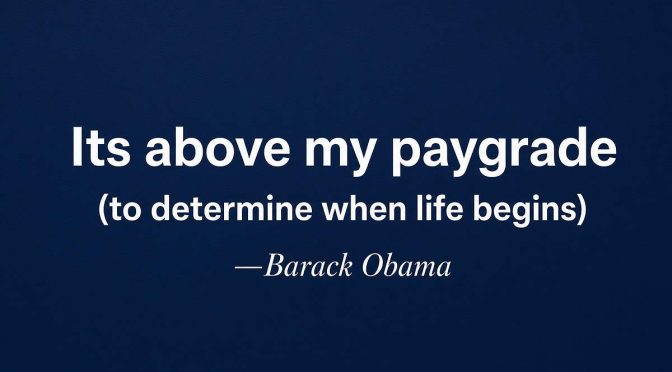
“Its above my paygrade” (to determine when life begins) —Barack Obama

It now seems to be well established that Barack Obama obstructed the Illinois Born Alive Infant Protection Act and, moreover, lied about his reason for doing so. It is probable that Obama’s untruth was neither a misspeak, nor some careless act of forgetfulness — he is far too intelligent for that. His opposition to the first two Born Alive Infant Protection Bills was ostensibly based on the fact that they did not contain clauses protecting the Roe versus Wade decision. Obama understood there existed no scientific or ethical distinction between a very late term abortion and death by post partum neglect (shelving to die —without solace— in soiled linen baskets and discarded as medical waste -see video) and that banning the latter might, consequently, endanger the legality of the former.

Obama must have recognized that human development is a continuum, a process in which it is impossible to draw meaningful and obvious subdividing lines for the purpose of making moral judgements. Such distinctions as can be observed, are, from a scientific viewpoint, completely insignificant and, therefore, ethically inconsequential. For example, what reasonable person can point to a significant structural difference between a baby one second before birth and the same baby one second after birth? An immediate corollary to this reasoning is the moral equivalence of, say, partial birth abortion and infanticide.

Thus, Obama was faced with the choice of either supporting a bill which logically endangered his pro abortion stance or blocking the legislation, thereby supporting infanticide. Since no politician wishes to be seen condoning infanticide, the legislation had to be prevented from leaving the committee, which is what appears to have happened. Obama and other Democrats on the committee voted down the bill even though it contained the desired Roe versus Wade exclusion clause. It only remained to justify this action. Since the decision was ethically unjustifiable a lie was forthcoming. Once again, Obama claimed that he had voted against the Bill for lack of the appropiate exclusion clause —except this time his objection had no merit.

Obama’s actions do not resemble the moral confusion typical of ethical relativists. His statements and actions show that he clearly saw the logical consequences of passing the Born Alive Infant Protection Act (even with an exclusion clause), obstructed it, and, for political expediency, lied about his reason for doing so.

Chronology

Barak Obama voted against the Born Alive Infant Protection Act. This act addressed cases where, during an abortion procedure, the live infant was actually born. The act would have banned killing the living child. According to National Right to Life Commission RLC spokesman Douglas Johnson:

“Newly obtained documents prove that in 2003, Barack Obama, as chairman of an Illinois state Senate committee, voted down a bill to protect live-born survivors of abortion — even after the panel had amended the bill to contain verbatim language, copied from a federal bill passed by Congress without objection in 2002, explicitly foreclosing any impact on abortion. Obama’s legislative actions in 2003 — denying effective protection even to babies born alive during abortions — were contrary to the position taken on the same language by even the most liberal members of Congress. The bill Obama killed was virtually identical to the federal bill that even NARAL ultimately did not oppose.”

Obama lied by claiming that he voted against the bill in committee because it lacked a codicil protecting the “Roe versus Wade” legislation. However, official documents of the Illinois Senate reveal that the amended 2003 bill did in fact contain such a protection. In particular, the following document shows the actual vote about which Obama lied. It can be seen that Obama voted YES on the amendment —which passed— and NO on the final vote, thereby killing the amended bill in committee.

Three bills were introduced during Obama’s tenure in Illinois Senate. The following is a brief chronology of events.

  1. 2001 Senate Bill 1095,   Born Alive Infant Protection Act
    • March 28, 2001   Obama voted “no” on Bill 1095 in the Illinois Senate Judiciary Committee.
    • March 30, 2001  Obama voted “present” on Bill 1095 after verbally opposing the bill on Senate floor.
  2. 2002 Senate Bill 1662,  Born Alive Infant Protection Act
    • March 6, 2002   Obama voted “no” on Bill 1662 in the Illinois Senate Judiciary Committee.
    • April 4, 2002  Obama voted “NO” on Bill 1662 and verbally opposing the bill on Senate floor.
  3. 2003 Senate Bill 1082,  Born Alive Infant Protection Act
    • March 12, 2003   Health & Human Services Committee, chaired by Barack Obama voted YES on a codicil protecting “Roe versus Wade”
    • March 12, 2003,  Obama made an about face and voted NO in committee on the ammended bill.

Additional Information

President Barack Obama’s Pro-Abortion Record: A Pro-Life Compilation

A Nobel Prize For Inanity


Last week, the prison population in England and Wales exceeded capacity. Rather than addressing the main causes of this increase, namely, the abandonment of traditional values and the collapse of the two parent family, the principal concern of the government seems to be that imprisoning more people will increase anthropogenic global warming. Citing “research” showing that carbon emissions within former Home Office bodies , including the prison service, have risen from 28,237 tonnes in 2005-06 to the insignificantly greater amount of 28,925 tonnes in 2006-07, Maria Eagle, Junior Justice Minister, has announced that an increase in the prison population together with changes in “regime facilities”, such as the provision of in-cell showers, have boosted CO2 emissions.

If there existed a Nobel prize for inanity, the scientists behind this ludicrous “research” would surely be in close competition with those at York University who recently calculated the carbon footprint of the average UK Christmas dinner or those who blame livestock for bovoprogenic warming. The Minister’s comments, which lack any common sense, disqualify her from office and illustrate the primitive level to which British education and science have fallen.

Meanwhile, Professor John White, an education adviser to the British government has stated that traditional disciplines such as Math, Geography and History should no longer be taught because they are “middle class creations”. Rather, they should be replaced by topics such as global warming and personal skills, taught via a regimen of “theme or project-based learning”. Professor White’s error is hardly original. The constructivist educational philosophy he espouses is already well entrenched in Britain, and has been since the period of school “comprehensivisation” following the second world war. Generations have already been idiotized —the blind (including Professor White) leading the blind into a rapidly approaching moral and intellectual dark age.

Addendum
The Bishops of London and Liverpool, Dr Richard Chartres and James Jones, are launching the Carbon Fast at Trafalgar Square. They hope to encourage people to reduce their carbon footprint for 40 days.

— The UK  is now an insane asylum.

By Philip Pennance

On the carbon footprint of cranberry sauce

According to Project leader professor Adisa Azapagic:

“Food production and processing are responsible for three quarters of the total carbon footprint, with the largest proportion – 60% – being related to the life cycle of the turkey.

“All stages in the supply chain have been considered, including raising the turkey, growing the vegetables, food storage, consumer shopping, cooking the meal at home and waste management.

“This includes the emissions of carbon dioxide due to energy consumption along the turkey supply chain and the emissions of methane and nitrous oxide generated due to the agricultural activities to raise the turkey.”

The cranberry sauce alone, normally imported from North America, contributes half the carbon footprint related to transport. 

–Filed under: Idiocy

The cost of human eggs – Warning to Puerto Rico students

There is nothing so foolish that some philosopher has not said it, and there is nothing so evil that some bioethicist has not proposed it. — Anthony Daniels

A controversy has arisen in the local media concerning advertisements for egg donors which have appeared in “Diálogo” a University of Puerto Rico supported publication. The Interim Director of Diálogo, Sylvia Álvarez Curbelo, has claimed that these advertisements are not paid for using UPR funds. However, this is misleading since the UPR does heavily subsidize the running costs of this publication, and by acquiescing to such advertisements, the UPR is, in effect, using public funds to provide a platform for these advertisements. In doing so, the University completely ignores the fact that oocyte (egg) donation is an invasive, painful, and physically demanding procedure with dangerous side effects.

Continue reading The cost of human eggs – Warning to Puerto Rico students →

Physicist blames Christians for global warming

b_sphere_all

“Pagan emptiness and fears about nature have led to hysteric and extreme claims about global warming. In the past, pagans sacrificed animals and even humans in vain attempts to placate capricious and cruel gods. Today they demand a reduction in carbon dioxide emissions.” —George Cardinal Pell

The American Physical Society (APS) has joined the junk science bandwagon. According to the abstract of a talk at the April 2007 meeting of the APS, “On failures in education and public policy”, by John Ely of University of Washington, an example of such a failure is

“the end of the world by global warming due to Christian religion forcing family planning money to be withheld from the UN leading to population excess”[sic]

This claim is scientific nonsense. As is well known, planets with no Christian populations such as Jupiter, Mars, and Venus are all simultaneously undergoing temperature changes or exhibiting severe weather. Nevertheless, this author appears to believe that mere Christianity (not CO2 or earthworms or the sun) is the principal motor behind global warming. This would be funny were it not for the fact that some environmentalists regularly come out with statements such as:

Continue reading Physicist blames Christians for global warming →