Ah, the 2022 Marco Curricular de Matemáticas from Puerto Rico’s Departamento de Educación. A bureaucratic masterpiece that takes the noble subject of mathematics — the one discipline built on irrefutable logic, precise definitions, deductive proof, and universal abstraction — and buries it alive under a mountain of mandated social, ethical, environmental, and ideological fluff.
In the section “Los temas transversales e integradores en el currículo de Matemáticas,” the document waxes philosophical about how these “ejes transversales” must “penetrar e influir toda la práctica educativa.” They supposedly integrate “ser, saber, hacer y convivir” through concepts, procedures, values, and attitudes. They are to be handled at theoretical, personal, and social levels, via “temas generadores” per grade, contextualized problems, PBL, real-life situations, and all the usual edu-speak. The goal? Transform education, connect to “preocupaciones sociales más actuales y urgentes,” align with 21st-century competencies and the UN’s Sustainable Development Goals, and turn every math class into a micro-laboratory of social engineering. The glorious list of irrelevancies. The document (and its grade-specific generators) serves up a greatest-hits compilation of modern curriculum fashion:
Identidad cultural e interculturalidad
Equidad y respeto entre todos los seres humanos
Educación cívica y ética
Educación para la paz
Educación ambiental / concienciación ambiental y ecológica
Emprendimiento e innovación
Promoción de la salud
Tecnologías de la Información y la Comunicación
Educación para el trabajo / educación y tecnología
Then the per-grade “temas generadores” pile on even more: autogestión, convivencia, diversidad cultural/funcional, ética en la vida diaria, finanzas, responsabilidad social, toma de decisiones, disciplina digital, cuidado del medio ambiente, antirracismo (explicitly in sexto grado), solidaridad, sensibilidad por la naturaleza, capital social, empresarismo, etc.
These are not optional flavor text. They are to be woven into the actual mathematics standards and expectations through “problemas en contexto,” actividades interdisciplinarias, and reflexión crítica. Math teachers are expected to treat quadratic equations as vehicles for discussing equitable resource distribution, use data analysis to promote health or environmental awareness, tie geometry to cultural identity, and turn budgeting problems into entrepreneurship-and-innovation sermons.
Their total, magnificent irrelevance to teaching math
Mathematics is not a delivery mechanism for your favorite social causes. It is the study of patterns, structure, quantity, space, and change using rigorous reasoning that does not require (and is actively hindered by) constant detours into “how does this make you feel about equity?” or “let’s reflect on our responsibility to the planet while solving for x.”
When you force a 6th grader learning ratios or statistics to also process “antirracismo” or “diversidad funcional,” you are not enhancing mathematical understanding — you are hijacking limited instructional time for amateur activism. When you turn fraction lessons into meditations on “equidad y respeto entre todos los seres humanos,” you replace deliberate practice with performative discussion. The math suffers. The social theme is usually treated superficially because the teacher’s actual expertise is in mathematics, not in running a sensitivity workshop.
The document claims this integration makes learning “significativo” and connects math to “la vida.” In reality, it does the opposite for serious mathematics. Real mathematical power comes from abstraction and transferability. A student who can manipulate variables fluently can later analyze any dataset — environmental, financial, health-related, or otherwise — without needing the curriculum to spoon-feed the “correct” social interpretation every single time. Forcing the transversal themes assumes students are too stupid to apply math to real problems unless the teacher explicitly lectures them on the approved values while doing it.
This is classic edu-babble cargo cultism: dress up vague attitudinal goals in fancy language (“ejes transversales,” “temas generadores,” “triple perspectiva”), mandate their presence in every subject, and pretend you’ve improved education. What you’ve actually done is dilute the one subject that most reliably builds clear, independent thinking — precisely the kind of thinking that might eventually allow students to evaluate social claims critically rather than recite them.
Pythagoras did not need to reflect on cultural identity or ecological awareness to discover his theorem. Gauss did not pause his work on number theory to discuss entrepreneurship or digital discipline. The mathematics itself is the point. Everything else is either a distraction or, at best, an occasional, teacher-chosen illustration that does not require bureaucratic enforcement across the entire syllabus.
The transversal themes in this document are not “integrated” with mathematics in any meaningful pedagogical sense. They are imposed upon it. They are irrelevant to the actual teaching of math because math does not need them to be rigorous, beautiful, or useful. Their presence reveals far more about the priorities of curriculum writers than about what children need to learn in order to think mathematically.
In short: stop turning math class into a mandatory TED Talk on whatever social issue is fashionable this decade. Teach the damn math. The rest can wait for subjects actually equipped to handle it.
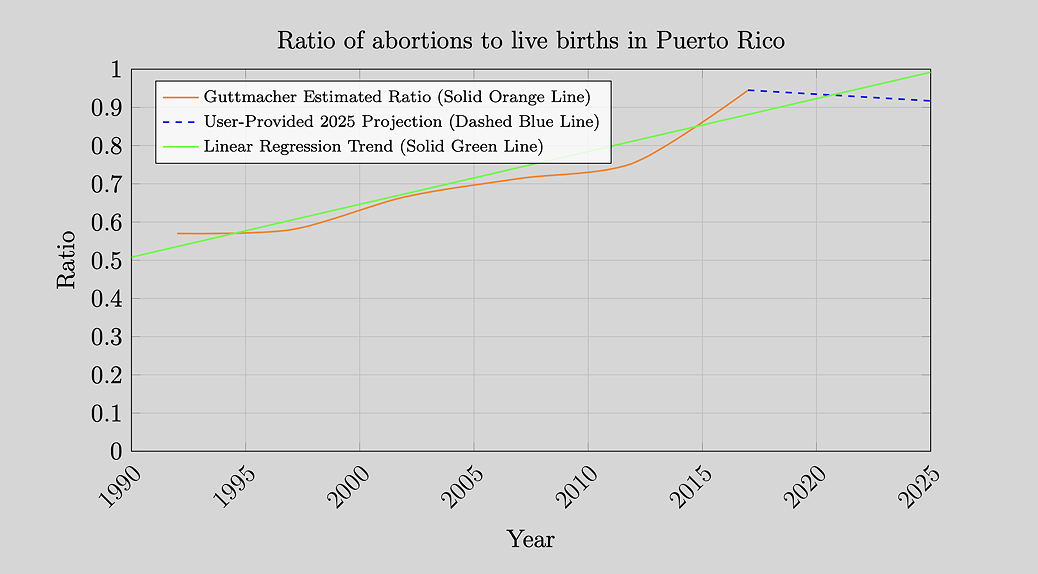
According to United Nations and Guttmacher Institute projections, there were approximately 19,087 live births, 34,745 deaths, and 17,510 abortions in Puerto Rico in 2025. The following graph shows the ratio of abortions to birth over time. Abortions caused by in-vitro fertilization procedures are not included. Since fertility per woman in Puerto Rico is now approximately 1.0, the population will be reduced by one half with each generation.
After multiple decades of following failed education philosophies which have reduced literacy rates, increased learning “disabilities”, produced a highly disaffected student body, and fragmented families, Puerto Rico has agreed (been bribed) into ceding total control of its education system to the US federal government by adopting the controversial “Every Student Succeeds Act” (ESSA). Although this decision was taken some years ago, the government is only now holding public hearings on some aspects of this issue. In order that the public remain in darkness concerning the rather mediocre content standards, the PR-DOE, now under the leadership of the ex-Obama bureaucrat Julia B. Keleher, has “vanished” the aforementioned documents [1] from its webpage. It would seemingly prefer that the public remain ignorant of the lack of purpose behind the so-called “content” taught to students. In reality, these “hearings” are merely a tool to rubber stamp what is already a fait-accompli.
Indeed, ESSA, which is oriented to social indoctrination rather than education, will only worsen the current crisis in education. By data mining, ESSA aims to enforce conformity – it is designed to condition students to accept and propagate radical liberal postmodern “values,” thereby producing a population of non-thinkers. This has long been the unstated aim of government schools. According to Gatto [2], such schools produce:
“Young people indifferent to the adult world and to the future; indifferent to almost everything except the diversion of toys and violence? Rich or poor, schoolchildren cannot concentrate on anything for very long. They have a poor sense of time past and to come; they are mistrustful of intimacy (like the children of divorce they really are); they hate solitude, are cruel, materialistic, dependent, passive, violent, timid in the face of the unexpected, addicted to distraction.”
Alma Acevedo | Friday, 4 January 2013 Source: Mercator Net
For us, children of a then more pious land, it was el gran día (the great day). Three Kings’ Day was, after Christmas, the greatest festivity of the year. It was a special holy day — of sharing, song, and celebration. Young and old alike looked forward to it with merry anticipation.
“Now when Jesus was born in Bethlehem of Judaea in the days of Herod the king, behold, there came wise men from the East to Jerusalem, Saying, Where is He that is born King of the Jews? for we have seen His star in the East, and are come to worship Him.” (Matthew 2:1-2)
It used to be that we believed. It was the mystery and the renunciation.
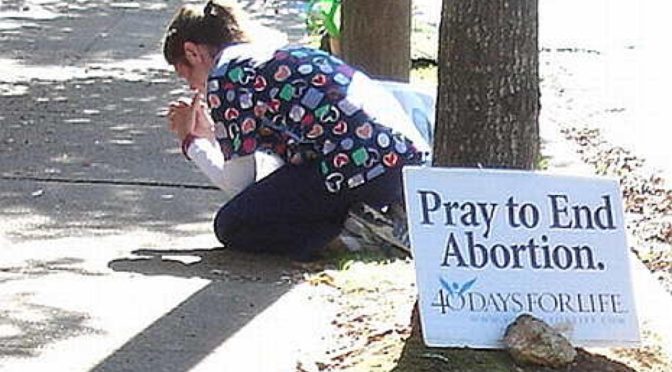
Comenzando el miércoles, 28 de septiembre de 2011, y hasta el domingo, 6 de noviembre de 2011, la ciudad de Bayamón, Puerto Rico, será sede —junto a muchas otras, a nivel mundial— del mayor evento pro-vida jamás celebrado en la historia: la campaña 40 Días por la Vida.
La campaña 40 Días por la Vida comprende tres elementos básicos, el más visible de estos es la vigilia pacífica que se realizará frente a la clínica de aborto.
During the current student boycott/blockade of classes at the University of Puerto Rico, the Rio Piedras campus has been the scene of multiple acts of vandalism and intimidation. These have been largely glossed over or concealed by Puerto Rican and international mass media which invariably portray student actions as peaceful in nature and blame the police for every occurence of violence. In reality, many participants hide their identities by covering their faces with hoods and masks. Some carry weapons, such as metal tubes, sticks with nails, baseball bats, slingshots and smoke bombs. It has been alleged that some receive funding from the Venezuelan dictator Chavez and/or “orientation” in Cuba (See poster). It is certainly the case that, socialist and communist groups have been very prominent during this strike. It is rather ironic that Venezuelan police and soldiers are currently suppressing student protests in Caracas with water cannons and rubber bullets.
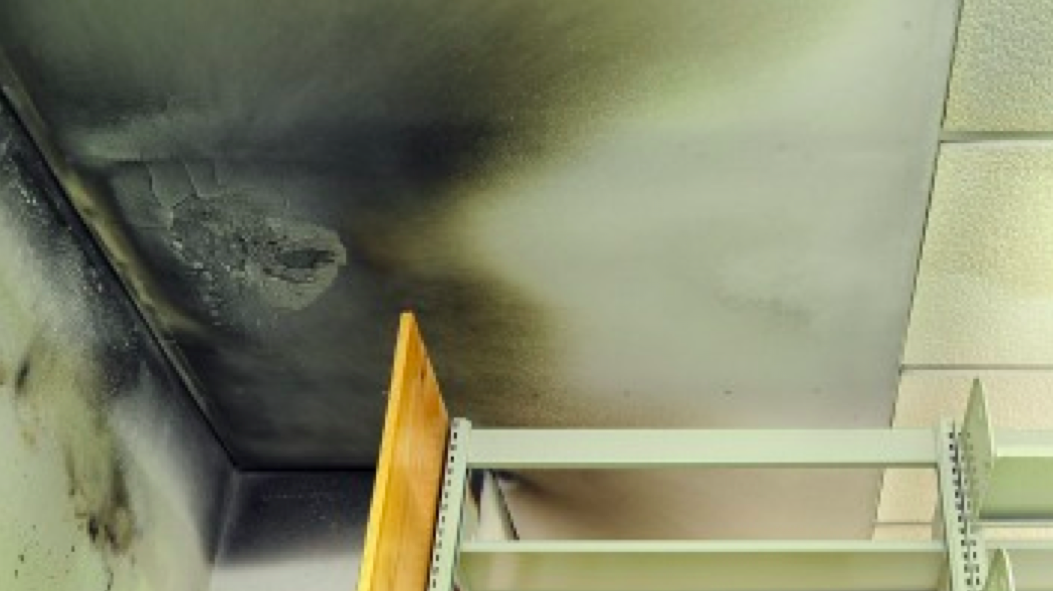
Fire Damage to Library
On Monday, December 20, in an effort to disrupt exams and lectures, and to terrorize students, a mob of students and assorted activists, many wearing hoods, smashed windows, and threw smoke bombs into classrooms, at the same time, taking photos of students and professors inside who did not support the strike. During this riot, the library collection suffered serious damage when smoke bombs caused a blaze which triggered the sprinkler system causing an estimated $2.2 million in damages. Here is a description of events by the Dean of Science, Brad Weiner:
Memo to the College of Natural Sciences December 22, 2010 To the Community of Natural Sciences: Brad R. Weiner Dean
On the afternoon of December 20, 2010, the College of Natural Sciences was attacked by a group of radical extremists, who through violence and intimidation are trying to prevent us from carrying out our regular academic mission. The primary target on the afternoon of the 20th was a departmental Calculus I exam scheduled for 5:30-7:30PM, which was to be given to approximately 450 students in 14 sections. Due to the viciousness and highly orchestrated nature of the attack, I believe it is critical that the Natural Sciences Community be aware of the events that transpired leading up to and during the event.
In the early afternoon (1-2PM), the Dean’s office received several reports from both students and professors that the Calculus I exam was going to be targeted by the extremists. The intent was to interrupt the exam. The Dean’s office notified the security office and the police of the information received. Security measures were taken.
From 2-3 PM, we began to notice a number of individuals surveying the premises of the two Natural Sciences’ buildings. The suspicious individuals were not students from Natural Sciences.
Beginning about 3 PM, the press began arriving, and established an outpost on the steps of the Architecture Building. Clearly they had been notified that something was going to happen. Likewise, “observers” from the Colegio de Abogados and the APPU began arriving about 3:30PM. They also had been notified that something was going to happen. During this time, the number of individuals foreign to Natural Sciences continued to increase. These individuals did not congregate in any single place, but instead were dispersed through the buildings and interior patio. Again, the Dean’s office notified once again the Head of the Campus Security and the police officers stationed in the area of Natural Sciences. Additional security measures were taken.
By 4 PM, it was quite clear that something was going to happen. It was announced that the extremists were marching from Carolina to the Rio Piedras campus. There was a significant amount of movement of people not usually seen around the College. Coincident with this, the students for the Calculus I exam were beginning to arrive.
Shortly before 5 PM, a fire was intentionally set on the third floor of the Natural Sciences library. The fire was first detected by Mr. José Terrón, who smelled smoke, and found several boxes of books/journals on fire. Mr. Terrón notified officials, and with the help of the state police the fire was extinguished before the fire department arrived. The heat from the fire, triggered the sprinkler system of the library, and a large part of the third floor of the library was inundated with water.
In concert with the sounding of the fire alarm and the confusion it created, one of the leaders of the extremists pulled out a megaphone, and rallied his troops to the front lobby of the Natural Sciences complex. The aforementioned individuals who had been dispersed throughout the area moved to the lobby. Estimates of the number of extremists vary between 100 and 300. After reaching the lobby, the extremists quickly dispersed again into the hallways of the Natural Sciences II building, throwing smoke bombs, overturning chairs and desks, and physically threatening and removing Calculus I students and Mathematics professors from the classrooms. The state police and campus security that were posted in the hallways were overwhelmed and called for re-enforcements. The riot squad arrived and eventually restored order. There were 4 arrests, and numerous people injured. The melee continued in other parts of the University, but was essentially over at that point in Natural Sciences. The Calculus I exam was canceled, and rescheduled for January.
I denounce the actions of these extremist groups that use physical violence and intimidation to advance their ideas, no matter if they are justified or not. They claim they are using creative methods to enforce their strike. For me, creativity should fall within the limits of the law, and their actions are clearly illegal. I want to even more vehemently denounce the act of setting a fire in our library. For me, if the members of these extremists groups want to characterize themselves as “students”, they have resigned that designation when they set fire to books. As scientists and academics, almost all of us have contributions in the collection of our library, as well as in libraries all over the world. The symbolic act of setting our library on fire, is for me the deepest of insults, and beyond pardon. For those of you who have forgotten history, the Dupont Plaza Hotel fire that claimed 97 lives on December 31, 1986, was originally set in a back room as a distraction. The quick action of employees and security officials limited the damages in the library, but they are still substantial. A significant portion of the Biology collection on the third floor has been damaged by water, and we are doing what we can to mitigate the losses. The library will be closed until further notice, but electronic services will continue to function.
I also want to call out the so-called “observers” from the APPU and the Colegio de Abogados. The sole function of these groups seem to be to “watch” the state police, and how they perform their duties, even in the midst of a full-scale riot. The “observers” appear to be blind to the rights and responsibilities of all other people that are present at the time. These “observers” did not lift a finger to protect the rights of the over 400 students and professors that were present for the Calculus I exam. To date, these same “observers” have not uttered a single word defending the innocent students and professors that strictly wished to exercise their civil right to comply with their roles and responsibilities in an academic setting. As we look back on 2010, we have a year that I am sure many of us would like to erase from the hard disk, and go back to where we were in 2009. A Mulligan, if you will. Without a doubt, it has been a difficult year for the University of Puerto Rico, and conflicts and ironies still abound: accreditation and certification breathing down our neck, a heavy police presence on our campus, book-burning “students”, blind “observers”, etc. Somehow, I remain optimistic. I remain optimistic because I see talented people doing creative work in the midst of all this ugliness. I remain optimistic because I see so many great students, who still want to learn, to study and to become science professionals. I remain optimistic because we have assembled a faculty that is truly global in perspective, equipped to meet the challenges of today and the future. I remain optimistic because I truly believe we will be stronger and better when we emerge from these challenges. So people, hang in there, have a happy and healthy holiday season, enjoy your family, and let’s look forward to a smoother ride in 2011. Brad R Weiner Dean, College of Natural Sciences and Director, Puerto Rico EPSCoR PO Box 23341 University of Puerto Rico
According to University President, De la Torre:
“It is regrettable and absurd that during calls for respectful dialogue and mass actions for peace during Christmas Eve, millions of dollars in damages are caused to our university facilities”
He also noted that:
“the fire perpetrated at the Natural Sciences Faculty Library has resulted in a significant part of the biology collection being destroyed. The damages are irreparable, and journals of great academic and historic value [some dating back a century] in the field of biology have had to be discarded because of the damage. It is regrettable and absurd that during calls for respectful dialogue and mass actions for peace during Christmas Eve, millions of dollars in damages are caused to our university facilities.”
An account of the damage to the Library is contained in the following letters:
Incendio de letras e ideas
Durante esta semana se suscitó un evento de violencia extremadamente lamentable en los predios de la Facultad de Ciencias Naturales de la Universidad de Puerto Rico Recinto de Rio Piedras. Como resultado de este incidente hubo arrestos y actos de agresión entre los estudiantes que protestaban y la policía estatal. El escenario se volvió aun más peligroso cuando individuos se adentraron a la Biblioteca de Ciencias Naturales e iniciaron un fuego en el tercer piso con la intención evidente de hacer daño a la propiedad y a los que trabajan y estudian en la Biblioteca. Este acto incendiario es uno deplorable y que debe ser censurado por toda la comunidad universitaria. Este fuego iniciado intencionalmente afortunadamente no cobró vidas pero si devastó la colección de revistas y libros del Departamento de Biología de la Facultad de Ciencias Naturales.
Luego de una evaluación de los daños la directora de la Biblioteca informó que casi toda la colección ubicada en el tercer piso era de temas en Biología y fue dañada por el fuego y el agua que se utilizó para apagar el mismo. Desafortunadamente, los daños son irreparables ya que revistas de gran valor académico e histórico (algunas que datan de más de un siglo) en el campo de la Biología tendrán que ser desechadas debido al daño causado por el agua y el hongo. La directora calcula que las pérdidas ya alcanzan los tres millones de dólares. Además, la Biblioteca tendrá que permanecer cerrada por un tiempo prolongado en lo que se atiende la situación y se preparan para el público y sus empleados.
Si bien es cierto que las pérdidas que sufrimos son materiales, lo más que nos preocupa es que esta retante situación que vivimos en nuestra Universidad ha llegado a límites insospechados donde se considere quemar bibliotecas y poner en peligro la seguridad de todos los que componemos la comunidad del Recinto de Rio Piedras y particularmente la Facultad de Ciencias Naturales. No se puede justificar bajo ningún concepto este acto que no abona en nada a la búsqueda de soluciones a este conflicto.
Definitivamente estamos ante una encrucijada que al día de hoy no alcanza un final constructivo. En el ínterin, debemos oponernos al que atente contra la propiedad, el bienestar y el progreso de la Facultad de Ciencias Naturales y nuestra universidad centenaria.
Carmen S. Maldonado-Vlaar, PhD Catedrática y Directora Interina Departamento de Biología Universidad de Puerto Rico-Rio Piedras
Figure 1. NAEP Math Scores for Puerto Rio at grade 4, by content area: 2007
Figure 2. NAEP Math Scores for Puerto Rio at grade 8, by content area: 2007
Blame for these results should be ascribed to:
The Puerto Rico Schools of Education which, in preference to mathematical content, have slavishly followed the pernicious ideologies of John Dewey, Jean Piaget, Lev S. Vygotsky, and last, if not least, Pablo Freire.
The Puerto Rico Department of Education for disseminating nonsense such as the following:
“The brain houses and integrates dissimilar functions in much the same way that the house has rooms for different daily activities. Draw a house with a room plan and yard. Draw lines (preferably of different colors) to connect rooms and areas with integrated functions [sic]. (For example: Food prepared in the kitchen is eaten in the dining room. After sweating in the yard you take a bath and get dressed in your room. [sic]) Imagine one of the rooms being destroyed. What would be the impact on the family? Think of another model you can make that shows how things interact with each other.” —Tips for Mathematics Teachers, San Juan Star, March 19, 1996