Category Archives: Music

A Mathematical Introduction to Melody

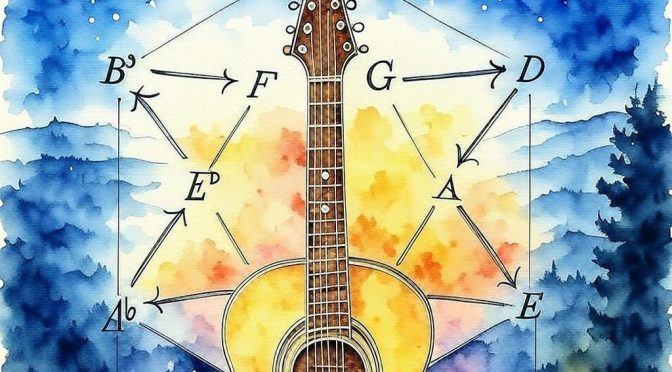
Algebraic music theory rests on the observations that the set I of intervals forms a Z-module (or free abelian group) under concatenation and that the set of pitches forms an affine space (or torsor) over this module. A change of key is simply a shift of origin.


Within this framework a melody is a walk in the affine space subject to welldefined local constraints (conjunct motion, leap compensation, tendency-tone resolution, diatonic membership, contour, range, etc.). A chord is expressed, via Chasles’ identity, as a vector sum of intervals; the same language yields a clean description of closed and open voicings, pitch-equivalent fingerings, and the affine subspaces that correspond to whole-tone scales, augmented triads, diminished-seventh chords and tritones.

The paper develop these ideas in elementary terms, supply the necessary multiplication and inversion tables, give explicit fretboard realisations of the principal intervals and dyads, and illustrate the theory with a detailed analysis of the traditional melody and harmony of Greensleeves. An appendix collects interval-stack constructions for the most common triads, seventh chords and ninth chords.
Download paper

Tables of Guitar Chord Triads – Ordered by Pitch

Under construction. See here for the mathematical theory behind these tables,

Commutative Diagrams and the Construction of Musical Scales

This article is intended as a minimal introduction to some basic musical ideas which fall within the intersection of mathematics and music. We discuss the science underlying the construction of Pythagorean and other tunings, giving mathematically clear definitions of the necessary musical terms. Careful distinction is made between the frequential and perceptual measures of pitch. The admissible changes of scale for each of these measures are derived. It is shown that commutative diagrams can provide a useful tool for the construction and analysis of scales. All needed musical notions are explained.

Download PDF

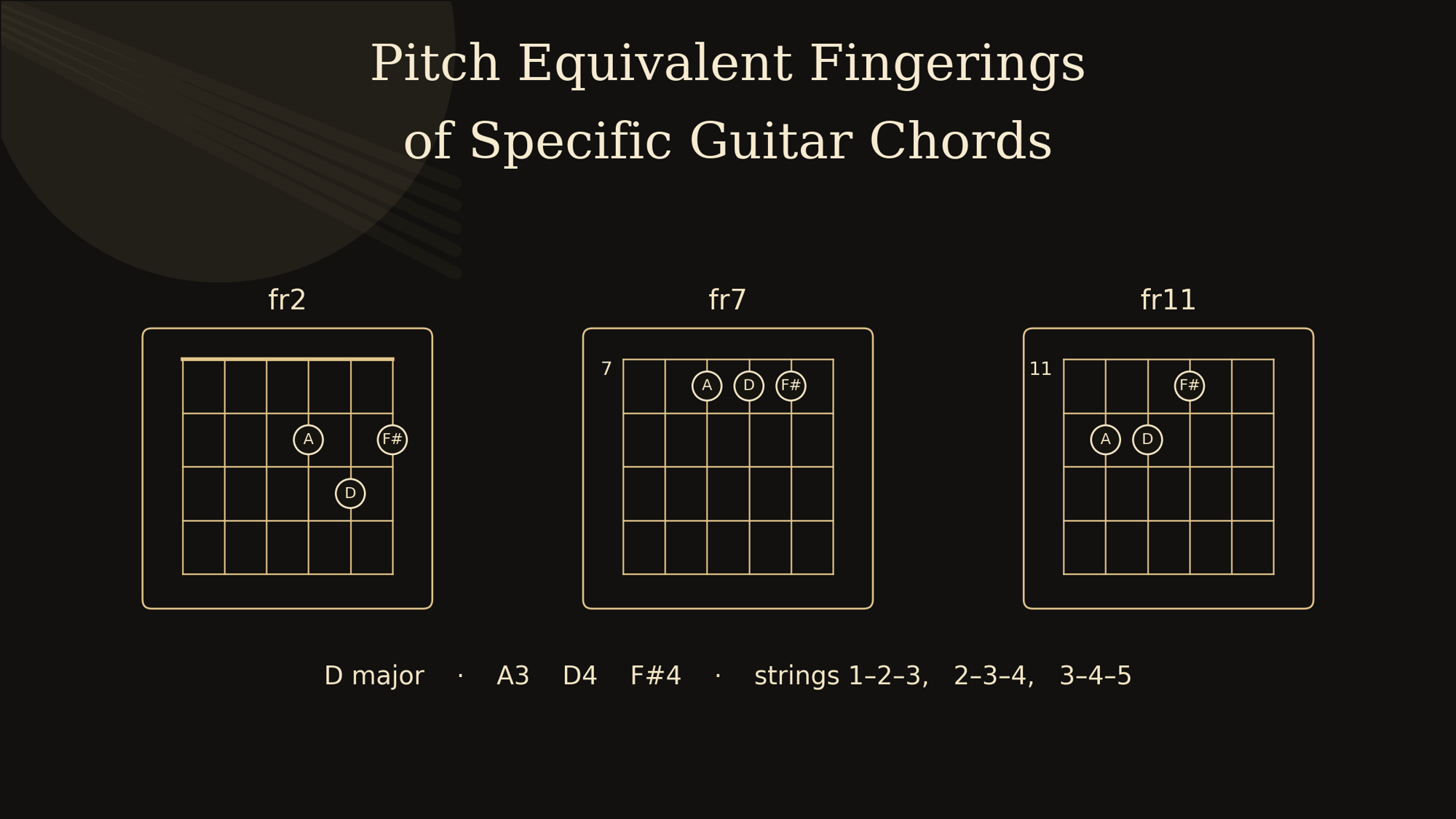
Pitch Equivalent Fingerings of Specific Guitar Chords

Go here first for the theory behind these tables.

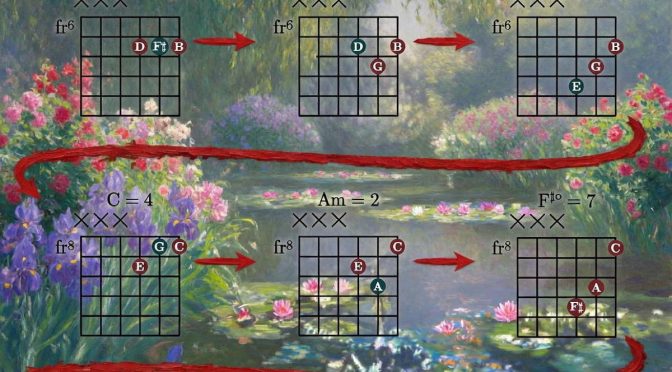
Guitar Chord Sequences Ordered by Pitch

Guitar Chord Sequences Ordered by Pitch

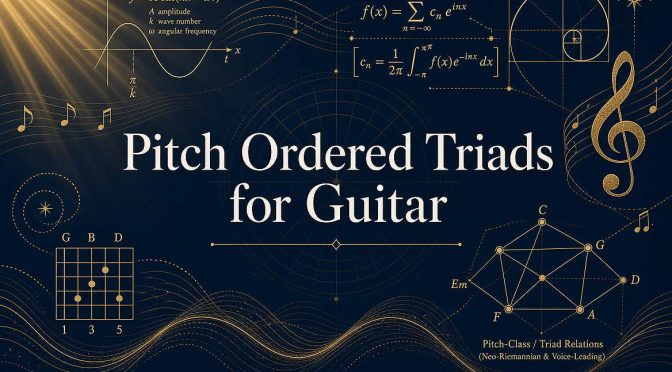
If one diatonic open/closed chord is known, anywhere on say, a guitar fretboard, then totally ordered sequences of ascending and descending voicings of the same parity can be calculated, iteratively, without reference to dictionaries of chord fingerings. As an application, tables of open and closed chords for various major scales over different regions of the guitar fret board are generated. The mathematics is contained in the paper below. Musicians can jump straight to the tables below. More tables are under construction.

Download paper.

Download PDF

Examples

  1. A Major Open Triads — Bass Note on String $6$ in Ascending Pitch Order
  2. C Major Open Triads on Frets 0 to 4 Ordered by Increasing Pitch
  3. C Major Open Triads on Frets 5 to 9 Ordered by Increasing Pitch
  4. C Major Open Triads on Frets 9 to 12 Ordered by Increasing Pitch
  5. C Major Closed Triads on Frets 0 to 5 Ordered by Increasing Pitch
  6. C-Major Harmonizations by Closed Triads

Se also Pitch Equivalent Fingerings of Specific Guitar Chords