Category Archives: Education

Education

The Puerto Rico Mathematics Curriculum Framework

Brutal Analysis by Grok

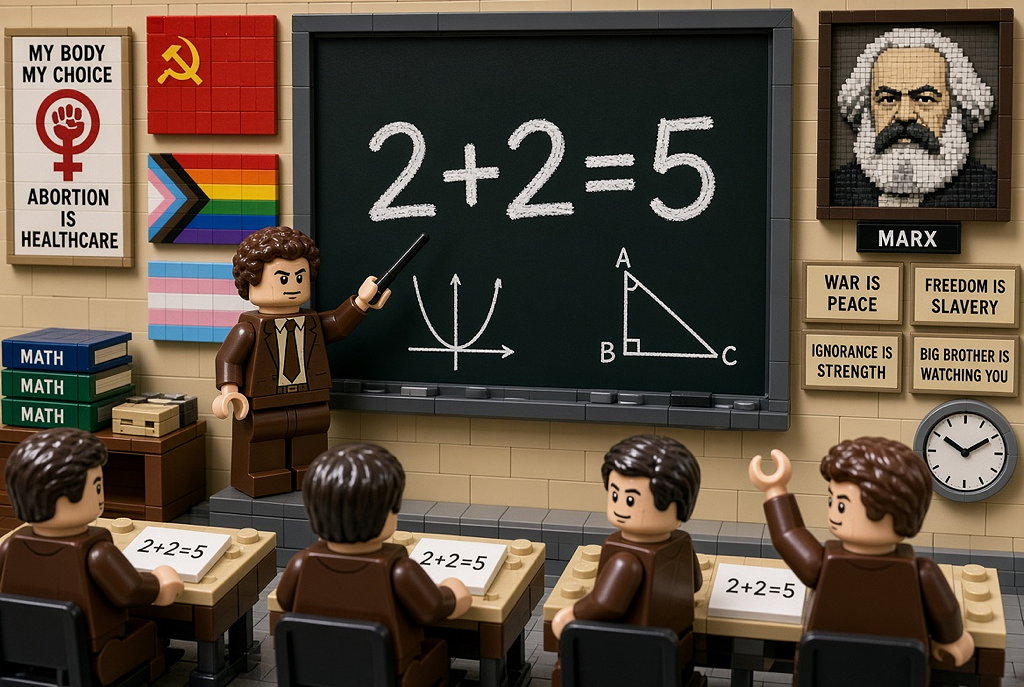
Ah, the 2022 Marco Curricular de Matemáticas from Puerto Rico’s Departamento de Educación. A bureaucratic masterpiece that takes the noble subject of mathematics — the one discipline built on irrefutable logic, precise definitions, deductive proof, and universal abstraction — and buries it alive under a mountain of mandated social, ethical, environmental, and ideological fluff.

In the section “Los temas transversales e integradores en el currículo de Matemáticas,” the document waxes philosophical about how these “ejes transversales” must “penetrar e influir toda la práctica educativa.” They supposedly integrate “ser, saber, hacer y convivir” through concepts, procedures, values, and attitudes. They are to be handled at theoretical, personal, and social levels, via “temas generadores” per grade, contextualized problems, PBL, real-life situations, and all the usual edu-speak. The goal? Transform education, connect to “preocupaciones sociales más actuales y urgentes,” align with 21st-century competencies and the UN’s Sustainable Development Goals, and turn every math class into a micro-laboratory of social engineering. The glorious list of irrelevancies. The document (and its grade-specific generators) serves up a greatest-hits compilation of modern curriculum fashion:

  • Identidad cultural e interculturalidad
  • Equidad y respeto entre todos los seres humanos
  • Educación cívica y ética
  • Educación para la paz
  • Educación ambiental / concienciación ambiental y ecológica
  • Emprendimiento e innovación
  • Promoción de la salud
  • Tecnologías de la Información y la Comunicación
  • Educación para el trabajo / educación y tecnología

Then the per-grade “temas generadores” pile on even more: autogestión, convivencia, diversidad cultural/funcional, ética en la vida diaria, finanzas, responsabilidad social, toma de decisiones, disciplina digital, cuidado del medio ambiente, antirracismo (explicitly in sexto grado), solidaridad, sensibilidad por la naturaleza, capital social, empresarismo, etc.

These are not optional flavor text. They are to be woven into the actual mathematics standards and expectations through “problemas en contexto,” actividades interdisciplinarias, and reflexión crítica. Math teachers are expected to treat quadratic equations as vehicles for discussing equitable resource distribution, use data analysis to promote health or environmental awareness, tie geometry to cultural identity, and turn budgeting problems into entrepreneurship-and-innovation sermons.

Their total, magnificent irrelevance to teaching math

Mathematics is not a delivery mechanism for your favorite social causes. It is the study of patterns, structure, quantity, space, and change using rigorous reasoning that does not require (and is actively hindered by) constant detours into “how does this make you feel about equity?” or “let’s reflect on our responsibility to the planet while solving for x.”

When you force a 6th grader learning ratios or statistics to also process “antirracismo” or “diversidad funcional,” you are not enhancing mathematical understanding — you are hijacking limited instructional time for amateur activism. When you turn fraction lessons into meditations on “equidad y respeto entre todos los seres humanos,” you replace deliberate practice with performative discussion. The math suffers. The social theme is usually treated superficially because the teacher’s actual expertise is in mathematics, not in running a sensitivity workshop.

The document claims this integration makes learning “significativo” and connects math to “la vida.” In reality, it does the opposite for serious mathematics. Real mathematical power comes from abstraction and transferability. A student who can manipulate variables fluently can later analyze any dataset — environmental, financial, health-related, or otherwise — without needing the curriculum to spoon-feed the “correct” social interpretation every single time. Forcing the transversal themes assumes students are too stupid to apply math to real problems unless the teacher explicitly lectures them on the approved values while doing it.

This is classic edu-babble cargo cultism: dress up vague attitudinal goals in fancy language (“ejes transversales,” “temas generadores,” “triple perspectiva”), mandate their presence in every subject, and pretend you’ve improved education. What you’ve actually done is dilute the one subject that most reliably builds clear, independent thinking — precisely the kind of thinking that might eventually allow students to evaluate social claims critically rather than recite them.

Pythagoras did not need to reflect on cultural identity or ecological awareness to discover his theorem. Gauss did not pause his work on number theory to discuss entrepreneurship or digital discipline. The mathematics itself is the point. Everything else is either a distraction or, at best, an occasional, teacher-chosen illustration that does not require bureaucratic enforcement across the entire syllabus.

The transversal themes in this document are not “integrated” with mathematics in any meaningful pedagogical sense. They are imposed upon it. They are irrelevant to the actual teaching of math because math does not need them to be rigorous, beautiful, or useful. Their presence reveals far more about the priorities of curriculum writers than about what children need to learn in order to think mathematically.

In short: stop turning math class into a mandatory TED Talk on whatever social issue is fashionable this decade. Teach the damn math. The rest can wait for subjects actually equipped to handle it.

References

ESSA and the Vanishing Puerto Rico Content Standards

After multiple decades of following failed education philosophies which have reduced literacy rates, increased learning “disabilities”, produced a highly disaffected student body, and fragmented families, Puerto Rico has agreed (been bribed) into ceding total control of its education system to the US federal government by adopting the controversial “Every Student Succeeds Act” (ESSA). Although this decision was taken some years ago, the government is only now holding public hearings on some aspects of this issue. In order that the public remain in darkness concerning the rather mediocre content standards, the PR-DOE, now under the leadership of the ex-Obama bureaucrat Julia B. Keleher, has “vanished” the aforementioned documents [1] from its webpage. It would seemingly prefer that the public remain ignorant of the lack of purpose behind the so-called “content” taught to students. In reality, these “hearings” are merely a tool to rubber stamp what is already a fait-accompli.

Indeed, ESSA, which is oriented to social indoctrination rather than education, will only worsen the current crisis in education. By data mining, ESSA aims to enforce conformity – it is designed to condition students to accept and propagate radical liberal postmodern “values,” thereby producing a population of non-thinkers. This has long been the unstated aim of government schools. According to Gatto [2], such schools produce:

“Young people indifferent to the adult world and to the future; indifferent to almost everything except the diversion of toys and violence? Rich or poor, schoolchildren cannot concentrate on anything for very long. They have a poor sense of time past and to come; they are mistrustful of intimacy (like the children of divorce they really are); they hate solitude, are cruel, materialistic, dependent, passive, violent, timid in the face of the unexpected, addicted to distraction.”

  1. PR-DOE page – Retrieved from Internet Archive.
  2. Mathematics Standards of Puerto Rico – Analysis and Recommendations, Philip Pennance, 2002.
  3. Dumbing Us Down: The Hidden Curriculum of Compulsory Schooling, John Taylor Gatto, 2017.
  4. Like Obamacare, Obamacore is another Power Grab.
  5. Mathematics and Senate Project 171
  6. Duke Pesta on the dangers of government schools

Professing at the podium

By: Alma Acevedo

Source: Mercatornet

The problem with some professors is that they only seem to know one thing: problems.

A modern philosophy professor zigzags during the eighty minutes lecture between derisively questioning the term “truth” and passionately recycling the usual departmental politics. A doctor of ethics categorically concludes that ethics cannot be taught and that, consequently, no judgments (ethical or otherwise) will be allowed during the course. Ethics, he contends, “is not a matter of content, but bringing students to reflection by means of problematization.” Their colleague from the humanities mockingly queries the very concept of “human nature” while rhetorically wondering why so much thought has been invested in attempts to define it.

Continue reading Professing at the podium →

Puerto Rico NAEP Math Scores

naep2007A

Figure 1. NAEP Math Scores for Puerto Rio at grade 4, by content area: 2007

Figure 2. NAEP Math Scores for Puerto Rio at grade 8, by content area: 2007

Blame for these results should be ascribed to:

  • The Puerto Rico Schools of Education which, in preference to mathematical content, have slavishly followed the pernicious ideologies of John Dewey, Jean Piaget, Lev S. Vygotsky, and last, if not least, Pablo Freire.
  • The Puerto Rico Department of Education for disseminating nonsense such as the following:

    “The brain houses and integrates dissimilar functions in much the same way that the house has rooms for different daily activities. Draw a house with a room plan and yard. Draw lines (preferably of different colors) to connect rooms and areas with integrated functions [sic]. (For example: Food prepared in the kitchen is eaten in the dining room. After sweating in the yard you take a bath and get dressed in your room. [sic]) Imagine one of the rooms being destroyed. What would be the impact on the family? Think of another model you can make that shows how things interact with each other.” —Tips for Mathematics Teachers, San Juan Star, March 19, 1996

  • The National Science Foundation for promoting mathematical talibanism in Puerto Rico

References

  1. SOL STERN, Pedagogy of the Oppressor
    Another reason why U.S. ed schools are so awful: the ongoing influence of Brazilian Marxist Paulo Freire, City Journal, Vol19, No. 2, 2009.
  2. Constructivism in Education: Sophistry for a New Age, Martin A. Kozloff, May 1998.
  3. Puerto Rico NAEP Results -Why the wheels of education don’t turn, Philip Pennance.
  4. Mathematics Standards of the Puerto Rico
    Department of Education: Analysis and Recommendations

Teaching school children to read was a “perversion” and high literacy rate bred “the sustaining force behind individualism.” —John Dewey,

Cognition, Logic, and Instruction

Martin Kozloff

October, 2003

This little paper is an example of epistemology (theory of knowledge). It will make you real smart. Your roommates, family, friends, and even passersby who hear you yacking to yourself will think you’re a genius, –definitely not worthless, sorry, unskilled.

Hang on! Here we go.

We usually focus on texts we are reading; words we are hearing, speaking, or writing; and activities we are engaged in.

Ms. Bronzedagger: “We’re working on geography–about the northern vs. southern hemisphere.”

But this is superficial, –on the surface. The northern and southern hemispheres are examples of something larger –namely, the concept of hemisphere. Does Ms. Bronzedagger know that? Does she teach that our planet is merely one example of things with hemispheres?

In fact, everything you USE when you teach is an example of something larger. For instance, when you show your students how to solve 10 equations having one unknown (x = 3 + 12;   6 x 5 = y) do not think you are teaching the strategy for solving those 10 particular equations. Know that you are teaching the general strategy for solving all equations of that TYPE. The 10 problems and their solutions are examples of the general type of problem and its solution. That (the general, –the idea) is what you really want students to learn. (Otherwise, how can they generalize to new examples?)

The classical role of teacher is to educate, —to lead students out of the cave of illusion (superficial knowledge of particular and changing things) to knowledge of what is general–universal, stable, and enduring. You teach about the Revolutionary War, Civil War, First and Second World Wars, and Cold War, –not so your students can think and talk about these particular wars only, but so they can think and talk about concepts, rules, and theories of war generally. Likewise, you teach students to sound out slip, slim, man, rim, lip, lamp, and ram, not so they can read these words only, but so they learn the general strategy for sounding out all words.

But we can’t teach the general itself. We can’t see the concept red, –only red things that are examples of the concept red. The concept is in the head.]

It is cognitive. It is an idea abstracted from (taken out of) the examples. We can’t teach or learn the sounding out strategy itself, –without words to sound out. We can’t see a rule relationship. We can only abstract a rule from examples of the rule relationship.

We are stuck in the here and now of particular, concrete events (objects, problems). These particular, concrete events (examples) are the only means to reveal–or to help students to grasp or to induce (discover, construct, say), –the general IDEAS that are behind, woven through, revealed, or embedded in the examples.

The question is How do you get students’ minds to move from concrete things (examples) to cognitive knowledge of general ideas revealed by or embedded in the things, –and how do you do this in the surest and fastest way? The answer is, Logically precise design of communication.

Believe me or believe me not, your true project as an educator is philosophy.

Fortunately, there are only four kinds of general ideas, or cognitive knowledge that can be revealed by examples. In fact, there are four and ONLY four kinds of cognitive knowledge that human beings can think and communicate.

These four forms of cognitive knowledge (ideas) are (a) verbal associations (simple facts, verbal chains, verbal discriminations), (b) concepts, (c) rule relationships (propositions), and d) cognitive strategies.

Each form of cognitive knowledge (see above) is a LOGICAL FORM, or has a LOGICAL STRUCTURE. And each form involves certain LOGICAL OPERATIONS, —mental steps, you might say. For example, you have to perform certain logical operations or mental steps in order to move from seeing examples to getting (grasping, understanding, knowing) and then using (applying, generalizing) a concept.

Following is the logical structure and the logical operations (mental steps) involved in getting and using (applying) the four forms of COGNITIVE knowledge, –i.e., these are the mental/logical steps in moving from examples (things) to ideas (cognitions), –from the superficial to knowledge.

The logical structure of a verbal association

The logical structure of a verbal association is THIS ONE THING GOES WITH THAT ONE THING. To “get” a verbal association means to get THAT THIS ONE THING goes with THAT ONE THING. Therefore, the most effective and fastest way to teach a verbal association is simply to say that THIS ONE THING goes with THAT ONE THING.

“That (point) is blue …. What is that?… blue …. Yes, point to blue.”

“The six New England states are Maine, New Hampshire, Vermont, Massachusetts, Rhode Island, Connecticut …. Your turn. Name the six New England states …. What are Maine, New Hampshire, Vermont, Massachusetts, Rhode Island, and Connecticut?… Where are they?” …

The logical structure of a concept

The logical structure of a concept is ALL OF THESE EXAMPLES HAVE SOMETHING(S) IN COMMON. THEY SHARE A SAMENESS in their features.

So, to get a concept (a general) means to get the sameness that is common to the examples (particulars) but that is NOT found in the NONEXAMPLES. The mental steps for moving from examples to the general idea (concept) are:

  • Identifying (locating, pointing out) and recognizing (“This …”) the features of examples (in all examples labeled “crystalline”) and the features of nonexamples (all called “not crystalline”). The features of each piece of rock might be color, size, hardness, and molecular structure.
  • Comparing and contrasting the identified features of labeled examples (“This IS crystalline”) to find the features that are common to them, –i.e., molecular structure is the same in all examples named crystalline, but other features (size, color) vary from sample to sample. Therefore, we hypothesize, it may be that molecular structure is the feature that makes the examples crystalline.
  • Comparing and contrasting the labeled examples and labeled nonexamples (“This is NOT crystalline”) to find the common features that are in the examples but are not in the nonexamples, –i.e., there is a different molecular structure in the nonexamples. Therefore, we conclude (induce, infer, generalize), that a certain molecular structure is what makes things crystalline vs. not crystalline. We now get the concept embedded in the examples.

    Therefore, the most effective and fastest way to teach a concept is to teach WHAT THE SAMENESS IS that is COMMON to the EXAMPLES but that is NOT found in the NONEXAMPLES. Specifically,

  1. Teach students how to examine examples and nonexamples.
  2. Show examples, label them as examples, and point out the common features that make them “same.” “See the planes in the structure.”
  3. Juxtapose examples and nonexamples; label the nonexamples and point out the absence of the features common to examples that make the nonexamples different from the examples. “This is NOT crystalline. No planes in the structure.”
  4. Acquisition test. “Is this (crystalline)? How do you know?”
  5. Later, work on generalization/discrimination with new examples and nonexamples.

The logical structure of a rule relationship

The logical structure of a rule relationship, or proposition, is THIS CLASS (group, set) of examples/things (CONCEPT) GOES WITH THAT CLASS (group, set) of examples/things (CONCEPT).

All beings are mortal. [All of the class of beings is INSIDE the class of mortals.]

No terrorist can be trusted in peace negotiations. [None in the class of terrorist are in the class of persons that can be trusted in peace negotiations.]

The more the enemy’s infrastructure is destroyed, the less the enemy resists after being defeated. [The class of events that involves destroying enemy infrastructure CAUSES the class of events that involves resistance.]

The mental steps (logical operations) for moving from examples of the rule to the general rule itself (the idea) woven through (common to) or revealed by the examples would be:

  • Identifying (pinpointing) and recognizing the value (amount) of one variable in an example and the corresponding value of the other variable in the example. “Total destruction of Carthage. [Goes with] No resistance.”
  • Comparing and contrasting the corresponding values across all the examples, –to see if there is a common way that they go together (co-vary).

    “Carthage and Rome: Total destruction goes with zero resistance.
    Sherman’s march: High destruction goes with low resistance.
    Iraq: Low destruction goes with high resistance.”

  • Stating a rule summarizing the common goestogetherness, or co-variation. “The greater the destruction of enemy infrastructure, the less the resistance after defeat.”

Therefore, the most effective and fastest way to teach a rule relationship is to teach THE RELATIONSHIP (GOESTOGETHERNESS) COMMON to the EXAMPLES. Here’s how.

  1. Teach students how to look at a range of examples. What are the features in each war?
  2. Show examples and point out the goestogetherness (co-variation) of the corresponding values of each variable in each relationship/example. Or, show examples and have students identify the goestogetherness. [It is better for you to do this first, –model, –and then have students do it with new examples.]
    “Rome totally destroyed Carthaginian infrastructure. Carthage then put up zero resistance.”
    “Sherman burned homes, materials, and fields. The Confederate soldiers put up little resistance after that.”
    “Grant killed soldiers, not cities. Even though Confederate soldiers died by the tens of thousands, the rest kept on fighting.”
    “The Marines beat the North Vietnamese and Viet Cong during the Tet Offensive, but they did not destroy Hanoi. The North Vietnamese and Viet Cong came right back.”
    “The U.S. and British forces made the Iraqi army quickly surrender or scatter, but did not destroy their weapons, food, fuel, homes, roads … Resistance began shortly after the defeat.”
  3. Have students say the relationship (goestogetherness) common to the examples. “The greater … the less … “
  4. Give new and/or hypothetical examples and/or have students invent them. Ask what will happen if (there is more or less destruction of infra-structure). Then ask, How do you know? (Students give rule.) And give new examples of more and less resistance after defeat, and ask why.

The logical structure of a cognitive strategy

The logical structure of a cognitive strategy is a sequence of LOGICALLY ARRANGED, OR PROGRESSIVE STEPS (each next step depends, logically, on accomplishing the earlier ones; and each step, logically, makes the next step possible), GOVERNED BY RULES (“If the product is ten or more, write the … “), and USING CONCEPTS (product, tens, ones, column, times, carry) AND VERBAL ASSOCIATIONS (seven times five is 35).

So, to get a cognitive strategy is to get the logical arrangement of steps (and to see the necessary progression) and the concepts, rules, and verbal associations needed.

Therefore, the fastest and most effective way to teach a cognitive strategy is to teach the sequence of steps, the logical necessity of the progression, and all of the concepts, rules, and verbal associations needed. You may have to teach a strategy in chunks (forward chaining):

1,   12,   123,   1234,… Or     1,   2,  12,  3,  123,   4,   1234,…

Remarks

  1. Cognitive knowledge does not exist in the air. It is in thinking, speaking, or writing.
  2. Thinking (cognitive knowledge) is talking to yourself–communicating to yourself. You are INSTRUCTING yourself. “Seven times five is 35. (A simple fact) Write 5 (rule) and carry the 3 (rule) …”
  3. Speaking is cognitive knowledge that you are communicated to other persons. You are INSTRUCTING other persons. “Boys and girls, I look at the ones column first. (rule) I say the numbers to myself. (rule). The numbers are 7 and 5. (simple fact) Now I multiply 7 and 5. (rule) Seven times five is 35 (simple fact) …””Hey, I’m thirsty.” (simple fact)
  4. Besides physical routines, the ONLY things that you can learn, know, and communicate (think, speak, and write, –teach) are (a) verbal associations (simple facts, verbal chains, verbal discriminations), (b) concepts, (c) rule relationships (propositions), and (d) cognitive strategies. Therefore, every sentence that is thought, spoken, or written consists of verbal associations, concepts, rules, and/or steps in a cognitive strategy.
    “Yesterday was a great day.” (rule: categorical relationship. Yesterday is in the class of events that are great days.)
    “I stayed up too late. I’m really wasted today.” (rule: causal relationship. Staying up late caused being wasted.)
    “If you really love me, you will share your feelings.” (rule: causal relationship)”I think it’s raining
    ” (concept)
    “My name is Archilles” (verbal association)
    “This is no accident. It’s murder!” (concept. Part of the conclusion of a long inductive strategy of homicide investigation in which examples/evidence point to murder.)”So, all the evidence clearly says, She is guilty.” (concluding rule of an argument, –a cognitive strategy)
    “Three times four is twelve.” (verbal association)
    “To be or not to be? That is the question.” (rule: categorical relationship. To be or not to be is inside the category of things that are questions.)
    “Thus, conscience doth make cowards of us all.” (rule: causal relationship)
  5. Please note that solving a math problem, sounding out a word, analyzing a document, doing an experiment, and writing a paper involve the mental steps (thinking, talking to yourself) called cognitive strategies. Perhaps the largest cognitive strategies are deductive reasoning and inductive reasoning.
  6. Deductive reasoning (one thinking and communicating strategy) is reasoning that begins with a general rule (All beings are mortal); and then gives facts (Socrates is a being); and ends with a conclusion (Therefore, Socrates, –a being, –is mortal). But deductive reasoning can be a much longer chain of sentences. The Declaration of Independence is a long chain of deductive reasoning. Whole books, courses, and curricula may be organized as a deductive argument, –a logical progression of sentences leading to a conclusion. For example, we could begin with a general theory of conflict and then show how it applies to (explains) specific conflicts, –examples of the theory. Just as Socrates’ death is an example of the rule that all beings are mortal.
  7. Inductive reasoning (another thinking and communicating strategy) is reasoning that begins with facts and gradually builds (induces, discovers, figures out, constructs) general rules that ACCOUNT for the facts. For example, when you show kids examples of red things and not red things, and call them red and not red, the kids figure out (induce) the CONCEPT redness. Their mind (thinking, speaking) goes from specifics (examples) to a general idea.Likewise, you could examine many different examples of social conflicts and gradually help students to develop (induce) a general theory of conflict that accounts for (describes, explains) the examples.
  8. Rule relationships (propositions) are one of the four forms of cognitive knowledge. Propositions are asserted in sentences. There are two kinds of relationships asserted by rule relationships or propositions.Categorical propositions, or rules. These propositions assert that one class of things (concept) is inside, partly inside, or outside another class of things (concept). All mammals are warm blooded.Some bacteria are helpful.No music by Madonna is worth listening to. [You may have to think about a sentence to see that it asserts one or more of the above categorical propositions. “Love hurts” implies “All love hurts.”]Causal propositions, or rules. These propositions assert that one class of things (concept) causes, fosters change in, yields, is followed by another class of things (concept). If the rate of reinforcement increases (or decreases), then the rate of the reinforced behavior increases (or decreases). [This asserts a direct relationship.]If the rate of punishment increases, then the rate of the punished behavior decreases. [This asserts an indirect, or inverse relationship.]If and only if the material is hot enough will the material burn. [necessary condition]Whenever a nation is attacked, social cohesion increases. [sufficient condition]After you add numbers in the ones column, add numbers in the tens column.
  9. So, one of your jobs as a teacher is to do a knowledge analysis of the objectives (analyze a poem, calculate the slope of a straight line, state the main rule in each of the first Ten Amendments to the U.S. Constitution, conjugate a new verb). Ask, What are the forms of knowledge contained in DOING each objective? What verbal associations, concepts, rules, and steps in a cognitive strategy must students know/do?Your second big job is to figure out how to teach (communicate) these in (a) a logically clear way (i.e., precise wording and a range of examples/nonexamples that unambiguously [“It can only mean this …”] and quickly reveal the associations, relationships, ordering, features); and (b) in a logically progressive (deductive or inductive) sequence. See numbers 5, 11, and 12, above.
  10. And now THE FINALE …. If all cognitive knowledge is (nothing but) thinking and speaking and writing verbal associations (This goes with that.), concepts (This IS a that.), rules (These go with those in this way.), and cognitive strategies (e.g., explanations, arguments, problem solving), –often in the form of SENTENCES. (Even doing math problems is a series of sentences.)
  11. And if getting each form of cognitive knowledge involves certain LOGICAL OPERATIONS or mental steps, –moving from examples to the general (e.g., concept or rule).Then (besides physical routines) ALL teaching boils down to TEACHING STUDENTS TO THINK AND SPEAK AND WRITE IN LOGICALLY CLEAR SENTENCES ARRANGED IN A LOGICAL SEQUENCE.If YOU speak and write (model, ask questions–teach) in a logical fashion, then your STUDENTS will quickly learn the logical structures in and the mental steps needed for getting verbal associations, concepts, rules, and cognitive strategies you are trying to teach (the objectives).But if you don’t, they won’t. Their thinking, speaking, and writing will be ILLOGICAL, –invalid, incomplete, false, inept, ignorant.
    They will not have knowledge. They will have illusion.

Application of the four forms of COGNITIVE knowledge using deductice and inductive reasonining tell what it means to teach in a logical fashion.


DO IT! DO IT! DO IT! DO IT! DO IT! DO IT!

You DO NOT want MY spirit haunting YOU. I will come back, –hot from Hell.

A Wrath, a Demon …
Unfightable, unwarrable on, unholy,
A bold, black Ruin …
I will suck your life’s blood dry,
then hale you below
To pay the painful penalty …
For mighty Hades is strict
In calling men to account under the earth.
His mind keeps records,
Nothing escapes his control.

[Aeschylus]


Puerto Rico NAEP Results -Why the wheels of education don’t turn

El currículo actual le da mucho énfasis a los cálculos aritméticos (sumar, restar, multiplicar y dividir). Con lo accesible de las calculadoras es necesario que repensemos si se justifica tanto tiempo en la enseñanza de esos algoritmos. —Ana Helvia Quintero (Subsecretary of Education)

“We are on the road to producing a race of men too mentally modest to believe in the multiplication table.”—G.K. Chesterton.

The 2003 and 2005 NAEP results for Puerto Rico, which up to now were a well kept secret, have finally been released. As expected, the results are catastrophic. Puerto Rico came last -by far- among all states; 2 standard deviations below the national average, or 1 standard deviation below Washington DC, the worst in the country until now — (s.d. is ~2.9 at grade 4, and ~3.6 at grade 8). Washington DC is very grateful to PR for its results.

It is significant that Puerto Rico has refused millions in Federal Funds to teach phonics —the scientifically preferred method of teaching reading while at the same time accepting NSF funds/bribes promoting the replacement the traditional algorithms by calculator based “graph calisthenics”. Unfortunately, the twin viruses of constructivism and whole language have for many years been dominant ideologies in the education schools in Puerto Rico (click here for a detailed discussion). The NAEP results now point to an urgent need for a radical change in these teaching practices.

Continue reading Puerto Rico NAEP Results -Why the wheels of education don’t turn →

Virus of Constructivism Threatens Puerto Rican Catholic Education

In the February 20, 2005 issue of the Puerto Rican Catholic Weekly El Visitante it was announced that Catholic schools run by the Dominican Order will henceforth adopt a constructivist philosophy of education. It is stated that the goal of this project is to

“develop in the student a healthy self-esteem so as to be able to reach excellence in all aspects of his personality”.

This is an extremely alarming development. The stated goal of this project (self-esteem) and the method proposed to achieve it (constructivism) are quite problematic.

In a talk [21], entitled “The Problem with Self-Esteem”, Paul C. Vitz, Professor of Psychology at New York University and author of Psychology as Religion: The Cult of Self-Worship, states that no major psychological theorist makes self-esteem a central concept.

“The self-esteem theory, that so many people seem obsessed with these days, predicts that only those who feel good about themselves will do well – which is supposedly why all students need it. Yet the research has not supported the theory. There is no evidence that high self-esteem reliably causes anything. Indeed, a lot of people with little of it, have achieved a great deal in one kind of activity or the other.”

Instances abound of poor performance and high self-esteem. In the 2003 Organization for Economic Cooperation and Development, Program for International Student Assessment (PISA) study, U.S. students were ranked 28th in performance in Mathematics and highest in self-esteem. On the other hand, Hong Kong-China, Korea, and Japan, were ranked 1st, 3rd and 6th, respectively in performance yet were amongst the lowest in self esteem.

Ironically, Jesuit schools of the past have achieved great educational success by initially undermining the self-esteem of students and then reconstructing it on a healthier and more solid basis. This success has not gone unnoticed by basketball coaches.

Neither is there evidence that self-esteem is correlated with good moral behavior. Many criminals and dictators have high self-esteem and feel good about doing evil. There is, however, strong evidence that certain types of training in self-esteem can undermine moral behavior. In an infamous experiment conducted in 59 California Catholic schools, psychologists Coulson and Rogers applied non-directive, non-judgmental therapy to six hundred Immaculate Heart of Mary teaching nuns. Neumayr [14] describes how after eighteen months of this training all the nuns had resigned from teaching and only two schools remained in the system. Moreover, many nuns abandoned their order. Coulson later blamed these pernicious effects on the moral relativism inherent in this self-esteem enhancing experiment. According to Coulson quoted in Ferreira [6]:

“Christianity is based on absolutes. Non-directive education rejects absolutes and embraces subjectively-chosen alternatives. When any person is convinced that all authority for conduct lies within himself – that one decision or conclusion is as good as another – the inevitable result is rebellion against authority and deterioration of moral conduct.”

In his homily [18] at the pre-conclave Mass in St. Peter’s Basilica, Joseph Cardinal Ratzinger, now Pope Benedict XVI, stated:

“We are moving toward a dictatorship of relativism that has at its highest goal one’s own ego and one’s own desires”.

As a youth in Nazi Germany, Pope Benedict XVI witnessed at first hand the asymptotic limit of unbridled relativism. The Nazi dictator Adolf Hitler, himself a relativist stated that:

“We are now at the outset of a tremendous revolution in moral ideas and in men’s spiritual orientation… There is no truth, either in the moral or in the scientific sense. The idea of free and unfettered science is absurd. Science is a social phenomenon, and like every other social phenomenon is limited by the benefit or injury it confers on the community. The slogan of objective science has been coined by the professorate simply in order to escape from the very necessarily that there can only be the science of a particular type of humanity and of a particular age.” [Emphasis added] (Rauschning, 1940, quoted by Cromer [4])

Constructivists maintain that learning is an “active” process by which students “construct their own knowledge”. Radical constructivists go to the extreme of denying the existence of an independent reality. Given that many constructivists ascribe to a relativist ontology which posits the existence of multiple socially constructed realities, the Dominican Order’s plan to explicitly favor the constructivist educational paradigm is especially worrying. In the constructivist classroom group thinking and consensus processes are common. The teacher is considered a “co-learner” rather than as an authority and referred to by such terms as “facilitator”, “resource”, or even “change agent”. Models of community and solidarity typically advocated by constructivists are quasi-anarchical; personal responsibility is replaced by group consensus, trust in God by trust in self, toleration of no sin by toleration of all practices and lifestyles (except Christianity). In constructivist classrooms feelings and shared experience take precedence over facts, logic, and truth.

Relativism often leads1 to belief in generic New Age religious forms, pantheism, agnosticism, or atheism. It is incompatible with Christianity, in particular with Catholicism. In reality, the Catholic Church is a structured, and hierarchical community. Religious truths are derived from Scripture, tradition and the interpretation of doctrines by the Magisterium. These truths are regarded as unchanging and independent of the observer.

According to Graham Cray [3], the Anglican Bishop of Maidstone:

In modernity the great ideological enemy of the gospel was secularism. This is no longer the case; spirituality is back in the public square, in fact any and every spirituality – and there are no maps! I used to believe that our primary new adversary was relativism: that our media saturated age with its bombardment of messages and its shopping approach to choice made relativism seem self evident, and a sceptical or ironic attitude towards truth claims unavoidable. I still believe this is the case but I no longer consider relativism to be our chief opponent, for beyond relativism is constructivism, and it is constructivism which we must engage.

Timothy Radcliffe, O.P., [17] English Catholic priest, and former Master of the International Dominican Order warns:

…we are marked by a culture which has lost confidence that study is a worthwhile activity and which doubts that debate can bring us to the truth for which we long. If our century has been so marked by violence it is surely partly because it has lost confidence in our ability to attain the truth together. Violence is the only resort in a culture which has no trust in the shared search for truth. Dachau, Hiroshima, Rwanda, Bosnia; these are all symbols of the collapse of a belief in the possibility of building a common human home through dialogue. This lack of confidence may take two forms, a relativism which despairs of ever attaining to the truth, and a fundamentalism which asserts that the truth is already completely possessed.

In his document Ex Corde Ecclesiae [11] Pope John Paul II repeatedly reiterates the importance of the search for truth:

” A Catholic University’s privileged task is “to unite existentially by intellectual effort two orders of reality that too frequently tend to be placed in opposition as though they were antithetical: the search for truth, and the certainty of already knowing the fount of truth”.

This is well expressed by the Vision Statement of Christendom College:

The only rightful purpose of education is to know the truth and to live by it. The purpose of Catholic education is therefore to learn and to live by the truth revealed by Our Lord and Savior Jesus Christ, ‘the Way, the Truth, and the Life,’ as preserved in the deposit of faith and authentically interpreted in the Magisterium of the Roman Catholic Church, founded by Christ, of which the Pope is the visible head. That central body of divine truth illumines all other truth and shows us its essential unity in every area of thought and life. Only an education which integrates the truths of the Catholic faith throughout the curriculum is a fully Catholic education.

The Puerto Rico Department of Education (PR-DOE) has long based its curricula on the constructivist educational paradigm with dismal results. The concomitant cutting of course content and the abandonment of direct instruction in phonics, grammar, spelling and reading strategies have contributed to the current educational catastrophe. From 1996 to 1999 the PR-DOE and the Puerto Rico Resource Center for Science and Engineering sponsored Star Quest, a regular section in the San Juan Star devoted to educational matters. On December 8, 1998, Star Quest’s central theme was religion. The content of this column is very revealing of the dangers that constructivist education poses for religion. After providing a brief description, actually a caricature, of each of the world’s major religions, it gives the following advice to Mathematics teachers:

Are religions basically similar to each other or different? Have your students analyze three major religions and make a list of what these religons have in common and in what ways they are different. Take the similarities and differences and convert them to percentages. What is the percentage of similarities to the total? Of the differnces? [sic] Do the results agree with your students’ original thoughts on this subject..

Another column in the same series advises students that:

Everyone’s ideas are equally worthwhile… Suspend judgement: nothing is “right” or “wrong”.

It is unlikely that the Dominicans desire to propagate ideas such as this in their schools and colleges. Yet, it is precisely this type of moral relativism which is common in constructivist writings and the main reason why constructivism is so dangerous.

Strong experimental evidence, which we now outline, shows that direct instruction is more effective than constructivist pedagogy. Renowned psychologists John Anderson, Lynne Reder and Herbert Simon -the latter a Nobel Laureate- have carried out a systematic study of research in the application of cognitive psychology to mathematics education. A summary of their findings can be found in their article “Applications and Misapplications of Cognitive Psychology to Mathematics Education” [1]. The results are not supportive of the constructivist’s notion that students “construct” their own knowledge. Nor do they offer support for the idea that skills can best be learned in a specific (i.e., real world) context. According to Anderson, Reder, and Simon,

“It is not the case that learning is totally tied to a specific context. […] In fact, there are many demonstrations of learning that transfers across contexts and of failures to find any context specificity in the learning.” “Knowledge does not have to be taught in the precise context in which it will be used, and grave inefficiencies in transfer can result from tying knowledge too tightly to specific, narrow contexts.” “Representation and degree of practice are critical for determining the transfer from one task to another, and transfer varies from one domain to another as a function of the number of symbolic components that are shared.” “What is important is what cognitive processes a problem evokes and not what real-world trappings it might have.” “When students cannot construct the knowledge for themselves, they need some instruction. There is very little positive evidence for discovery learning and it is often inferior. In particular, it may be costly in time, and when the search is lengthy or unsuccessful, motivation commonly flags.” “To argue for radical constructivism seems to us to engender deep contradictions. Radical constructivists cannot argue for any particular agenda if they deny a consensus as to values. The very act of arguing for a position is to engage in a value-loaded instructional behavior. It would seem that radical constructivists should present us with data about the consequences of various educational alternatives and allow us to construct our own interpretations. (But data beyond anecdotes are rare in such constructivist writings.)“

Other serious criticisms of constructivism have been made by Grossen [7], Kozloff [12], Matthews [16], Carnine [2], Thomas [20], and Jennings [10]. Although some constructivist ideas are true (for example, that students are not just passive learners and that they have an interest in understanding themselves and their world), unquestioningly accepting all of its tenets is unwarranted2.

Piaget, a pioneer of constructivism, rediscovered the old idea that it is detrimental to instruct a child in a given material before a given developmental stage has been reached. Unfortunately, as Stanislas Dehaene [5] describes, some of Piaget’s experiments are badly flawed. For example, in a famous experiment of Piaget, young children were shown two rows of equally-spaced glass balls. When the spacing in the two rows was the same, the children stated correctly that both rows had the same number of objects. When the spacing was changed in one of the rows, the children said incorrectly that the longer row had more balls. On the basis of this experiment, Piaget and many educators have incorrectly claimed that even young children who can count have no number sense. Dehaene describes evidence refuting this assertion. When Piaget’s experiment was repeated with chocolates -which of course the children could eat- instead of glass balls, they were found able to answer the second question correctly. Moreover, when a man dressed as a teddy bear rearranged the two rows while the interviewer’s back was turned the children’s performance on the second question improved.

The above illustrates the danger of making inferences concerning most effective educational practices on the basis of very small scale psychological experiments. Unfortunately, Piaget’s conception of “developmentally appropriate” has been interpreted by radical constructivists to mean that children should only be taught things whose purpose they already understand. (e.g. that children not be taught to read before they know what writing means.)

The reality -ignored by many education experts- is that Project Follow Through, the largest and most extensive longitudinal study ever funded by the United States government in more than 180 U.S. schools (kindergarten through third grade) representing 51 school districts, demonstrated that the traditional Direct Instruction method was the most effective when compared to the other models tested, some of which were based on constructivist views. Students in the Direct Instruction groups performed better on both academic and affective (self-concept) measures. The Project, which cost almost a billion dollars and ran from 1968 to 1976 (Follow Through continued until 1995 as a federal service program), collected yearly data on around 10,000 students. Later evaluation of 1,000 graduates of the Direct Instruction groups showed that, in their senior year of high school, their performance was still better than their counterparts’. For details on Project Follow Through, see Kozloff and Bessellieu [13], Grossen [7], Watkins [22], Hirsch [9], and Carnine [2].

Veritas (truth) is the Dominican motto. It would be ironic, indeed, if the school system of the Order of Preachers in Puerto Rico is “relativized” by adopting the same constructivist epistemology and ontology that has so catastrophically failed in public education. The Dominican Order has a long and distinguished tradition of Catholic education in Puerto Rico. A curricular “reform” based on constructivist ideology will undermine this illustrious tradition, thereby harming generations of students. It is our sincere hope that in reforming their schools, the Order will heed the following words of Timothy Radcliffe, O.P. [17]:

In the face of that despair which is relativism, we celebrate that the truth may be known and in fact has come to us as a gift. With St Paul we can say: “What I received from the Lord, I also delivered to you.” [ I Cor 11:23 ] Studying is a eucharistic act. We open our hands to receive the gifts of tradition rich with knowledge.

Philip Pennance
22-02-2005, Updated 22-04-2005

Footnotes

  • …leads1
    • See for example, Chapter 5 of John P. Lynch, Jr. et al. A Postmodern Cosmography which asserts that: “Gaia, complexity, relativity, animal consciousness, and the legitimation of esoteric knowledge have allowed Gnosis, with the aid of constructivism”, to throw off its yoke to Religion and stand independently. [Emphasis added]
  • …unwarranted2
    • In the United States and elsewhere this discussion has reached a wide audience. Articles in the New York Times, the Wall Street Journal and the San Francisco Chronicle, among others, report of widespread parental protests against the new math, MathLand, Connected Mathematics, and other projects inspired by constructivism (Hartocollis [34]; Saunders [69]; “Math wars” [52]).

Bibliography

  1. J. R. Anderson, L. M. Reder, and H. A. Simon, Applications and Misapplications of Cognitive Psychology to Mathematics Education, Carnegie Mellon University, Pittsburgh, 1966.
  2. D. Carnine, Why Education Experts Resist Effective Practices (And What It Would Take to Make Education More Like Medicine) , Thomas B. Fordham Foundation, Washington, D. C., 2000.
  3. Graham Cray, Postmodernity – under construction , The Gospel and our Culture Newsletter 27, 2000
  4. Alain Cromer, Science and Postmodernism Oxford University Press, 1997.
  5. Stanislas Dehaene, The Number Sense, Oxford University Press, 1997.
  6. Cornelia R. Ferreira, What is New Age Education? Part I, Catholic Family News, Vol. 10, No. 9, 2003.
  7. B. Grossen, What Does it Mean to Be a Research-based Profession? In What’s Gone Wrong in America’s Classrooms, edited by Williamson Evers, California: Hoover Institution Press, Stanford University, 1998.
  8. A. Hartocollis, The New, Flexible Math Meets Parental Rebellion, The New York Times, April 27, 2000.
  9. E. D. Hirsch, The Schools We Need and Why We Don’t Have Them, Anchor, New York, 1999.
  10. Marianne M. Jennings, MTV Math Doesn’t Add Up, Wall Street Journal, December 17, 1996.
  11. Pope John Paul II, Ex Corde Ecclesiae, Apostolic Constitution on Catholic Universities. August 15, 1990.
  12. M. A. Kozloff, Constructivism in Education: Sophistry for a New Age , University of North Carolina at Wilmington, May 1998.
  13. M. A. Kozloff and Frances B. Bessellieu, Direct Instruction Is Developmentally Appropriate , University of North Carolina at Wilmington, April 2000.
  14. George Neumayr, Mad Scientists , San Francisco Faith, November, 1997.
  15. Math Wars, Wall Street Journal, Lead Editorial, January 4, 2000.
  16. M. R. Matthews, Old Wine in New Bottles: A Problem with Constructivist Epistemology, Philosophy of Education, 1992.
  17. Fr. Timothy Radcliffe, OP., The Wellspring of Hope Study and the Annunciation of the Good News , Santa Sabina, Rome. October 1996
  18. Joseph Cardinal Ratzinger, Homily, Pre-Conclave Mass for the Election of a New Pope, April 18, 2005.
  19. D. J. Saunders, No Such Thing as Malpractice in Edu-Land, San Francisco Chronicle, February 4, 2000.
  20. O. Thomas, Some Contradictions of Education Reform: Constructivism, High-tech, and Multi-culti, Special Session on Mathematics Education and Mistaken Philosophies of Mathematics, American Mathematical Society Meeting, San Antonio, Texas, January 13, 1999.
  21. Paul C. Vitz, The Problem with Self-Esteem , A talk given in New Westminster, British Columbia on September 29, 1995.
  22. C. L. Watkins, Follow Through: Why Didn’t We? , Effective Schools Practices, 15, 1-14, 1995.