All posts by Webmaster

Puerto Rico NAEP Results -Why the wheels of education don’t turn

El currículo actual le da mucho énfasis a los cálculos aritméticos (sumar, restar, multiplicar y dividir). Con lo accesible de las calculadoras es necesario que repensemos si se justifica tanto tiempo en la enseñanza de esos algoritmos. —Ana Helvia Quintero (Subsecretary of Education)

“We are on the road to producing a race of men too mentally modest to believe in the multiplication table.”—G.K. Chesterton.

The 2003 and 2005 NAEP results for Puerto Rico, which up to now were a well kept secret, have finally been released. As expected, the results are catastrophic. Puerto Rico came last -by far- among all states; 2 standard deviations below the national average, or 1 standard deviation below Washington DC, the worst in the country until now — (s.d. is ~2.9 at grade 4, and ~3.6 at grade 8). Washington DC is very grateful to PR for its results.

It is significant that Puerto Rico has refused millions in Federal Funds to teach phonics —the scientifically preferred method of teaching reading while at the same time accepting NSF funds/bribes promoting the replacement the traditional algorithms by calculator based “graph calisthenics”. Unfortunately, the twin viruses of constructivism and whole language have for many years been dominant ideologies in the education schools in Puerto Rico (click here for a detailed discussion). The NAEP results now point to an urgent need for a radical change in these teaching practices.

Continue reading Puerto Rico NAEP Results -Why the wheels of education don’t turn →

Unmasking the Strategy to Legalize Abortion throughout Latin America

Just a few hours before the vote by the Constitutional Court on a case which will legalize abortion in Colombia, the Documentation and Analysis team of HazteOir (HO), a web based civil association based in Madrid, issued an exhaustive report on the strategy being employed by a group of international organizations to legalize abortion throughout the continent. Experts in both Europe and Latin America point out that Colombia is merely the beach head for this strategy, and warn that the case before the Colombian Constitutional Court is intended as the key to what could be a cascade of similar legalizations.

The report, entitled “Harassment and Destruction of Life: The UN’s Astounding Gamble in favor of Abortion in Latin America”, aims to shed light upon the existence of a ten year old plan, jointly crafted by a number of international bodies, whose shared aim is the legalization of abortion throughout the region. The instigators of this scheme include the UN Committee on Human Rights [sic], the Ford and Rockefeller Foundations, and the International Planned Parenthood Federation (IPPF), an abortion business whose revenue from a global network of abortion clinics amounts to billions of dollars annually.

The document makes clear that the scheme, which involves High Impact International Litigation, is yet another attempt to impose certain global agendas on countries which would not otherwise accept them. These agendas include the legalization of abortion in Latin America and, in European countries in which abortion is already legal, the abolition of conscience clauses for doctors who refuse to carry out such operations.

The report points out that this strategy is one of many being employed to achieve a new international order, in which small, unelected groups of ideologues, unquestioned by anybody and answerable for their actions to nobody, impose their agendas on
entire countries by deception and control of the media.

According to HO, “for Latin America to promote legal abortion is a step backwards when in Spain, which, sadly, pioneered the legalization of abortion, there is now a consensus of public and political opinion that abortion is a tragedy for both mother and child, a tragedy that should be eliminated by offering positive alternatives to mothers who have unexpected pregnancies.

Source: “HazteOir.org unmasks the strategy to legalize abortion in Latin America” HazteOir.org, 9th of May 2006. —Translated by Philip Pennance for Human Life International.

A Fable of Global Warming

A fable to illustrate that the same set of data can be compatible with both alleged global warming and cooling simultaneously, ergo, proving that both sides in this nonsensical debate are correct.

On a certain planet called X, the average temperature had been a steady 16° X for as long as anyone could remember. During a spell of particularly clement weather, a climatologist from X took two temperature measurements and and recorded the extreme values 0°X and 36. Their arithmetic mean was 18°X – a full 2 degrees X above the long-term average.

Eager for the fame and funding that such a discovery might bring, the scientist quickly drafted a grant proposal outlining a theory of X-kind-induced global warming. The proposal carefully hinted at dire consequences for X-habitants unless immediate lifestyle changes—with potentially drastic economic repercussions—were implemented.

News of the “discovery” appeared in the local newspaper (aptly named The X-PRESS) and was beamed across the galaxy. Before long, a scientist from the distant planet Zeldon arrived to investigate. Unfamiliar with the X scale, the visitor converted the readings using the square-root relation between the two temperature scales. The values 0°X and 36°X became 0°Z and 6°Z yielding a new mean of 3°Z. Noting that the previous average of 16°X converted to 4°Z, the Zeldonian announced that the data showed no evidence of warming—in fact, they indicated global cooling.

A diplomatic incident followed. The Zeldonian suggested that the X-ians’ thermometric scales were poorly designed. In the ensuing exchange, the X-climatologist defended their mercury-based thermometer, noting that its column length varied linearly with temperature and was even used as dental amalgam. The Zeldonian retorted that any fluid producing the square of the temperature in degrees Z was hardly a model of intelligent design. Unmoved, the visitor wrote a competing grant proposal to study global cooling. Meanwhile, on a distant planet in another galaxy, yet another scientist—using a third temperature scale—found no statistically significant change in the average temperature of X and promptly lost tenure for failing to publish.

Like its religious counterpart, this fable shows how the same pair of measurements can be interpreted as either warming or cooling if a non-linear change of temperature scale is made.

© Philip Pennance 01-30-2005

For a more detailed discussion, please see the following pdf:

Boletín de agosto 2005

Lo último relacionado con el
“nuevo” bachillerato

A pesar de que en mayo de 2003, en reunión debidamente convocada, el Claustro del Recinto rechazó abrumadoramente la propuesta de reconceptuación del Bachillerato y el Senado Académico se vio precisado a replantearse el asunto. Ahora, transcurridos dos años, los decanos de facultades y los directores de escuelas han circulado a la comunidad universitaria otra Propuesta para la Revisión del Bachillerato en el Recinto de Río Piedras, que tiene tantos defectos y lagunas como la anterior. Desde marzo del corriente, los funcionarios citados cuentan con un calendario y con directrices de trabajo orientadas a la aprobación de ese cuestionable proyecto.

Al leer esta Propuesta surgen de inmediato las siguientes interrogantes:

  1. ¿Cuál es la justificación de los cambios propuestos?
  2. ¿Cuál es el fundamento para la definición de educación general (a modo de ejemplo, se definen las Humanidades como “procesos humanos en el tiempo y el espacio”(!)?
  3. ¿Cuál es la justificación para los límites de créditos por componente y para el total de créditos?
  4. ¿Por qué no reconocer que la determinación de esos límites depende, no sólo de los “requisitos de acreditación profesional”, sino también del perfil del ingresado y de la naturaleza de la disciplina o profesión?
  5. ¿Por qué eliminar un segundo año de Humanidades y de Ciencias Naturales y sustituirlo por seis créditos de Literatura y tres de Arte?
  6. ¿Por qué reducir la enseñanza de cursos medulares como Español e Inglés?
  7. ¿Cuál es la definición de “pensamiento logicomatemático”, de “literatura” y de “arte“, y con base en qué criterios se crearán y ubicarán cursos bajo estos renglones?

Especial mención amerita el proceso que ha culminado en dicha Propuesta. La Certificación Núm. 11 (Año Académico 2003-2004) del Senado Académico encomendó a los decanos y directores que

“en consulta con sus facultades y otros sectores universitarios, generen, en conjunto […] un documento de consenso sobre la revisión curricular”.

Asimismo, la Certificación Núm. 3 (Año Académico 2004-2005)

“mandata [sic] a los decanos y directores de escuelas a promover durante este semestre [agosto-diciembre 2004], en las distintas instancias de sus unidades, la discusión de los documentos producidos hasta el momento por los decanos en torno a la revisión curricular del bachillerato en el Recinto … “ [énfasis suplido].

Sin embargo, a pesar de que el grupo de decanos y directores señala que ha “incorporado” sugerencias y preocupaciones producto de las discusiones en sus facultades y escuelas, lo cierto es que hay unidades en las cuales las discusiones no se han llevado a cabo, o han sido incompletas y aisladas, y sus propuestas no se han elevado a dicho foro. Esto desvirtúa el mandato del Senado Académico. La Propuesta tampoco demuestra que los proponentes hayan tomado en consideración las numerosas y pertinentes reacciones, interrogantes y recomendaciones que dentro y fuera del Recinto generó el llamado proyecto de nuevo bachillerato. Muestras claras de esto lo son la ausencia de justificación para los cambios y de una consideración del perfil del estudiante de nuevo ingreso, el privilegiar la flexibilidad por sobre el rigor académico, la marcada preferencia por un bachillerato de 120 créditos y un perfil del egresado carente de una debida definición.

Insistimos en que esta nueva Propuesta sufre de las mismas deficiencias de contenido y de proceso del malogrado proyecto de nuevo bachillerato cuya derogación reclamó el Caucus de Senadores Estudiantiles y el Claustro en su reunión de mayo de 2003.

Por otro lado, en su Informe al Senado Académico en reunión de marzo de 2005, la Rectora señaló que el Comité Conjunto de Acreditación de la MSCHE y el CES (Middle States Commission on Higher Education y el Consejo de Educación Superior)

“estima que el Recinto carece de una filosofía coherente de “educación general” y un concepto claro de lo que debe ser el componente medular de educación general del bachillerato. Se le requiere al Recinto completar la revisión del bachillerato y someter un itinerario completo de implantación, la cual debe comenzar en el año académico 2007-2008.”

La Propuesta de los decanos y directores dista mucho de cumplir con el señalamiento relacionado con la educación general. No queremos pensar que se esté utilizando el proceso de reacreditación como pretexto para impulsar o imponer una propuesta de revisión curricular que carece de solvencia académica y de la debida justificación. Según el Informe, el Comité encontró que

“los estudiantes valoran la calidad de la educación y de los servicios que reciben”

y que

“nuestra oferta académica graduada y subgraduada es amplia y de gran calidad vis a vis los recursos con los que contamos para ponerla en vigor.”

Si esto es así, ¿qué diagnóstico sirve de fundamento a la aludida Propuesta de los decanos y directores?

Participar en procesos de revisión curricular incide en nuestra misión universitaria. Sin embargo, coincidimos con Alicea [circa 1999], que lo razonable es “aplicar un principio de parsimonia, tal que se procuren cambios delimitados esenciales”. Desde su mismo Anteproyecto, la llamada reconceptualización [sic] del bachillerato ha sido

“una especie de utopía defectuosa, un desgarrado esfuerzo totalizador de propuestas educativas que tienen, como mal de fondo, la ingenua pretensión de contenerlo todo; un modelo ecléctico que pretende reunir los fetiches ideológico-educativos del momento” (Alicea, pág. 3).

Grupo de Universitarios pro Excelencia Académica. Agosto de 2005

Climate – Selected Posts

Consensus: “The process of abandoning all beliefs, principles, values, and policies in search of something in which no one believes, but to which no one objects; the process of avoiding the very issues that have to be solved, merely because you cannot get agreement on the way ahead. What great cause would have been fought and won under the banner: ‘I stand for consensus?

― Margaret Thatcher

Virus of Constructivism Threatens Puerto Rican Catholic Education

In the February 20, 2005 issue of the Puerto Rican Catholic Weekly El Visitante it was announced that Catholic schools run by the Dominican Order will henceforth adopt a constructivist philosophy of education. It is stated that the goal of this project is to

“develop in the student a healthy self-esteem so as to be able to reach excellence in all aspects of his personality”.

This is an extremely alarming development. The stated goal of this project (self-esteem) and the method proposed to achieve it (constructivism) are quite problematic.

In a talk [21], entitled “The Problem with Self-Esteem”, Paul C. Vitz, Professor of Psychology at New York University and author of Psychology as Religion: The Cult of Self-Worship, states that no major psychological theorist makes self-esteem a central concept.

“The self-esteem theory, that so many people seem obsessed with these days, predicts that only those who feel good about themselves will do well – which is supposedly why all students need it. Yet the research has not supported the theory. There is no evidence that high self-esteem reliably causes anything. Indeed, a lot of people with little of it, have achieved a great deal in one kind of activity or the other.”

Instances abound of poor performance and high self-esteem. In the 2003 Organization for Economic Cooperation and Development, Program for International Student Assessment (PISA) study, U.S. students were ranked 28th in performance in Mathematics and highest in self-esteem. On the other hand, Hong Kong-China, Korea, and Japan, were ranked 1st, 3rd and 6th, respectively in performance yet were amongst the lowest in self esteem.

Ironically, Jesuit schools of the past have achieved great educational success by initially undermining the self-esteem of students and then reconstructing it on a healthier and more solid basis. This success has not gone unnoticed by basketball coaches.

Neither is there evidence that self-esteem is correlated with good moral behavior. Many criminals and dictators have high self-esteem and feel good about doing evil. There is, however, strong evidence that certain types of training in self-esteem can undermine moral behavior. In an infamous experiment conducted in 59 California Catholic schools, psychologists Coulson and Rogers applied non-directive, non-judgmental therapy to six hundred Immaculate Heart of Mary teaching nuns. Neumayr [14] describes how after eighteen months of this training all the nuns had resigned from teaching and only two schools remained in the system. Moreover, many nuns abandoned their order. Coulson later blamed these pernicious effects on the moral relativism inherent in this self-esteem enhancing experiment. According to Coulson quoted in Ferreira [6]:

“Christianity is based on absolutes. Non-directive education rejects absolutes and embraces subjectively-chosen alternatives. When any person is convinced that all authority for conduct lies within himself – that one decision or conclusion is as good as another – the inevitable result is rebellion against authority and deterioration of moral conduct.”

In his homily [18] at the pre-conclave Mass in St. Peter’s Basilica, Joseph Cardinal Ratzinger, now Pope Benedict XVI, stated:

“We are moving toward a dictatorship of relativism that has at its highest goal one’s own ego and one’s own desires”.

As a youth in Nazi Germany, Pope Benedict XVI witnessed at first hand the asymptotic limit of unbridled relativism. The Nazi dictator Adolf Hitler, himself a relativist stated that:

“We are now at the outset of a tremendous revolution in moral ideas and in men’s spiritual orientation… There is no truth, either in the moral or in the scientific sense. The idea of free and unfettered science is absurd. Science is a social phenomenon, and like every other social phenomenon is limited by the benefit or injury it confers on the community. The slogan of objective science has been coined by the professorate simply in order to escape from the very necessarily that there can only be the science of a particular type of humanity and of a particular age.” [Emphasis added] (Rauschning, 1940, quoted by Cromer [4])

Constructivists maintain that learning is an “active” process by which students “construct their own knowledge”. Radical constructivists go to the extreme of denying the existence of an independent reality. Given that many constructivists ascribe to a relativist ontology which posits the existence of multiple socially constructed realities, the Dominican Order’s plan to explicitly favor the constructivist educational paradigm is especially worrying. In the constructivist classroom group thinking and consensus processes are common. The teacher is considered a “co-learner” rather than as an authority and referred to by such terms as “facilitator”, “resource”, or even “change agent”. Models of community and solidarity typically advocated by constructivists are quasi-anarchical; personal responsibility is replaced by group consensus, trust in God by trust in self, toleration of no sin by toleration of all practices and lifestyles (except Christianity). In constructivist classrooms feelings and shared experience take precedence over facts, logic, and truth.

Relativism often leads1 to belief in generic New Age religious forms, pantheism, agnosticism, or atheism. It is incompatible with Christianity, in particular with Catholicism. In reality, the Catholic Church is a structured, and hierarchical community. Religious truths are derived from Scripture, tradition and the interpretation of doctrines by the Magisterium. These truths are regarded as unchanging and independent of the observer.

According to Graham Cray [3], the Anglican Bishop of Maidstone:

In modernity the great ideological enemy of the gospel was secularism. This is no longer the case; spirituality is back in the public square, in fact any and every spirituality – and there are no maps! I used to believe that our primary new adversary was relativism: that our media saturated age with its bombardment of messages and its shopping approach to choice made relativism seem self evident, and a sceptical or ironic attitude towards truth claims unavoidable. I still believe this is the case but I no longer consider relativism to be our chief opponent, for beyond relativism is constructivism, and it is constructivism which we must engage.

Timothy Radcliffe, O.P., [17] English Catholic priest, and former Master of the International Dominican Order warns:

…we are marked by a culture which has lost confidence that study is a worthwhile activity and which doubts that debate can bring us to the truth for which we long. If our century has been so marked by violence it is surely partly because it has lost confidence in our ability to attain the truth together. Violence is the only resort in a culture which has no trust in the shared search for truth. Dachau, Hiroshima, Rwanda, Bosnia; these are all symbols of the collapse of a belief in the possibility of building a common human home through dialogue. This lack of confidence may take two forms, a relativism which despairs of ever attaining to the truth, and a fundamentalism which asserts that the truth is already completely possessed.

In his document Ex Corde Ecclesiae [11] Pope John Paul II repeatedly reiterates the importance of the search for truth:

” A Catholic University’s privileged task is “to unite existentially by intellectual effort two orders of reality that too frequently tend to be placed in opposition as though they were antithetical: the search for truth, and the certainty of already knowing the fount of truth”.

This is well expressed by the Vision Statement of Christendom College:

The only rightful purpose of education is to know the truth and to live by it. The purpose of Catholic education is therefore to learn and to live by the truth revealed by Our Lord and Savior Jesus Christ, ‘the Way, the Truth, and the Life,’ as preserved in the deposit of faith and authentically interpreted in the Magisterium of the Roman Catholic Church, founded by Christ, of which the Pope is the visible head. That central body of divine truth illumines all other truth and shows us its essential unity in every area of thought and life. Only an education which integrates the truths of the Catholic faith throughout the curriculum is a fully Catholic education.

The Puerto Rico Department of Education (PR-DOE) has long based its curricula on the constructivist educational paradigm with dismal results. The concomitant cutting of course content and the abandonment of direct instruction in phonics, grammar, spelling and reading strategies have contributed to the current educational catastrophe. From 1996 to 1999 the PR-DOE and the Puerto Rico Resource Center for Science and Engineering sponsored Star Quest, a regular section in the San Juan Star devoted to educational matters. On December 8, 1998, Star Quest’s central theme was religion. The content of this column is very revealing of the dangers that constructivist education poses for religion. After providing a brief description, actually a caricature, of each of the world’s major religions, it gives the following advice to Mathematics teachers:

Are religions basically similar to each other or different? Have your students analyze three major religions and make a list of what these religons have in common and in what ways they are different. Take the similarities and differences and convert them to percentages. What is the percentage of similarities to the total? Of the differnces? [sic] Do the results agree with your students’ original thoughts on this subject..

Another column in the same series advises students that:

Everyone’s ideas are equally worthwhile… Suspend judgement: nothing is “right” or “wrong”.

It is unlikely that the Dominicans desire to propagate ideas such as this in their schools and colleges. Yet, it is precisely this type of moral relativism which is common in constructivist writings and the main reason why constructivism is so dangerous.

Strong experimental evidence, which we now outline, shows that direct instruction is more effective than constructivist pedagogy. Renowned psychologists John Anderson, Lynne Reder and Herbert Simon -the latter a Nobel Laureate- have carried out a systematic study of research in the application of cognitive psychology to mathematics education. A summary of their findings can be found in their article “Applications and Misapplications of Cognitive Psychology to Mathematics Education” [1]. The results are not supportive of the constructivist’s notion that students “construct” their own knowledge. Nor do they offer support for the idea that skills can best be learned in a specific (i.e., real world) context. According to Anderson, Reder, and Simon,

“It is not the case that learning is totally tied to a specific context. […] In fact, there are many demonstrations of learning that transfers across contexts and of failures to find any context specificity in the learning.” “Knowledge does not have to be taught in the precise context in which it will be used, and grave inefficiencies in transfer can result from tying knowledge too tightly to specific, narrow contexts.” “Representation and degree of practice are critical for determining the transfer from one task to another, and transfer varies from one domain to another as a function of the number of symbolic components that are shared.” “What is important is what cognitive processes a problem evokes and not what real-world trappings it might have.” “When students cannot construct the knowledge for themselves, they need some instruction. There is very little positive evidence for discovery learning and it is often inferior. In particular, it may be costly in time, and when the search is lengthy or unsuccessful, motivation commonly flags.” “To argue for radical constructivism seems to us to engender deep contradictions. Radical constructivists cannot argue for any particular agenda if they deny a consensus as to values. The very act of arguing for a position is to engage in a value-loaded instructional behavior. It would seem that radical constructivists should present us with data about the consequences of various educational alternatives and allow us to construct our own interpretations. (But data beyond anecdotes are rare in such constructivist writings.)“

Other serious criticisms of constructivism have been made by Grossen [7], Kozloff [12], Matthews [16], Carnine [2], Thomas [20], and Jennings [10]. Although some constructivist ideas are true (for example, that students are not just passive learners and that they have an interest in understanding themselves and their world), unquestioningly accepting all of its tenets is unwarranted2.

Piaget, a pioneer of constructivism, rediscovered the old idea that it is detrimental to instruct a child in a given material before a given developmental stage has been reached. Unfortunately, as Stanislas Dehaene [5] describes, some of Piaget’s experiments are badly flawed. For example, in a famous experiment of Piaget, young children were shown two rows of equally-spaced glass balls. When the spacing in the two rows was the same, the children stated correctly that both rows had the same number of objects. When the spacing was changed in one of the rows, the children said incorrectly that the longer row had more balls. On the basis of this experiment, Piaget and many educators have incorrectly claimed that even young children who can count have no number sense. Dehaene describes evidence refuting this assertion. When Piaget’s experiment was repeated with chocolates -which of course the children could eat- instead of glass balls, they were found able to answer the second question correctly. Moreover, when a man dressed as a teddy bear rearranged the two rows while the interviewer’s back was turned the children’s performance on the second question improved.

The above illustrates the danger of making inferences concerning most effective educational practices on the basis of very small scale psychological experiments. Unfortunately, Piaget’s conception of “developmentally appropriate” has been interpreted by radical constructivists to mean that children should only be taught things whose purpose they already understand. (e.g. that children not be taught to read before they know what writing means.)

The reality -ignored by many education experts- is that Project Follow Through, the largest and most extensive longitudinal study ever funded by the United States government in more than 180 U.S. schools (kindergarten through third grade) representing 51 school districts, demonstrated that the traditional Direct Instruction method was the most effective when compared to the other models tested, some of which were based on constructivist views. Students in the Direct Instruction groups performed better on both academic and affective (self-concept) measures. The Project, which cost almost a billion dollars and ran from 1968 to 1976 (Follow Through continued until 1995 as a federal service program), collected yearly data on around 10,000 students. Later evaluation of 1,000 graduates of the Direct Instruction groups showed that, in their senior year of high school, their performance was still better than their counterparts’. For details on Project Follow Through, see Kozloff and Bessellieu [13], Grossen [7], Watkins [22], Hirsch [9], and Carnine [2].

Veritas (truth) is the Dominican motto. It would be ironic, indeed, if the school system of the Order of Preachers in Puerto Rico is “relativized” by adopting the same constructivist epistemology and ontology that has so catastrophically failed in public education. The Dominican Order has a long and distinguished tradition of Catholic education in Puerto Rico. A curricular “reform” based on constructivist ideology will undermine this illustrious tradition, thereby harming generations of students. It is our sincere hope that in reforming their schools, the Order will heed the following words of Timothy Radcliffe, O.P. [17]:

In the face of that despair which is relativism, we celebrate that the truth may be known and in fact has come to us as a gift. With St Paul we can say: “What I received from the Lord, I also delivered to you.” [ I Cor 11:23 ] Studying is a eucharistic act. We open our hands to receive the gifts of tradition rich with knowledge.

Philip Pennance
22-02-2005, Updated 22-04-2005

Footnotes

  • …leads1
    • See for example, Chapter 5 of John P. Lynch, Jr. et al. A Postmodern Cosmography which asserts that: “Gaia, complexity, relativity, animal consciousness, and the legitimation of esoteric knowledge have allowed Gnosis, with the aid of constructivism”, to throw off its yoke to Religion and stand independently. [Emphasis added]
  • …unwarranted2
    • In the United States and elsewhere this discussion has reached a wide audience. Articles in the New York Times, the Wall Street Journal and the San Francisco Chronicle, among others, report of widespread parental protests against the new math, MathLand, Connected Mathematics, and other projects inspired by constructivism (Hartocollis [34]; Saunders [69]; “Math wars” [52]).

Bibliography

  1. J. R. Anderson, L. M. Reder, and H. A. Simon, Applications and Misapplications of Cognitive Psychology to Mathematics Education, Carnegie Mellon University, Pittsburgh, 1966.
  2. D. Carnine, Why Education Experts Resist Effective Practices (And What It Would Take to Make Education More Like Medicine) , Thomas B. Fordham Foundation, Washington, D. C., 2000.
  3. Graham Cray, Postmodernity – under construction , The Gospel and our Culture Newsletter 27, 2000
  4. Alain Cromer, Science and Postmodernism Oxford University Press, 1997.
  5. Stanislas Dehaene, The Number Sense, Oxford University Press, 1997.
  6. Cornelia R. Ferreira, What is New Age Education? Part I, Catholic Family News, Vol. 10, No. 9, 2003.
  7. B. Grossen, What Does it Mean to Be a Research-based Profession? In What’s Gone Wrong in America’s Classrooms, edited by Williamson Evers, California: Hoover Institution Press, Stanford University, 1998.
  8. A. Hartocollis, The New, Flexible Math Meets Parental Rebellion, The New York Times, April 27, 2000.
  9. E. D. Hirsch, The Schools We Need and Why We Don’t Have Them, Anchor, New York, 1999.
  10. Marianne M. Jennings, MTV Math Doesn’t Add Up, Wall Street Journal, December 17, 1996.
  11. Pope John Paul II, Ex Corde Ecclesiae, Apostolic Constitution on Catholic Universities. August 15, 1990.
  12. M. A. Kozloff, Constructivism in Education: Sophistry for a New Age , University of North Carolina at Wilmington, May 1998.
  13. M. A. Kozloff and Frances B. Bessellieu, Direct Instruction Is Developmentally Appropriate , University of North Carolina at Wilmington, April 2000.
  14. George Neumayr, Mad Scientists , San Francisco Faith, November, 1997.
  15. Math Wars, Wall Street Journal, Lead Editorial, January 4, 2000.
  16. M. R. Matthews, Old Wine in New Bottles: A Problem with Constructivist Epistemology, Philosophy of Education, 1992.
  17. Fr. Timothy Radcliffe, OP., The Wellspring of Hope Study and the Annunciation of the Good News , Santa Sabina, Rome. October 1996
  18. Joseph Cardinal Ratzinger, Homily, Pre-Conclave Mass for the Election of a New Pope, April 18, 2005.
  19. D. J. Saunders, No Such Thing as Malpractice in Edu-Land, San Francisco Chronicle, February 4, 2000.
  20. O. Thomas, Some Contradictions of Education Reform: Constructivism, High-tech, and Multi-culti, Special Session on Mathematics Education and Mistaken Philosophies of Mathematics, American Mathematical Society Meeting, San Antonio, Texas, January 13, 1999.
  21. Paul C. Vitz, The Problem with Self-Esteem , A talk given in New Westminster, British Columbia on September 29, 1995.
  22. C. L. Watkins, Follow Through: Why Didn’t We? , Effective Schools Practices, 15, 1-14, 1995.

UN – Warning to Donors

On December 26th 2004, a massive tsunami devastated many countries bordering the Indian Ocean leaving hundreds of thousands of persons dead and many more homeless. Unfortunatly, the United Nations, agency UNFPA, which describes itself as the “largest international public sector supplier of contraceptives, condoms and other “reproductive health” essentials, is seeking donations of 28 million dollars for reproductive “healthcare” for the victims of this disaster.

According to the Catholic Family and Human Rights Institute,

the so called reproductive health kits developed by UNFPA for the initial acute phase of an emergency, include condoms, oral and injectable contraceptives including the abortifacient morning-after pills, and IUD[s]. The kits also contain manual vacuum aspirators, portable abortion devices that are easily used in primitive conditions such as refugee areas.

Thus, rather than helping the victims of this disaster by providing food, help with economic reconstruction and medical care, the priorities of this UN agency are in reality, the provision of abortion services including “emergency” contraception and the promotion of promiscuous and unsafe sexual practices such as the use of condoms. The UNFPA falsely claims that distribution of condoms helps control the spread of AIDS. The abject failure of this pernicious policy is well illustrated by the spread of this disease in Africa. Uganda, the only African country to successfully beat back its AIDS epidemic, did so, NOT by following the UN backed policies based on the promotion of so called “safe sex” but rather by encouraging abstinence. The failure of the UN to learn from the Uganda policy and adopt standard public health measures which promote chastity borders on criminal negligence and will inevitably lead to the deaths of millions of people.

Failure to halt the spread of AIDS and control diseases such as malaria are not the only opportunity cost of the UN’s blind obsession with abortion and population control. For many years, UN agencies have supported the coercive and genocidal one child policies of the Chinese government which are based upon forced abortions, compulsory sterilization, infanticide, and control of the number of live births. These policies have lead to the murder of millions of babies and to a catastrophic decline in the number of female births. If current trends continue, China will soon have an exponentially decreasing 4-2-1 population distribution with one grandson supporting 2 parents and 4 grandparents. Future economic and social collapse will likely follow.

The UN has become a corrupt organization, obsessed by dystopic visions of a new world order. Its solutions to many of the world’s ills are predicated upon primitive neo-malthusian notions of population reduction with no clear analysis of the consequences, moral or otherwise. Such an organization is manifestly unfit to lead relief efforts. For this reason, donors of aid are strongly urged to give only to reputable charities and to investigate carefully how their money will be used.

Philip Pennance
30-01-2005

References

  1. When the sisterhood rules the world: The sad tale of UNICEF, by Carey Roberts.
  2. UNFPA Elusive About Abortion Aid for Tsunami Victims.
  3. Weekly Standard Exposé on Fanatical Focus on Abortion by UNICEF, UNFPA, CPR

Boletín —27 de septiembre de 2004

Llamado de Alerta a la Comunidad Universitaria

Saludos, compañeras y compañeros universitarios:

Les informamos que, en su Certificación Núm. 3 (2004-2005), el Senado Académico decidió Extender hasta el segundo semestre del presente año académico el período otorgado a los decanos y directores de escuelas para someter el Informe entorno a la revisión curricular del bachillerato, según dispone el inciso 5 de la Certificación Núm.11, Año Académico 2003-2004, del Senado Académico. Ese informe debe recoger unos consensos sobre las características generales del programa de bachillerato, la educación general y el perfil del egresado. La Certificación 3 también Mandata a los decanos y directores de escuelas anpromoverndurante este semestre, en las distintas instancias de sus unidades, la discusión de los documentos producidos hasta el momento por los decanos entorno a la revisión curricular del bachillerato… En el Senado se anunció que ya los Decanos elaboraron los documentos sobre la educación general y el perfil del egresado, y están redactando otro sobre las características generales del bachillerato para la discusión por las facultades, escuelas y otros sectores universitarios, a tenor con la Certificación 11 (2003-2004). Una vez discutidos esos temas en las distintas instancias, los Decanos someterán el informe de consenso al Senado para su examen y discusión.

Con la aprobación de las certificaciones 11 y 3, el Senado ha hecho patente su voluntad de atender la solicitud del Caucus de Senadores Estudiantiles del 20 febrero de 2003 y la resolución del Claustro del 5 de mayo de 2003 de derogar el proyecto del nuevobachillerato. Sorprende, por tanto,que el borrador del documento de autoestudio para la reacreditación del Recinto por la Middle States Association (MSA) se esté utilizando para promover el cuestionado proyecto. Sorprende más aún que las autoridades universitarias estén utilizando una estrategia que podría poner en riesgo la reacreditación institucional. Es insólito que en la página 185 del documento de autoestudio se consigne que el Senado dectaró una moratoria para la implantación del nuevo bachillerato, cuando, por el contrario, lo que el Senado aprobó fue detener su implantación y devolver la discusión de la revisión curricular a la comunidad universitaria (Certificación 11). El documento de auto estudio omite resoluciones de facultades y departamentos en las cuales se repudia el proyecto, como es el caso de la Facultad de Administración de Empresas. Por otro lado, se alude de forma triunfalista a las decisiones curriculares de algunas unidades, aun cuando esas decisiones no han sido sometidas al proceso de evaluación que requiere la reglamentación vigente. El documento de autoestudio inducea error a la agencia acreditadora en torno a la posición que asumió la comunidad universitaria sobre el nuevo bachillerato. Parecería que se pretende utilizar el proceso amplio y abarcador de la autoevaluación del Recinto como pretexto para impulsar la implantación de la propuesta deficiente del nuevo bachillerato, que ha sido repudiada contundentemente por los estudiantes y por el Claustro. Es imprescindible aclarar al a MSA que el acuerdo del Claustro de mayo de 2003 y las decisiones del Senado alteraron significativamente el informe de progreso que las autoridades universitarias del Recinto habían sometido a esa agencia acreditadora en el mes de septiembre de 2002.[1]

Se acompaña la ponencia de las compañeras senadoras María del Rosario Rodríguez Orellana y Trini Ayoroa Santaliz ante el Comité de Autoestudio en las vistas públicas del lunes 13 de septiembre. En su ponencia ellas denuncian las irregularidades mencionadas. Las ponencias declaustrales reconocidos reiteran esta apreciación [2], además de otras contradicciones e inexactitudes del documento de autoestudio.

Les exhortamos a leer el documento de autoestudio; en particular, el Capítulo 11: Ofrecimientos Académicos y el Capítulo 12: Educación General, y a que hagan llegar sus reacciones a la mayor brevedad al Comité de Autoestudio. También les exhortamos a reclamar de sus decano(a)s y directores de escuela la discusión de la revisión curricular y a participar en este importante proceso.

Grupo de Universitarios pro Excelencia Académica

27 de septiembre de 2004

[1] Implementation of the New Design for the Bachelor Degree on the Río Piedras Campus, Progress Report,September 2002.

[2] “El narrativo de este estándar [12] no está claro. Nos preocupa que la agencia acreditadora no pueda entender la realidad del Recinto sobre este aspecto… En la página 184 da la impresión de que quienes redactaron estaban a favor del nuevo bachillerato y esto no debe ser así. Todos sabemos sobre este tema hay posiciones completamente opuestas lo cual ha impedido la implantación del mismo. De mantener la visión de que existe consenso en el Recinto sobre el nuevo bachillerato se deben ofrecer las evidencias. Por otro lado las debilidades,fortalezas y recomendaciones que se presentan al final del capítulo no van acorde con el narrativo presentado.” (Deponentes de la Facultad de Ciencias Sociales, 13 de septiembre de 2004).

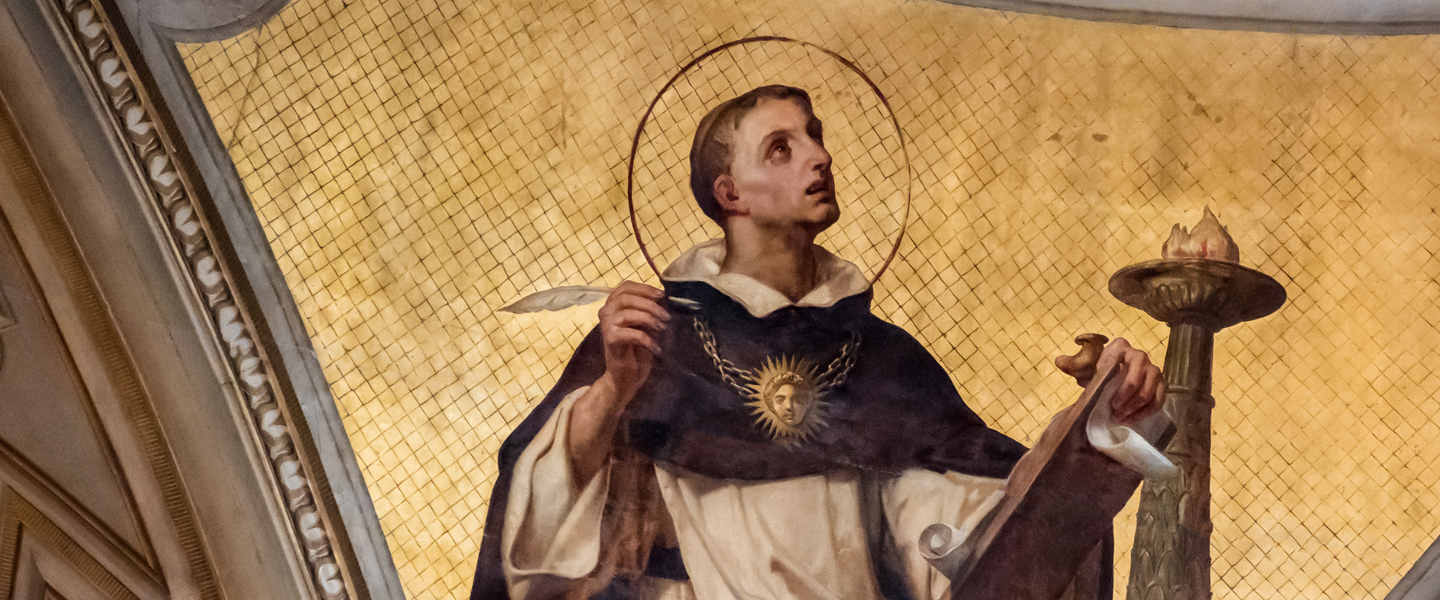
Student’s Prayer by Thomas Aquinas

Creator of all things, true source of light and wisdom,
origin of all being,
graciously let a ray of your light penetrate
the darkness of my understanding.

Take from me the double darkness
in which I have been born,
an obscurity of sin and ignorance.

Give me a keen understanding,
a retentive memory, and
the ability to grasp things correctly and fundamentally.

Grant me the talent of being exact
in my explanations and the ability to express myself
with thoroughness and charm.

Point out the beginning,
direct the progress,
and help in the completion.

I ask this through Christ our Lord.

Amen.

  —–Thomas Aquinas

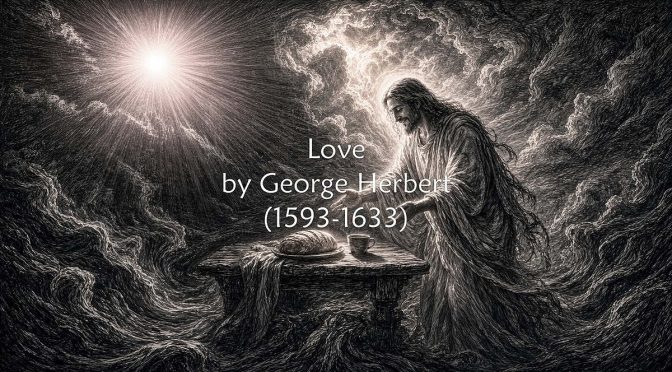
Love

Love bade me welcome; yet my soul drew back,
Guiltie of dust and sin.
But quick-ey’d Love, observing me grow slack
From my first entrance in,
Drew nearer to me, sweetly questioning
If I lack’d anything.

A guest, I answer’d, worthy to be here.
Love said, You shall be he.
I, the unkinde, ungrateful? Ah, my deare,
I cannot look on thee.
Love took my hand and smiling did reply:
Who made the eyes but I?

Truth, Lord; but I have marr’d them; let my shame
Go where it doth deserve.
And know you not, says Love; who bore the blame?
My deare, then I will serve.
You must sit down, says Love, and taste my meat.
So I did sit and eat.
–George Herbert