Tag Archives: Puerto Rico

Puerto Rico Demographic Winter


A continuing strike [4] by students at the University of Puerto Rico (UPR) has now closed the institution for more than a month at a cost of over 100 million dollars. Nominally, the strike is about tuition costs, but political interests are clearly exacerbating the situation. At a more fundamental level the strike can be viewed as a minor skirmish in a developing inter-generational competition for resources fueled by demographic collapse.

In 1968, Paul Ehrlich published The Population Bomb predicting that by the year 2000, hundreds of millions would die of starvation due to a population explosion. Indeed, millions of intellectuals believed this simplism and today in Puerto Rico, as elsewhere, the myth of a population explosion is a dominant narrative in schools and universities.

However, the evidence (see [1], [2], [5]) suggests that the earth is rapidly approaching a catastrophic population implosion. The problem today is not overpopulation but underpopulation. For a population to reproduce itself, the fertility rate (as explained in the video in Fig 1. below) must average 2.1 children per woman.

Figure 1. A Necessary Condition for a Stable Population

Many nations already have rates significantly less than the critical replacement level of 2.1 and most are falling rapidly. For example, the population of Russia (fertility 1.36 in 2010) dropped by over 12 million between 1992 and 2008. Japan’s population of 128 million is predicted to fall to about 89 million by 2050 at which point, around 40% of the population will be over 65. By 2050, median age is expected to increase to 55 in Germany and 58 in Italy. With few exceptions (see figure Fig 2), similar gerontological shifts are occurring worldwide.

Global Fertility Decline
Fig. 2. Global Fertility Decline

Such demographic trends are not easily reversed. Russia and China have found to their chargrin, that once fertility rates drop below replacement, not even financial incentives can raise them significantly. In Shanghai, labor shortages have forced the government to relax its draconian population control measures —but to no avail. Many Chinese no longer even want children, especially girls, and rates of abortion and infanticide remain high. Forced abortions continue at a rate of about 35,000 per day under that country’s coercive one-child policy. The strongly anti natalist policies of the United Nations, USAID, International Planned Parenthood, NGO’s such as Amnesty International, Oxfam and Christian Aid, as well as major philanthropists such as George Soros have wrought worldwide cultural changes. These changes including increased rates of abortion, contraception and breakdown of the traditional family have had a devastating effect on fertility and health. The number of common sexually transmitted diseases has increased from essentially 5 to more than 30, effecting up to a quarter of the population in some US cities. Paradoxically, the promotion of condoms has actually increased the rate of HIV and other infections [8]. According to Dr. Edward C. Green (director of the AIDS Prevention Research Project at the Harvard Center for Population and Development Studies)

“There is a consistent association shown by our best studies, including the U.S.-funded ‘Demographic Health Surveys,’ between greater availability and use of condoms and higher (not lower) HIV-infection rates,”

Countries undergoing demographic decline inevitably suffer severe and prolonged economic downturns. The productive segment of the age spectrum is reduced from above by aging and from below by low birth rates. As the political power of the elderly increases in proportion to their numbers and propensity to vote, spending on health and pensions rises. Rather than risk opposing this trend politicians prefer to play safe by reducing spending on education, defense, and transport. As in the current strike at the UPR, the younger segment of the population naturally reacts to the rising costs of tuition. The outcome is an intergenerational conflict over limited resources.

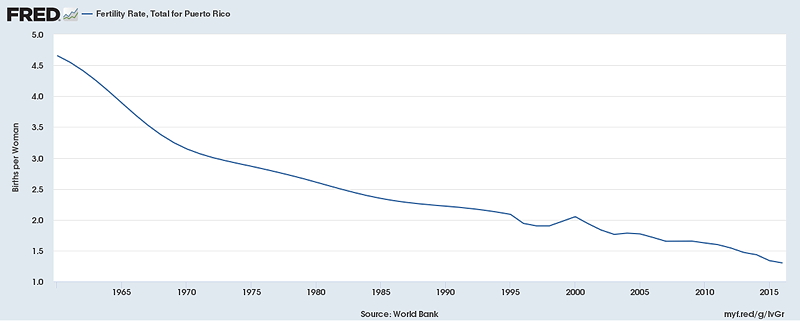
Puerto Rico Total Fertility Rates
YearTotal 
Fertility Rate
Percentage 
Change
Rank
19604.55  
20032.02 142
20041.91-5.45%147
20051.75-8.38%166
20061.750.00%167
20071.771.14%158
20081.76-0.56%160
20091.71-2.84%170
20101.60-3.54%176
20151.341  
20230.89

1CDC Data

4-2-1 Population Distribution

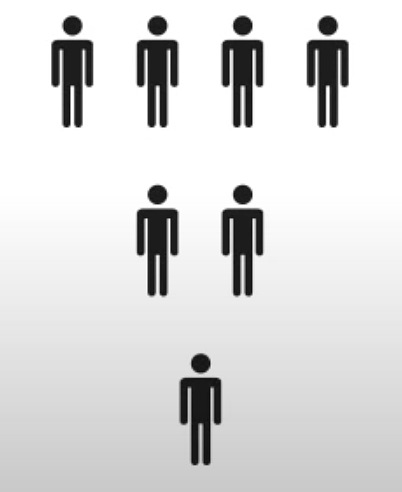
The above global trends are already reflected in the demographic profile of Puerto Rico, and projections point to a declining and ageing population. The median age of females has risen steadily reaching 37.9 years in 2009. According to CIA data, the total fertility rate has fallen steadily from 2.02 in 2003 to an estimated 1.65 in 2010, an average change of about -0.04 per year. In 1960 it was 4.55. Puerto Rico’s birthrate now ranks 176 out of a survey of 200 countries in the world. The current fertility level of 1.65 means, roughly speaking, each generation will be 18% smaller than the preceding. Moreover, if the current rate of decrease in fertility is maintained, then by 2020, total fertility will be close to one child per woman -the point at which the population will be reduced by one half in each succeeding generation. The population will then trend towards, what is known in demography as, a 4-2-1 distribution. One adult child will have to provide support for his two parents and four grandparents.

Historically, the decline in fertility in Puerto Rico can be attributed to a population control regime started by USAID and other organizations. In the fifties, Puerto Rico women were the victims of a mass sterilization program[3] masquerading as an anti-poverty campaign. Many were not even informed of the consequences. By 1970 approximately 30% of Puerto Rico’s female population of childbearing age had been sterilized -the highest rate in the world. In the sixties’s Puerto Rico women were used as guinea pigs in the mass testing of unproven contraceptive hormones [6] and by 1963, dozens had died. At that time it was not well known that oral contraceptives, apart from their abortifacient propensity by causing death of the fertilized ovum, also caused blood clots, heart attacks, and pulmonary embolisms, cancer, pelvic inflammatory disease, depression and other conditions (see: (https://thepillkills.org/). In 1973, the demographic decline accelerated as a consequence of the US Supreme Court ruling Roe v. Wade legalizing abortion. If the abortion rate, estimated at .68 in 2001, were reduced in half, the fertility level of Puerto Rico would be above replacement.

Measures of legal abortion in Puerto Rico1
CountryYearNo.*Ratio‡ Total abortion rate§
Puerto Rico199119,200230.68


1Guttmacher Institute
‡Abortions per 100 known pregnancies.
§The number of abortions that would be experienced by the average woman during her reproductive lifetime, given present age-specific abortion rates.
*Worldwide, about one-fourth of the approximately 180 million pregnancies are terminated by abortion.
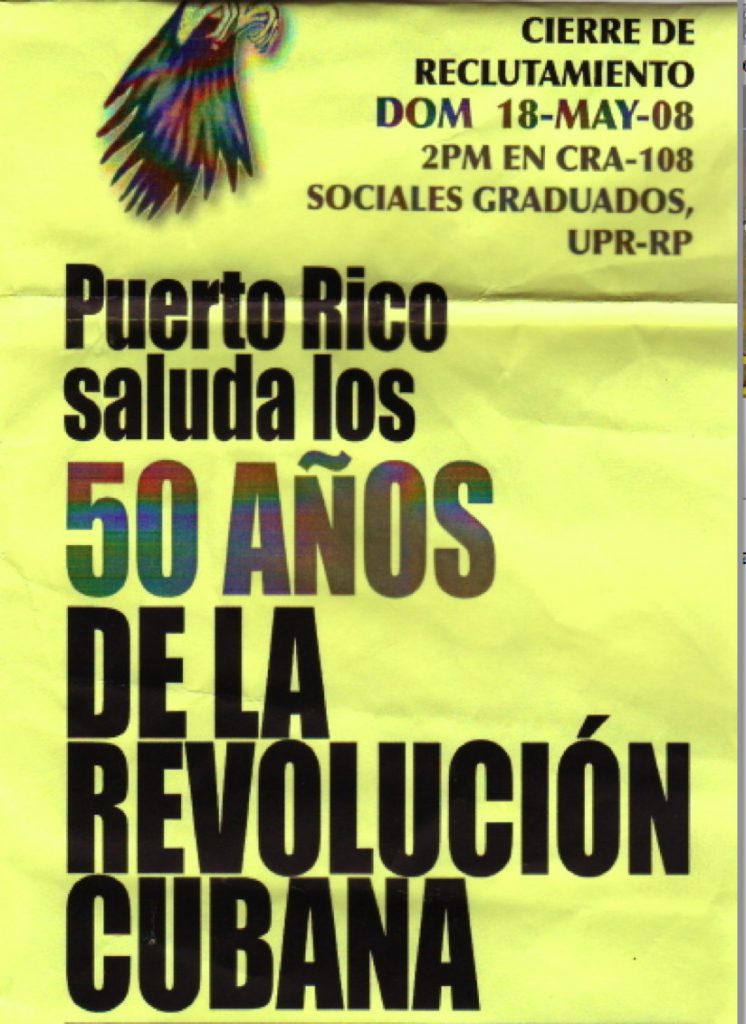
UPR facilities used to violate blockade of Cuba

The likely economic consequences of this population decline for Puerto Rico are well described by Alexander F. Díaz, in his article Demographic storm [2]. In fact, the decline in fertility is already being experienced in the closing of schools and the diminishing enrollment in post secondary education. The Puerto Rico Department of Education is planning for a reduction of 14,000 students in the public schools in 2010 and at least 40 schools are in danger of closing. The University of Puerto Rico has experienced an estimated 14% drop in enrollment at its main campus in Rio Piedras from 21,561 students in 2000 to 18,653 in 2010. To date, this fall in enrollment has gone largely uncommented. There is a tendency among educators to hide the decline. The UPR Department of English website still proclaims a total enrollment in 2010 of 22,000 students. Many professors are wedded -apparently without the possibility of divorce- to the long discredited narrative of population explosion and continue to teach this in their courses. The decline in enrollment, and concurrent loss of revenues, has contributed to the UPR’s 300 million dollar deficit and is a contributing cause of the current five week student strike. However, unlike in previous strikes, not all of the student’s demands are likely to be met. The government does not have the luxury of robbing the already weakened general economy to bale out an institution which has long been a black hole for money: where tenure is a sinecure; where students regularly take more than 8 years to graduate; where professors of postmodern stripe dedicate time to propagating the discredited ideologies of Freud, Marx, and Freire or the lunacy of gender theory; where many students, ignorant of communist atrocities, proudly wear Che t-shirts and, in violation of Federal laws, participate in brigades to visit Cuba; where student unrest receives the endorsement of dictators such as Castro and Chavez; where Literature professors devote class time to showing triple x movies; where Body Art has supplanted Western Civilization in the curriculum. When a large percentage of the population is unemployed and lacks health care or an adequate pension and revenue is limited, there is no political incentive for a government, with dwindling revenues, to divert additional resources to a dysfunctional institution [7]. Better to adopt a politically expedient solution such as converting the main campus in Rio Piedras into a graduate research facility. With the fall in student numbers, the remaining students could be easily accomodated in other campuses in Puerto Rico or the US.

Prospects for the independence of Puerto Rico are also impacted by current demographic realities. The economic advantages of the relationship with the US are such that there is little imperative for Puerto Ricans to seek full independence and it is unsurprising that at least 40% of the population favor statehood. In fact, during the 2008 elections, the Puerto Rico Independence Party (PIP) lost official recognition obtaining only 2.04% of the vote.

An obvious necessary requisite for independence is a successful and growing economy for only in such an economy would independence be viable. A healthy and expanding economy requires a young and growing population. Demographic and economic decline in Puerto Rico can be expected to translate into an outmigration to the US mainland. Since it is generally young people who leave, a feedback loop is formed leading to a spiral of further decline. Already, almost half of all Puerto Ricans live on the mainland. For this reason, it is clearly in the interests of parties seeking independence for Puerto Rico to encourage population growth and strong stable families.

By embracing “diversity” in a desperate search for members, the Puerto Rico Independence Party, the Refundacion Comunista, the Frente Socialista, and other groups supporting independence, have fallen into the trap of adopting radical feminist agendas which promote abortion and population control, and which have contributed to the breakdown of the traditional family. The antinatalist stance adopted by these organizations is agravating the demographic decline which has already made political independence for Puerto Rico a virtual impossibility. Holding two contradictory beliefs simultaneously is a hallmark of incompetence or psychiatric disorder. Unless the various Puerto Rican pro independence parties cease promoting a “culture of death” and adopt rational policies, in accord with their principal objective, the prospects for Puerto Rican independence would seem, at best, bleak.

Philip Pennance, May 2010
https://pennance.us/

Addendum

Puerto Rico birthrates fell by 3.8 percent in 2009 and marriages dropped by 13.2 percent from 2007 to 2008. According to the 2010 Census, Puerto Rico’s population fell by 2.2 percent from 3,808,610 in 2000 to 3,725,789 in 2010. Since no US state has shown a comparable population decrease, Puerto Rico’s share of more than $400 billion in annual federal aid will be correspondingly reduced with disastrous consequences for the local economy. There are already more than 500,000 non-Puerto Ricans residing on the island Puerto Rican. Unless abortion is halted and the contraceptive mentality changed. Puerto Rican culture remains in serious danger of dissapearing along with any prospects of independence. Meanwhile the perpetual unrest at the UPR continues —added 12/27/2010

References

  1. Steven Malanga, Our Vanishing Ultimate Resource. Plummeting birthrates threaten prosperity worldwide. Can America buck the trend?, City Journal Vol 20, no. 1.
  2. Alexander F. Diaz, Demographic storm, Carribean Business, August 14, 2008 | Volume: 36 | No: 32.
  3. Philip Pennance, The cost of human eggs – Warning to Puerto Rico students.
  4. La Huelga y El Visitante. Concerning the Strike at the UPR.
  5. Demographic Winter. Documentary on demographic collapse.
  6. Mujeres en Puerto Rico utiliazadas como “conejillos de Indias”, Boletin de Vida Humana Internacional 15 Oct 2003.
  7. All UPR Posts at Pennance.us
  8. Philip Pennance, Condom Roulette.

Virus of Constructivism Threatens Puerto Rican Catholic Education

In the February 20, 2005 issue of the Puerto Rican Catholic Weekly El Visitante it was announced that Catholic schools run by the Dominican Order will henceforth adopt a constructivist philosophy of education. It is stated that the goal of this project is to

“develop in the student a healthy self-esteem so as to be able to reach excellence in all aspects of his personality”.

This is an extremely alarming development. The stated goal of this project (self-esteem) and the method proposed to achieve it (constructivism) are quite problematic.

In a talk [21], entitled “The Problem with Self-Esteem”, Paul C. Vitz, Professor of Psychology at New York University and author of Psychology as Religion: The Cult of Self-Worship, states that no major psychological theorist makes self-esteem a central concept.

“The self-esteem theory, that so many people seem obsessed with these days, predicts that only those who feel good about themselves will do well – which is supposedly why all students need it. Yet the research has not supported the theory. There is no evidence that high self-esteem reliably causes anything. Indeed, a lot of people with little of it, have achieved a great deal in one kind of activity or the other.”

Instances abound of poor performance and high self-esteem. In the 2003 Organization for Economic Cooperation and Development, Program for International Student Assessment (PISA) study, U.S. students were ranked 28th in performance in Mathematics and highest in self-esteem. On the other hand, Hong Kong-China, Korea, and Japan, were ranked 1st, 3rd and 6th, respectively in performance yet were amongst the lowest in self esteem.

Ironically, Jesuit schools of the past have achieved great educational success by initially undermining the self-esteem of students and then reconstructing it on a healthier and more solid basis. This success has not gone unnoticed by basketball coaches.

Neither is there evidence that self-esteem is correlated with good moral behavior. Many criminals and dictators have high self-esteem and feel good about doing evil. There is, however, strong evidence that certain types of training in self-esteem can undermine moral behavior. In an infamous experiment conducted in 59 California Catholic schools, psychologists Coulson and Rogers applied non-directive, non-judgmental therapy to six hundred Immaculate Heart of Mary teaching nuns. Neumayr [14] describes how after eighteen months of this training all the nuns had resigned from teaching and only two schools remained in the system. Moreover, many nuns abandoned their order. Coulson later blamed these pernicious effects on the moral relativism inherent in this self-esteem enhancing experiment. According to Coulson quoted in Ferreira [6]:

“Christianity is based on absolutes. Non-directive education rejects absolutes and embraces subjectively-chosen alternatives. When any person is convinced that all authority for conduct lies within himself – that one decision or conclusion is as good as another – the inevitable result is rebellion against authority and deterioration of moral conduct.”

In his homily [18] at the pre-conclave Mass in St. Peter’s Basilica, Joseph Cardinal Ratzinger, now Pope Benedict XVI, stated:

“We are moving toward a dictatorship of relativism that has at its highest goal one’s own ego and one’s own desires”.

As a youth in Nazi Germany, Pope Benedict XVI witnessed at first hand the asymptotic limit of unbridled relativism. The Nazi dictator Adolf Hitler, himself a relativist stated that:

“We are now at the outset of a tremendous revolution in moral ideas and in men’s spiritual orientation… There is no truth, either in the moral or in the scientific sense. The idea of free and unfettered science is absurd. Science is a social phenomenon, and like every other social phenomenon is limited by the benefit or injury it confers on the community. The slogan of objective science has been coined by the professorate simply in order to escape from the very necessarily that there can only be the science of a particular type of humanity and of a particular age.” [Emphasis added] (Rauschning, 1940, quoted by Cromer [4])

Constructivists maintain that learning is an “active” process by which students “construct their own knowledge”. Radical constructivists go to the extreme of denying the existence of an independent reality. Given that many constructivists ascribe to a relativist ontology which posits the existence of multiple socially constructed realities, the Dominican Order’s plan to explicitly favor the constructivist educational paradigm is especially worrying. In the constructivist classroom group thinking and consensus processes are common. The teacher is considered a “co-learner” rather than as an authority and referred to by such terms as “facilitator”, “resource”, or even “change agent”. Models of community and solidarity typically advocated by constructivists are quasi-anarchical; personal responsibility is replaced by group consensus, trust in God by trust in self, toleration of no sin by toleration of all practices and lifestyles (except Christianity). In constructivist classrooms feelings and shared experience take precedence over facts, logic, and truth.

Relativism often leads1 to belief in generic New Age religious forms, pantheism, agnosticism, or atheism. It is incompatible with Christianity, in particular with Catholicism. In reality, the Catholic Church is a structured, and hierarchical community. Religious truths are derived from Scripture, tradition and the interpretation of doctrines by the Magisterium. These truths are regarded as unchanging and independent of the observer.

According to Graham Cray [3], the Anglican Bishop of Maidstone:

In modernity the great ideological enemy of the gospel was secularism. This is no longer the case; spirituality is back in the public square, in fact any and every spirituality – and there are no maps! I used to believe that our primary new adversary was relativism: that our media saturated age with its bombardment of messages and its shopping approach to choice made relativism seem self evident, and a sceptical or ironic attitude towards truth claims unavoidable. I still believe this is the case but I no longer consider relativism to be our chief opponent, for beyond relativism is constructivism, and it is constructivism which we must engage.

Timothy Radcliffe, O.P., [17] English Catholic priest, and former Master of the International Dominican Order warns:

…we are marked by a culture which has lost confidence that study is a worthwhile activity and which doubts that debate can bring us to the truth for which we long. If our century has been so marked by violence it is surely partly because it has lost confidence in our ability to attain the truth together. Violence is the only resort in a culture which has no trust in the shared search for truth. Dachau, Hiroshima, Rwanda, Bosnia; these are all symbols of the collapse of a belief in the possibility of building a common human home through dialogue. This lack of confidence may take two forms, a relativism which despairs of ever attaining to the truth, and a fundamentalism which asserts that the truth is already completely possessed.

In his document Ex Corde Ecclesiae [11] Pope John Paul II repeatedly reiterates the importance of the search for truth:

” A Catholic University’s privileged task is “to unite existentially by intellectual effort two orders of reality that too frequently tend to be placed in opposition as though they were antithetical: the search for truth, and the certainty of already knowing the fount of truth”.

This is well expressed by the Vision Statement of Christendom College:

The only rightful purpose of education is to know the truth and to live by it. The purpose of Catholic education is therefore to learn and to live by the truth revealed by Our Lord and Savior Jesus Christ, ‘the Way, the Truth, and the Life,’ as preserved in the deposit of faith and authentically interpreted in the Magisterium of the Roman Catholic Church, founded by Christ, of which the Pope is the visible head. That central body of divine truth illumines all other truth and shows us its essential unity in every area of thought and life. Only an education which integrates the truths of the Catholic faith throughout the curriculum is a fully Catholic education.

The Puerto Rico Department of Education (PR-DOE) has long based its curricula on the constructivist educational paradigm with dismal results. The concomitant cutting of course content and the abandonment of direct instruction in phonics, grammar, spelling and reading strategies have contributed to the current educational catastrophe. From 1996 to 1999 the PR-DOE and the Puerto Rico Resource Center for Science and Engineering sponsored Star Quest, a regular section in the San Juan Star devoted to educational matters. On December 8, 1998, Star Quest’s central theme was religion. The content of this column is very revealing of the dangers that constructivist education poses for religion. After providing a brief description, actually a caricature, of each of the world’s major religions, it gives the following advice to Mathematics teachers:

Are religions basically similar to each other or different? Have your students analyze three major religions and make a list of what these religons have in common and in what ways they are different. Take the similarities and differences and convert them to percentages. What is the percentage of similarities to the total? Of the differnces? [sic] Do the results agree with your students’ original thoughts on this subject..

Another column in the same series advises students that:

Everyone’s ideas are equally worthwhile… Suspend judgement: nothing is “right” or “wrong”.

It is unlikely that the Dominicans desire to propagate ideas such as this in their schools and colleges. Yet, it is precisely this type of moral relativism which is common in constructivist writings and the main reason why constructivism is so dangerous.

Strong experimental evidence, which we now outline, shows that direct instruction is more effective than constructivist pedagogy. Renowned psychologists John Anderson, Lynne Reder and Herbert Simon -the latter a Nobel Laureate- have carried out a systematic study of research in the application of cognitive psychology to mathematics education. A summary of their findings can be found in their article “Applications and Misapplications of Cognitive Psychology to Mathematics Education” [1]. The results are not supportive of the constructivist’s notion that students “construct” their own knowledge. Nor do they offer support for the idea that skills can best be learned in a specific (i.e., real world) context. According to Anderson, Reder, and Simon,

“It is not the case that learning is totally tied to a specific context. […] In fact, there are many demonstrations of learning that transfers across contexts and of failures to find any context specificity in the learning.” “Knowledge does not have to be taught in the precise context in which it will be used, and grave inefficiencies in transfer can result from tying knowledge too tightly to specific, narrow contexts.” “Representation and degree of practice are critical for determining the transfer from one task to another, and transfer varies from one domain to another as a function of the number of symbolic components that are shared.” “What is important is what cognitive processes a problem evokes and not what real-world trappings it might have.” “When students cannot construct the knowledge for themselves, they need some instruction. There is very little positive evidence for discovery learning and it is often inferior. In particular, it may be costly in time, and when the search is lengthy or unsuccessful, motivation commonly flags.” “To argue for radical constructivism seems to us to engender deep contradictions. Radical constructivists cannot argue for any particular agenda if they deny a consensus as to values. The very act of arguing for a position is to engage in a value-loaded instructional behavior. It would seem that radical constructivists should present us with data about the consequences of various educational alternatives and allow us to construct our own interpretations. (But data beyond anecdotes are rare in such constructivist writings.)“

Other serious criticisms of constructivism have been made by Grossen [7], Kozloff [12], Matthews [16], Carnine [2], Thomas [20], and Jennings [10]. Although some constructivist ideas are true (for example, that students are not just passive learners and that they have an interest in understanding themselves and their world), unquestioningly accepting all of its tenets is unwarranted2.

Piaget, a pioneer of constructivism, rediscovered the old idea that it is detrimental to instruct a child in a given material before a given developmental stage has been reached. Unfortunately, as Stanislas Dehaene [5] describes, some of Piaget’s experiments are badly flawed. For example, in a famous experiment of Piaget, young children were shown two rows of equally-spaced glass balls. When the spacing in the two rows was the same, the children stated correctly that both rows had the same number of objects. When the spacing was changed in one of the rows, the children said incorrectly that the longer row had more balls. On the basis of this experiment, Piaget and many educators have incorrectly claimed that even young children who can count have no number sense. Dehaene describes evidence refuting this assertion. When Piaget’s experiment was repeated with chocolates -which of course the children could eat- instead of glass balls, they were found able to answer the second question correctly. Moreover, when a man dressed as a teddy bear rearranged the two rows while the interviewer’s back was turned the children’s performance on the second question improved.

The above illustrates the danger of making inferences concerning most effective educational practices on the basis of very small scale psychological experiments. Unfortunately, Piaget’s conception of “developmentally appropriate” has been interpreted by radical constructivists to mean that children should only be taught things whose purpose they already understand. (e.g. that children not be taught to read before they know what writing means.)

The reality -ignored by many education experts- is that Project Follow Through, the largest and most extensive longitudinal study ever funded by the United States government in more than 180 U.S. schools (kindergarten through third grade) representing 51 school districts, demonstrated that the traditional Direct Instruction method was the most effective when compared to the other models tested, some of which were based on constructivist views. Students in the Direct Instruction groups performed better on both academic and affective (self-concept) measures. The Project, which cost almost a billion dollars and ran from 1968 to 1976 (Follow Through continued until 1995 as a federal service program), collected yearly data on around 10,000 students. Later evaluation of 1,000 graduates of the Direct Instruction groups showed that, in their senior year of high school, their performance was still better than their counterparts’. For details on Project Follow Through, see Kozloff and Bessellieu [13], Grossen [7], Watkins [22], Hirsch [9], and Carnine [2].

Veritas (truth) is the Dominican motto. It would be ironic, indeed, if the school system of the Order of Preachers in Puerto Rico is “relativized” by adopting the same constructivist epistemology and ontology that has so catastrophically failed in public education. The Dominican Order has a long and distinguished tradition of Catholic education in Puerto Rico. A curricular “reform” based on constructivist ideology will undermine this illustrious tradition, thereby harming generations of students. It is our sincere hope that in reforming their schools, the Order will heed the following words of Timothy Radcliffe, O.P. [17]:

In the face of that despair which is relativism, we celebrate that the truth may be known and in fact has come to us as a gift. With St Paul we can say: “What I received from the Lord, I also delivered to you.” [ I Cor 11:23 ] Studying is a eucharistic act. We open our hands to receive the gifts of tradition rich with knowledge.

Philip Pennance
22-02-2005, Updated 22-04-2005

Footnotes

  • …leads1
    • See for example, Chapter 5 of John P. Lynch, Jr. et al. A Postmodern Cosmography which asserts that: “Gaia, complexity, relativity, animal consciousness, and the legitimation of esoteric knowledge have allowed Gnosis, with the aid of constructivism”, to throw off its yoke to Religion and stand independently. [Emphasis added]
  • …unwarranted2
    • In the United States and elsewhere this discussion has reached a wide audience. Articles in the New York Times, the Wall Street Journal and the San Francisco Chronicle, among others, report of widespread parental protests against the new math, MathLand, Connected Mathematics, and other projects inspired by constructivism (Hartocollis [34]; Saunders [69]; “Math wars” [52]).

Bibliography

  1. J. R. Anderson, L. M. Reder, and H. A. Simon, Applications and Misapplications of Cognitive Psychology to Mathematics Education, Carnegie Mellon University, Pittsburgh, 1966.
  2. D. Carnine, Why Education Experts Resist Effective Practices (And What It Would Take to Make Education More Like Medicine) , Thomas B. Fordham Foundation, Washington, D. C., 2000.
  3. Graham Cray, Postmodernity – under construction , The Gospel and our Culture Newsletter 27, 2000
  4. Alain Cromer, Science and Postmodernism Oxford University Press, 1997.
  5. Stanislas Dehaene, The Number Sense, Oxford University Press, 1997.
  6. Cornelia R. Ferreira, What is New Age Education? Part I, Catholic Family News, Vol. 10, No. 9, 2003.
  7. B. Grossen, What Does it Mean to Be a Research-based Profession? In What’s Gone Wrong in America’s Classrooms, edited by Williamson Evers, California: Hoover Institution Press, Stanford University, 1998.
  8. A. Hartocollis, The New, Flexible Math Meets Parental Rebellion, The New York Times, April 27, 2000.
  9. E. D. Hirsch, The Schools We Need and Why We Don’t Have Them, Anchor, New York, 1999.
  10. Marianne M. Jennings, MTV Math Doesn’t Add Up, Wall Street Journal, December 17, 1996.
  11. Pope John Paul II, Ex Corde Ecclesiae, Apostolic Constitution on Catholic Universities. August 15, 1990.
  12. M. A. Kozloff, Constructivism in Education: Sophistry for a New Age , University of North Carolina at Wilmington, May 1998.
  13. M. A. Kozloff and Frances B. Bessellieu, Direct Instruction Is Developmentally Appropriate , University of North Carolina at Wilmington, April 2000.
  14. George Neumayr, Mad Scientists , San Francisco Faith, November, 1997.
  15. Math Wars, Wall Street Journal, Lead Editorial, January 4, 2000.
  16. M. R. Matthews, Old Wine in New Bottles: A Problem with Constructivist Epistemology, Philosophy of Education, 1992.
  17. Fr. Timothy Radcliffe, OP., The Wellspring of Hope Study and the Annunciation of the Good News , Santa Sabina, Rome. October 1996
  18. Joseph Cardinal Ratzinger, Homily, Pre-Conclave Mass for the Election of a New Pope, April 18, 2005.
  19. D. J. Saunders, No Such Thing as Malpractice in Edu-Land, San Francisco Chronicle, February 4, 2000.
  20. O. Thomas, Some Contradictions of Education Reform: Constructivism, High-tech, and Multi-culti, Special Session on Mathematics Education and Mistaken Philosophies of Mathematics, American Mathematical Society Meeting, San Antonio, Texas, January 13, 1999.
  21. Paul C. Vitz, The Problem with Self-Esteem , A talk given in New Westminster, British Columbia on September 29, 1995.
  22. C. L. Watkins, Follow Through: Why Didn’t We? , Effective Schools Practices, 15, 1-14, 1995.

Unidad 1: Fundamentos de Geometría

Concerning the Lesson Plan for Week 1 of 10th Grade Geometry (Unidad 1: Fundamentos de Geometría) in Puerto Rico

This 10th Grade Geometry Lesson Plan Is a Masterclass in Educational Malpractice

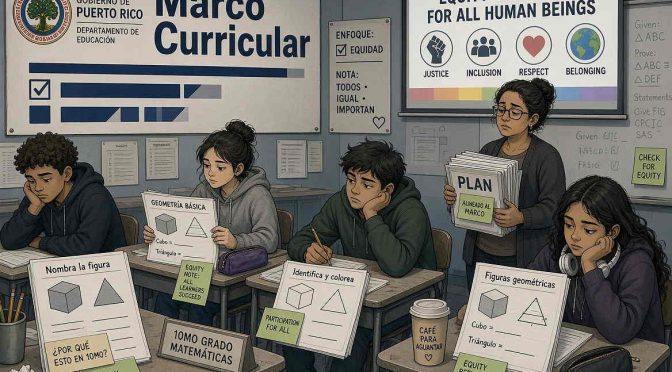
This weekly lesson plan for a 10th-grade Geometry class in Puerto Rico is a glorious monument to educational malpractice. It takes a subject that should build logical reasoning and proof skills and turns it into a week-long exercise in low-level busywork, heavily padded with forced social themes.

Does It Align with the Geometry Content Standards?

Technically, yes — in the most pathetic, checkbox-ticking way possible.

According to the 2022 Puerto Rico Mathematics Standards, there is an expectation coded ES.G.36 called “Conceptos básicos de geometría”:

  • ES.G.36.1: Reconoce el concepto geometría.
  • ES.G.36.2: Nombra e identifica los conceptos básicos en figuras geométricas y de la vida diaria como: punto, recta, plano, segmento, rayo.

The plan hits these specific expectations. Monday is basically “What even is geometry, guys?” and the rest of the week focuses on naming basic elements and graphing on the Cartesian plane.

However, this is Décimo grado (10th grade). Spending an entire week on material that belongs in middle school (or earlier) is not alignment — it’s a symptom of how far the standards and their implementation have been watered down.

Everything That’s Wrong With This Plan

Here’s a breakdown of the major problems:

  • The content level is embarrassingly low for 10th grade
    Students are defining what geometry is and identifying basic shapes like triangles and cubes. By 10th grade, they should already be doing proofs, congruence criteria, similarity, and applying coordinate geometry at a much higher level. This plan feels like it was written for 6th or 7th graders.
  • The math is constantly interrupted by social justice cosplay
    Almost every day includes forced transversal themes, especially the repeated emphasis on “equidad y respeto entre todos los seres humanos.” Tuesday is largely devoted to a PowerPoint discussion on social themes rather than geometry. The actual mathematics feels like an afterthought.
  • Objectives are pathetically low-level
    Every objective sits at the “remember” or “understand” level: define, name, identify, discuss, graph. There is almost no analysis, justification, or higher-order thinking expected from 10th graders.
  • Activities are mostly time-wasting fluff
  • Visiting the school patio to observe and draw geometric figures (in 10th grade).
  • Team research and oral presentations on René Descartes.
  • Vague “practice the elements under study.”
    These are not rigorous Geometry activities.
  • The plan is poorly written and incomplete
    Friday’s objectives are cut off mid-sentence. Many instructions are vague. The document is bloated with repeated footnotes about transversal themes.
  • Heavy reliance on discussion instead of mathematical practice
    There is far too much “discuta,” “dialogue,” and “reflexión,” and far too little actual doing of geometry (constructions, proofs, problem-solving).
  • The bureaucratic template is broken
    The plan is overloaded with checkboxes, repeated equity notes on every page, and excessive focus on “temas generadores.” It feels like the form was prioritized over actual teaching and learning.

Bottom Line

This lesson plan doesn’t just fail to challenge 10th-grade students — it actively insults their intelligence. It technically checks the box for the low-level expectation ES.G.36, but it completely fails to deliver a meaningful Geometry education.

If this is what “Fundamentos de Geometría” looks like in 10th grade, then the entire high school Geometry sequence is in serious trouble. Students deserve better than a week of naming points and discussing equity while occasionally glancing at shapes.

This plan is not teaching Geometry.
It’s teaching compliance with a poorly designed template.

References