General
Topic 1. Review
- Elementary set theory and logic.
- Functions.
- Summation notation.
Topic 2. Combinatorics
- The definition of a finite set and its cardinality.
- The number of words of a given length in a finite alphabet.
- The elementary combinatorics of sets.
- The inclusion-exclusion principle.
- Pascals identity.
- Permutations and combinations (subsets).
- The binomial theorem.
- Bipartitions of a finite set.
- Counting functions of different kinds.
Topic 3. Probability Theory.
- Discrete random experiments.
- The sample space of a random experiment.
- Events.
- Random variables.
- Relative frequency.
- Probability.
- Conditional Probability.
- Independent events.
- Bayes’ theorem.
Topic 4 Random Variabkles.
- The distribution of a discrete random variable.
- Distribution functions.
- Density functions.
- The mean and variance of a discrete random variable.
- Chebyshev’s inequality.
- Continuos random variables.
- The law of large numbers.
Topic 5. Introduction to Statistics.
- Independent samples.
- Statistics and parameters.
- Estimators.
- Statistics which measure dispersion.
- Transformations and changes of scale.
- Stevens’ Classification
- Standardization.
Topic 6. R programming.
- Installation of R
- Introduction to R
Topic 7. Probability distributions.
- Bernoulli random variables.
- The binomial distribution.
- The Poisson distribution.
- The sum of Poisson variables.
- The multinomial distribution.
- The normal distribution.
- The normal approximation to the binomial distribution.
- Distribution of the mean.
- The central limit theorem.
- Sampling from finite populations
Topic 8. Inferential statistics.
- Estimation.
- Confidence intervals.
- Confidence intervals for the mean of a population.
- Interpretation of confidence intervals
- Behaviour of the error.
Topic 9. Hypothesis testing.
- Comparison of the Neyman-Pearson and Fisher methodologies
- Tipo I and II errors.
- Power of a test. Power curves
- Inferences concerning the mean.
- Comparison of two means
- The case of “large” samples.
- The case of “small” samples from populations of known variances.
- Comparison of two variances.
- Inferences concerning the proportion.
- Non parametric tests.
- Tests for independence.
Topic 10. Simple Linear Regression.
- Confidence intervals for the regression parameters.
- Inferences concerning the regression parameters
- Predictions
- Confidence intervals for predictions.
- The analysis of residuals.
- Heteroscedastic data.
- Outliers and remedial measures.
- SAS general linear model procedure.
- Introduction to the analysis of variance.
Sample Exams
Exercises
- Descriptive Statistics
- Distrubution of the Mean
- Elementary Combinatorics
- Probability
- Density functions
- Binomial
- Probability Trees
- Independence
- The Normal Distribution
- Tests of Hypotheses
- SAS Exercises
- SAS Assignments 1991-1994
- Regression and Correlation
- Different Statistics
Related Notes
- The Distribution of the Mean
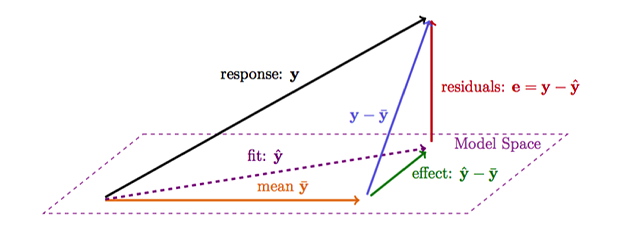
- Projection and Least Squares (Advanced version)
- Linear Correlation
- Some Important Density Functions
- Selected Formulae
- Elementary Combinatorial Formulae
Bibliography
- Murray R Spiegel Schaum’s Outline of Statistics, McGraw-Hill.
- Feller, Introduction to Probability Theory and its Applications (Vol. 1), Wiley.
Evaluation
Grade will be based upon 4 exams.