Category Archives: Pro-Life

Censorship of Prolife Images

Woe to those who call evil good and good evil, who put darkness for light and light for darkness…

Isaiah 5:20,

There are some who do not want you to know that in New York, almost 80% of black babies are killed by abortion. This Manhatten billboard was removed after only two days when pro choice activists called it “racist”.

Manhattan Billboard
Manhattan Billboard

More recently, in Chicago, “pro choice” vandals covered over the following billboard which highlights Obama’s proactive support for abortion and infanticide including the Planned Parenthood’ Foundation’s ongoing genocide by abortion of the black comunity.

toy-soldier

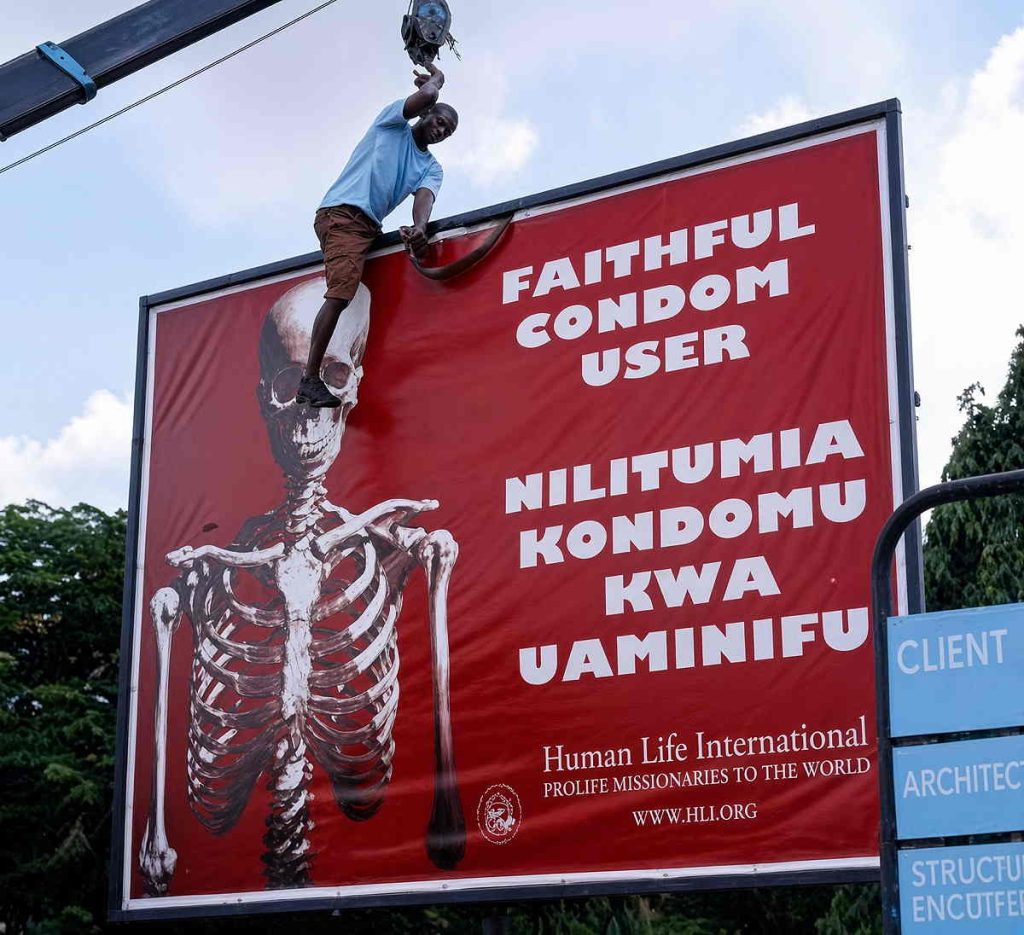
Even the following billboard has caused controversy

It is unlikely that the following Polish billboard would be permitted in the US.

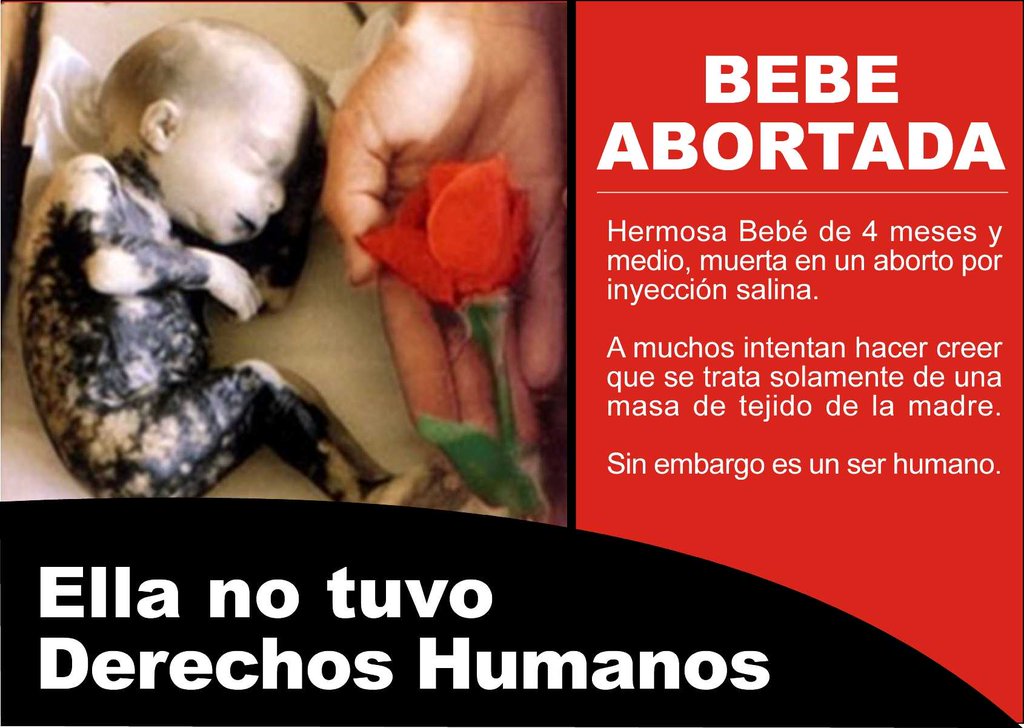
when an advertisement using the following image was censored by TV channels for being too graphic

The reality is that, as a portrayal of abortion, it is not graphic enough.

Also of interest:

  1. Sky-high abortion rate among blacks, minorities only getting worse: latest CDC data

    BY KIRSTEN ANDERSEN

Puerto Rico Demographic Winter


A continuing strike [4] by students at the University of Puerto Rico (UPR) has now closed the institution for more than a month at a cost of over 100 million dollars. Nominally, the strike is about tuition costs, but political interests are clearly exacerbating the situation. At a more fundamental level the strike can be viewed as a minor skirmish in a developing inter-generational competition for resources fueled by demographic collapse.

In 1968, Paul Ehrlich published The Population Bomb predicting that by the year 2000, hundreds of millions would die of starvation due to a population explosion. Indeed, millions of intellectuals believed this simplism and today in Puerto Rico, as elsewhere, the myth of a population explosion is a dominant narrative in schools and universities.

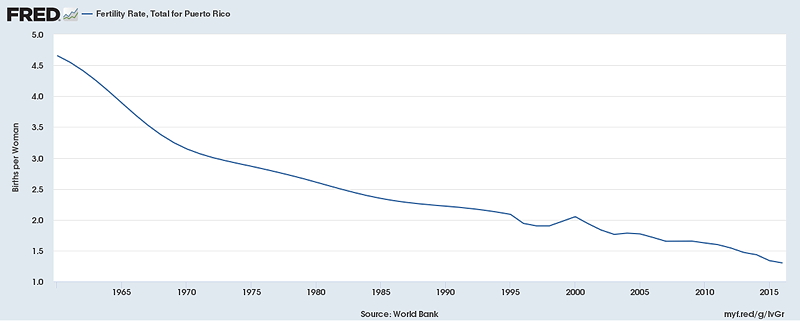
However, the evidence (see [1], [2], [5]) suggests that the earth is rapidly approaching a catastrophic population implosion. The problem today is not overpopulation but underpopulation. For a population to reproduce itself, the fertility rate (as explained in the video in Fig 1. below) must average 2.1 children per woman.

Figure 1. A Necessary Condition for a Stable Population

Many nations already have rates significantly less than the critical replacement level of 2.1 and most are falling rapidly. For example, the population of Russia (fertility 1.36 in 2010) dropped by over 12 million between 1992 and 2008. Japan’s population of 128 million is predicted to fall to about 89 million by 2050 at which point, around 40% of the population will be over 65. By 2050, median age is expected to increase to 55 in Germany and 58 in Italy. With few exceptions (see figure Fig 2), similar gerontological shifts are occurring worldwide.

Global Fertility Decline
Fig. 2. Global Fertility Decline

Such demographic trends are not easily reversed. Russia and China have found to their chargrin, that once fertility rates drop below replacement, not even financial incentives can raise them significantly. In Shanghai, labor shortages have forced the government to relax its draconian population control measures —but to no avail. Many Chinese no longer even want children, especially girls, and rates of abortion and infanticide remain high. Forced abortions continue at a rate of about 35,000 per day under that country’s coercive one-child policy. The strongly anti natalist policies of the United Nations, USAID, International Planned Parenthood, NGO’s such as Amnesty International, Oxfam and Christian Aid, as well as major philanthropists such as George Soros have wrought worldwide cultural changes. These changes including increased rates of abortion, contraception and breakdown of the traditional family have had a devastating effect on fertility and health. The number of common sexually transmitted diseases has increased from essentially 5 to more than 30, effecting up to a quarter of the population in some US cities. Paradoxically, the promotion of condoms has actually increased the rate of HIV and other infections [8]. According to Dr. Edward C. Green (director of the AIDS Prevention Research Project at the Harvard Center for Population and Development Studies)

“There is a consistent association shown by our best studies, including the U.S.-funded ‘Demographic Health Surveys,’ between greater availability and use of condoms and higher (not lower) HIV-infection rates,”

Countries undergoing demographic decline inevitably suffer severe and prolonged economic downturns. The productive segment of the age spectrum is reduced from above by aging and from below by low birth rates. As the political power of the elderly increases in proportion to their numbers and propensity to vote, spending on health and pensions rises. Rather than risk opposing this trend politicians prefer to play safe by reducing spending on education, defense, and transport. As in the current strike at the UPR, the younger segment of the population naturally reacts to the rising costs of tuition. The outcome is an intergenerational conflict over limited resources.

Puerto Rico Total Fertility Rates
YearTotal 
Fertility Rate
Percentage 
Change
Rank
19604.55  
20032.02 142
20041.91-5.45%147
20051.75-8.38%166
20061.750.00%167
20071.771.14%158
20081.76-0.56%160
20091.71-2.84%170
20101.60-3.54%176
20151.341  
20230.89

1CDC Data

4-2-1 Population Distribution

The above global trends are already reflected in the demographic profile of Puerto Rico, and projections point to a declining and ageing population. The median age of females has risen steadily reaching 37.9 years in 2009. According to CIA data, the total fertility rate has fallen steadily from 2.02 in 2003 to an estimated 1.65 in 2010, an average change of about -0.04 per year. In 1960 it was 4.55. Puerto Rico’s birthrate now ranks 176 out of a survey of 200 countries in the world. The current fertility level of 1.65 means, roughly speaking, each generation will be 18% smaller than the preceding. Moreover, if the current rate of decrease in fertility is maintained, then by 2020, total fertility will be close to one child per woman -the point at which the population will be reduced by one half in each succeeding generation. The population will then trend towards, what is known in demography as, a 4-2-1 distribution. One adult child will have to provide support for his two parents and four grandparents.

Historically, the decline in fertility in Puerto Rico can be attributed to a population control regime started by USAID and other organizations. In the fifties, Puerto Rico women were the victims of a mass sterilization program[3] masquerading as an anti-poverty campaign. Many were not even informed of the consequences. By 1970 approximately 30% of Puerto Rico’s female population of childbearing age had been sterilized -the highest rate in the world. In the sixties’s Puerto Rico women were used as guinea pigs in the mass testing of unproven contraceptive hormones [6] and by 1963, dozens had died. At that time it was not well known that oral contraceptives, apart from their abortifacient propensity by causing death of the fertilized ovum, also caused blood clots, heart attacks, and pulmonary embolisms, cancer, pelvic inflammatory disease, depression and other conditions (see: (https://thepillkills.org/). In 1973, the demographic decline accelerated as a consequence of the US Supreme Court ruling Roe v. Wade legalizing abortion. If the abortion rate, estimated at .68 in 2001, were reduced in half, the fertility level of Puerto Rico would be above replacement.

Measures of legal abortion in Puerto Rico1
CountryYearNo.*Ratio‡ Total abortion rate§
Puerto Rico199119,200230.68


1Guttmacher Institute
‡Abortions per 100 known pregnancies.
§The number of abortions that would be experienced by the average woman during her reproductive lifetime, given present age-specific abortion rates.
*Worldwide, about one-fourth of the approximately 180 million pregnancies are terminated by abortion.

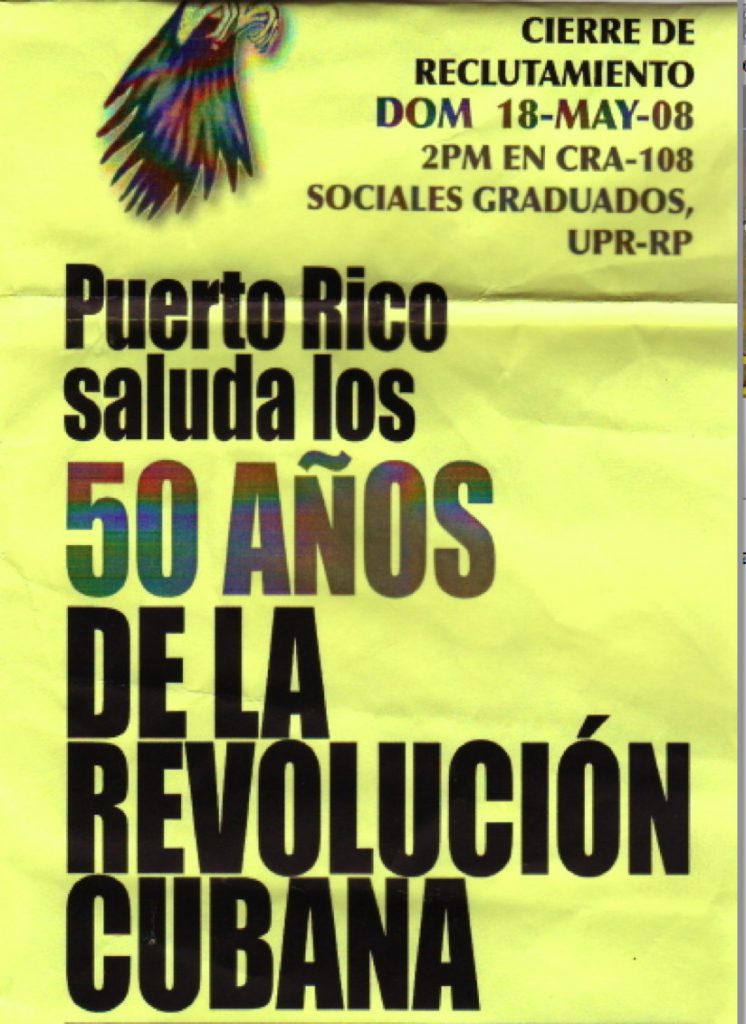
UPR facilities used to violate blockade of Cuba

The likely economic consequences of this population decline for Puerto Rico are well described by Alexander F. Díaz, in his article Demographic storm [2]. In fact, the decline in fertility is already being experienced in the closing of schools and the diminishing enrollment in post secondary education. The Puerto Rico Department of Education is planning for a reduction of 14,000 students in the public schools in 2010 and at least 40 schools are in danger of closing. The University of Puerto Rico has experienced an estimated 14% drop in enrollment at its main campus in Rio Piedras from 21,561 students in 2000 to 18,653 in 2010. To date, this fall in enrollment has gone largely uncommented. There is a tendency among educators to hide the decline. The UPR Department of English website still proclaims a total enrollment in 2010 of 22,000 students. Many professors are wedded -apparently without the possibility of divorce- to the long discredited narrative of population explosion and continue to teach this in their courses. The decline in enrollment, and concurrent loss of revenues, has contributed to the UPR’s 300 million dollar deficit and is a contributing cause of the current five week student strike. However, unlike in previous strikes, not all of the student’s demands are likely to be met. The government does not have the luxury of robbing the already weakened general economy to bale out an institution which has long been a black hole for money: where tenure is a sinecure; where students regularly take more than 8 years to graduate; where professors of postmodern stripe dedicate time to propagating the discredited ideologies of Freud, Marx, and Freire or the lunacy of gender theory; where many students, ignorant of communist atrocities, proudly wear Che t-shirts and, in violation of Federal laws, participate in brigades to visit Cuba; where student unrest receives the endorsement of dictators such as Castro and Chavez; where Literature professors devote class time to showing triple x movies; where Body Art has supplanted Western Civilization in the curriculum. When a large percentage of the population is unemployed and lacks health care or an adequate pension and revenue is limited, there is no political incentive for a government, with dwindling revenues, to divert additional resources to a dysfunctional institution [7]. Better to adopt a politically expedient solution such as converting the main campus in Rio Piedras into a graduate research facility. With the fall in student numbers, the remaining students could be easily accomodated in other campuses in Puerto Rico or the US.

Prospects for the independence of Puerto Rico are also impacted by current demographic realities. The economic advantages of the relationship with the US are such that there is little imperative for Puerto Ricans to seek full independence and it is unsurprising that at least 40% of the population favor statehood. In fact, during the 2008 elections, the Puerto Rico Independence Party (PIP) lost official recognition obtaining only 2.04% of the vote.

An obvious necessary requisite for independence is a successful and growing economy for only in such an economy would independence be viable. A healthy and expanding economy requires a young and growing population. Demographic and economic decline in Puerto Rico can be expected to translate into an outmigration to the US mainland. Since it is generally young people who leave, a feedback loop is formed leading to a spiral of further decline. Already, almost half of all Puerto Ricans live on the mainland. For this reason, it is clearly in the interests of parties seeking independence for Puerto Rico to encourage population growth and strong stable families.

By embracing “diversity” in a desperate search for members, the Puerto Rico Independence Party, the Refundacion Comunista, the Frente Socialista, and other groups supporting independence, have fallen into the trap of adopting radical feminist agendas which promote abortion and population control, and which have contributed to the breakdown of the traditional family. The antinatalist stance adopted by these organizations is agravating the demographic decline which has already made political independence for Puerto Rico a virtual impossibility. Holding two contradictory beliefs simultaneously is a hallmark of incompetence or psychiatric disorder. Unless the various Puerto Rican pro independence parties cease promoting a “culture of death” and adopt rational policies, in accord with their principal objective, the prospects for Puerto Rican independence would seem, at best, bleak.

Philip Pennance, May 2010
https://pennance.us/

Addendum

Puerto Rico birthrates fell by 3.8 percent in 2009 and marriages dropped by 13.2 percent from 2007 to 2008. According to the 2010 Census, Puerto Rico’s population fell by 2.2 percent from 3,808,610 in 2000 to 3,725,789 in 2010. Since no US state has shown a comparable population decrease, Puerto Rico’s share of more than $400 billion in annual federal aid will be correspondingly reduced with disastrous consequences for the local economy. There are already more than 500,000 non-Puerto Ricans residing on the island Puerto Rican. Unless abortion is halted and the contraceptive mentality changed. Puerto Rican culture remains in serious danger of dissapearing along with any prospects of independence. Meanwhile the perpetual unrest at the UPR continues —added 12/27/2010

References

  1. Steven Malanga, Our Vanishing Ultimate Resource. Plummeting birthrates threaten prosperity worldwide. Can America buck the trend?, City Journal Vol 20, no. 1.
  2. Alexander F. Diaz, Demographic storm, Carribean Business, August 14, 2008 | Volume: 36 | No: 32.
  3. Philip Pennance, The cost of human eggs – Warning to Puerto Rico students.
  4. La Huelga y El Visitante. Concerning the Strike at the UPR.
  5. Demographic Winter. Documentary on demographic collapse.
  6. Mujeres en Puerto Rico utiliazadas como “conejillos de Indias”, Boletin de Vida Humana Internacional 15 Oct 2003.
  7. All UPR Posts at Pennance.us
  8. Philip Pennance, Condom Roulette.

Brain Death – The Hoax That Won’t Die

by Earl E. Appleby, Jr.

Whether you are classified as dead or alive depends upon your attending physician’s understanding of the concept of death. The radical departure from the traditional cardiorespiratory standard of death inherent in “brain death” has, in Capron and Kass’s words, brought “extramedical concepts to the forefront of concern.”

Moreover, “medical judgments,” as Lamb reminds us “are informed by philosophical presuppositions, whether or not the latter are explicitly formulated.” The following article explicates the “philosophical presuppositions” underlying the “extramedical concepts” of brain death as articulated by its proponents.

If as propagandist par excellence, Joseph Goebbels maintained, a lie repeated often enough is soon believed, the brainwashed public’s blind faith in “brain death” is telling testimony to the pervasive power of the big lie. Regrettably, while the medical myth of brain death won’t die, its victims do.

Brain death, a prominent proponent attests, is “a creation of prevailing medical technologies.” Ironically, these “technologies” have nothing to do with the ability to determine death and everything to do with the ability to sustain life. Brain death “standards” have more permutations than the HIV-virus and like AIDS, they are all deadly. The first U.S. guidelines were proposed by the Ad Hoc Committee of the Harvard Medical School to examine the Definition of Brain Death. Their 1968 report, revealingly entitled A Definition of Irreversible Coma, cites two “reasons “to define irreversible coma as a new criterion for death”: (1) “increased efforts to save those who are desperately injured,” in the wake of medical progress in “resuscitative and supportive measures,” and (2) “controversy in obtaining organs for transplantation” in light of the traditional cardiorespiratory definition of death.

Death by Definition

Over the years, physicians have practiced euthanasia,” Dr. Willard Gaylin, of the infamous Hastings Center, acknowledges in Harvesting the Dead. “They have withheld antibiotics or other simple treatments when it was felt that a life did not warrant sustaining, or pulled the plug on the respirator when they were convinced that what was being sustained no longer warranted the definition of life.”

The staged debate among its sundry sects notwithstanding, the real question posed by the brain-death cult is not whether its victims are dead but whether they have a right to life. We are, in Gaylin’s words, “faced with the task of deciding whether that which we have kept alive is a human being, or, to put it another way, whether that human being. . . should be considered alive.'” “The problem,” he concludes, “is well on its way to be resolved by what must have seemed a relatively simple and ingenious method. As it turned out, the difficult issues of euthanasia could be evaded by redefining death.” (emphasis added)

We live in a world in which words are wielded as weapons. “Euthanasians,” Fr. Paul Marx reminds us, “abuse language magnificently to their own ends.” Once the dehumanizing derangement of “beating-heart cadavers,” “ventilated corpses,” “living dead,” and other such sociobiological bigotries were accorded the dignity due rational discourse, the wholesale inflation of death by definition was guaranteed. The difference between so-called “whole brain death,” perversely peddled as the “pro-life” definition of brain death, and its kindred spirits, “cerebral death,” “neocortical death,” “social death,” ad nauseam, is the difference between a call girl and a street walker the price at which something sacred will be sold.

Dying for Dollars

Price, of course, is the bottom-line of checkbook euthanasia (and of euthanasia, in general). Brain death is no exception. British advocate Dr. Christopher Pallis cites “the cost-effectiveness equation” as one reason why “it is bad to ventilate a corpse.” Dr. Chandler Brook, of the SUNY Medical Center, asks, “Can an affluent society squander its resources in the preservation of ineffectual life in the body after brain death?'”

Responds Dr. A. Earl Walker, author of Cerebral Death, “The expense of resuscitative efforts in terms of money, professional personnel and hospital facilities made it imperative that their unnecessary use be eliminated.” Dennis Horan, who chaired the American Bar Association’s brain-death committee, continues, “Maintaining patients on respirators in an ICU at $750 or $900 a day until the policy runs out, even though they are brain-dead, is just as morally wrong as the reverse side of the coin.” (Beware those who equate taking life with preserving it.)

Of course, when cost drives the engine of euthanasia, the cover of “choice” is discarded. At the Kennedy Institute of Ethics, Dr. LeRoy Walters warns, “Either patients themselves will say by some kind of prior agreement [‘living will’] that they don’t want to be artificially (sic) sustained in these conditions or insurance companies, Medicare, and hospitals are going to start worrying about cost questions.” When this unholy trinity worries about cost, patients should worry about their lives.

Whose Gift of Life?

Anyone unwise enough to have signed an organ donor card also has legitimate cause for concern. Would you trust a doctor who regards your body “not as an organism in need of healing but as a container of biological useful materials” (to use bioethicist Arthur Caplan’s apt description)? That’s exactly what organ donors do.

Although “organ donors are declared dead, they hardly resemble patients who have died from cardiopulmonary arrest,” the authors of Psychosocial and Ethical Implications of Organ Retrieval concede.

In fact, they remind us in many ways of living patients. They are warm and retain a healthy color, which, is no surprise, because their hearts continue to pump oxygenated blood through their bodies. Digestion, metabolism, and elimination continue.

“Should the (brain-dead) ‘patient’ have a cardiac arrest, even resuscitation is considered essential,” the article in the New England Journal of Medicine (NEJM) continues.

It is no wonder intensive-care-unit personnel may feel confused about having to perform cardiopulmonary resuscitation on a patient who has been declared dead, whereas a ‘do-not-resuscitate’ order has been written for a (legally) living patient in the next bed.

There is a simple scientific reason why brain-dead organ donors remind us of the living. It is because they are . . . until, of course, their organs are “harvested.” “It is the life that remains in dead organ donors that makes their gift worthwhile, the NEJM article affirms. Precisely. The “gift of life” is the gift of the life of the “donor,” often without consent, rarely with informed consent.

Last Words

“Writers on death have failed to ask the most basic question about the death definition problem,” according to Prof. Gerald Dworkin. “What difference does it make whether somebody is dead?”

To regard “someone who is permanently unconscious as dead is, in my opinion, not a bad thing,” Dr. Daniel Wikler, of the University of Wisconsin, declares. And he is not alone.

As for CURE, we wholeheartedly endorse the views expressed by Doctors Joseph Evers and Paul Byrne in their landmark expose, “Brain Death-Still a Controversy” (The Pharos, Fall, 1990): To say that a patient on a ventilator, declared “brain dead,” is certain to die, and is, therefore, no longer a person is to deny reality.

Great care must be taken not to declare a person dead even one moment before death has actually occurred. Death should only be declared after, not before the fact, as to declare death prematurely is to commit a fundamental injustice. A person who is dying is still alive, even a moment before death, and must be treated as such.

Death ought not to be declared unless and until there is destruction of the entire brain, and of the respiratory and circulatory systems as well.

Condom Roulette


In 2004 August more than 40 million condoms of the Engabu brand were found to be defective and were recalled to be destroyed. This was after a huge public outcry concerning condom failures which may have exposed many people to HIV/AIDS. Unfortunately, more reliable condoms are not a solution. Independent of the reliability p, repeated use of condoms with a p% failure rate is like unto a game of Russian Roulette with a 100/p chambered revolver —so, for example a 20% failure rate would correspond to Russian Roulette with a five chambered revolver. The outcome of such a game is determined by:

Theorem. The risk of contracting AIDS during so-called “protected sex”approaches 100 percent as the number of episodes of sexual intercourse with an infected person increases.

Proof: Consider a Bernoulli random variable with value 1 if condom fails and zero otherwise. Let X be the sum of n such variables. Assume the variables are independent and identically distributed. For any n, the sum has a binomial distribution and it is a simple exercise to show that the probability that X > 0 (i.e. of at least one failure) approaches 1 as n increases.

Condom promotion spreads HIV

Two important related and seemingly contradictory effects are possible when condoms are promoted:

  • E1. A reduction in virus transmission probability per coital act when condoms are used.
  • E2. An overall increase in transmission rate in the population due to increases in promiscuity encouraged by the promotion of condoms.

Since factors (E1) and (E2) work in opposite directions, much polemic has been generated by those who, for economic or ideological motives or simply because they fail to understand that both effects are simultaneously possible, focus only on E1 and ignore the above theorem. In reality, evidence indicates that when condoms are distributed, the alleged benefit due to factor E1 is more than nullified by E2. According to Dr. Edward C. Green, director of the AIDS Prevention Research Project at the Harvard Center for Population and Development Studies,

“There is a consistent association shown by our best studies, including the U.S.-funded ‘Demographic Health Surveys,’ between greater availability and use of condoms and higher (not lower) HIV-infection rates,” he said in an interview earlier this year.

“This may be due in part to a phenomenon known as risk compensation,” Green explained, “meaning that when one uses a risk-reduction ‘technology’ such as condoms, one often loses the benefit (reduction in risk) by ‘compensating’ or taking greater chances than one would take without the risk-reduction technology.”

If a group or individual is already maximally promiscuous and condom using, effect E2 will be negligible. However, in this case, the reduction in transmission probability per coital act achieved by condoms will be more than counterbalanced by the fact that, for HIV discordant couples, the asymptotic limit of repeated condom roulette is virus transmission with probability 1. As a result, the overall residual infection rate for such a group will remain high —despite condom promotion and use. Only behavioral shifts can reduce overall infection rates. This partly explains why, notwithstanding the promotion of condoms, transmission rates for certain populations, such blacks in many US inner city areas and gays have remained many times the average for the population as a whole. In the case of gays, reductions in average life spans exceeding 8 years have been observed and, in some studies as much 20 years. HIV infection rates for US blacks in 2003 were 650% higher than for the population as a whole.

For populations of intermediate promiscuity, effect E2 will tend to outweigh E1 and the promotion of condoms can be expected to increase the net infection rate, a fact in accordance with the studies cited by Green. It is notable that every year, for many years, the South African government has distributed hundreds of millions of condoms in a futile bid to control the AIDS epidemic. Despite this, the AIDS rate has risen to almost 30%. and millions are condemned to die in this futile and unethical attempt to refute the now empirically based null hypothesis that “condoms are ineffective in fighting the AIDS epidemic”.

In the case of a highly monogamous population, factor E1 is insignificant and promotion of condoms can only increase the virus transmission rate. This might be the case in some
poor countries, where promiscuity is kept low, precisely because the majority of the population can afford neither condoms nor the shame of children born out of wedlock. In such a situation the false sense of security caused by the distribution of free condoms can be especially significant in increasing disease transmission. Moreover, the very notion that unfaithful men will use condoms to protect their wives is absurd. In reality many prefer to hide their unfaithfulness and/or HIV status. And what of normal couples who want children?

In every case, we see that the promotion of condoms fails stop the AIDS epidemic and can actually increases the level of infection. Despite the annual use of over 10 billion condoms AIDS rates remain high. Halting the epidemic can only be done by promoting abstinence and monogamy. In this sense, the recent controversial claim by Pope Benedict that condoms cannot stop the AIDS epidemic and can even worsen it is good science and good mathematics. Those who proclaim otherwise may have blood on their hands.

Some Statistics

The following table based upon data from the 2003 World Factbook of the US Central Intelligence Agency shows HIV/AIDS rates as a function of Catholic population.

CountryReligion% Aids Infection
Burundi62% Catholic6%
Angola38% Catholic3.9%
Ghana63% Christian3.1%
Uganda33% Catholic (66%christian)4.1%
Botswana5% Catholic37.3%
South Africa6% Catholic21.5%

The available statistics show that countries with a large Catholic percentage population, show significantly lower rates of HIV/AIDS infections than countries with mostly non-Catholic populations.

References

  1. EPIDEMIOLOGIST: POPE IS RIGHT ABOUT CONDOMS —Says Issue Is a “Prisoner of Ideology” Zenit 2009-09-15
  2. Will Condoms Really Stop AIDS In Africa?

The Democrats: Party of Infanticide

The following exchange between the chief sponsor of the bill banning partial abortion bill, Senator Rick Santorum (R-Pa.), and the leading opponent, Senator Barbara Boxer (D-Ca.) occurred on October 20, 1999. No comment is necessary.

Senator Santorum: I think the issue of where we draw the line constitutionally is very important. And I’m sure the Senator from California [Senator Boxer] agrees with me. I think the senator from California would say that she and I, and the senator from Illinois and the senators from Arkansas and Kansas here, we are all protected by the Constitution with a right to life. Would you agree with that, senator from California — [would you] answer that question?

Senator Boxer: I support the Roe versus Wade decision.

Santorum: So you would agree any child that’s born has the right to life, is protected under the Constitution? Once that child is born?

Boxer: I agree with the Roe v. Wade decision. And what you are doing goes against it and will harm the women of this country. And I will speak to that issue when I get the floor myself.

Santorum: But I would like to ask you a question. You agree, once that child is born, is separated from the mother, that that child is protected by the Constitution and cannot be killed? Do you agree with that?

Boxer: I would make this statement: That this Constitution, as it currently is — some of you want to amend it to say that life begins at conception. I think when you bring your baby home, when your baby is born — and there is no such thing as partial-birth — the baby belongs to your family and has all the rights. But I am not willing to amend the Constitution to say that a fetus is a person, which I know you would.

But we will get into that later. I would prefer to address –I know my colleague is engaging me in a colloquy on his time, and I appreciate it — I will answer these questions.

I think what my friend is doing, by asking me these questions, is off point. My friend wants to tell the doctors in this country what to do. My friend from Pennsylvania says they are “rogue” doctors. The AMA will tell you they no longer support you. The American nurses don’t support you. The obstetricians and gynecologists don’t support you. So my friend can ask me my philosophy all day. On my own time I will talk about it.

Santorum: If I can reclaim my time: First of all, the AMA still believes this is bad medicine. They do not support the criminal penalties provisions in this bill, but they still believe — I think you know that to be the case — that this procedure is not medically necessary, and they stand by that statement.

I ask the senator from California, again: you believe, you said “once the baby comes home.” Obviously, you don’t mean they have to take the baby out of the hospital for it to be protected by the Constitution. Once the baby is separated from the mother, you would agree — completely separated from the mother — you would agree that baby is entitled to constitutional protection?

Boxer: I will tell you why I don’t want to engage in this. You did the same conversation with a colleague of mine, and I never saw such a twisting of his remarks. [Editor’s note: See Nov. 14, 1996 NRL News, page 24, for transcript of an exchange between Santorum and Senator Russ Feingold (D-Wi.).]

Santorum: Well, be clear, then. Let’s be clear.

Boxer: I am going to be very clear when I get the floor. What you are trying to do is take away the rights of women and their families and their doctors to have a procedure. And now you are trying to turn the question into, “When does life begin?” I will talk about that on my own time.

Santorum: What I am trying to do is get an answer from the senator from California as to where you would draw the line? Because that really is the important part of this debate.

Boxer: I will repeat. I will repeat, since the senator has asked me a question…I am answering the question I have been posed by the senator. And the answer to the question is, I stand by Roe v. Wade. I stand by it. I hope we have a chance to vote on it. It is very clear, Roe v. Wade. That is what I stand by. My friend doesn’t.

Santorum: Are you suggesting Roe v. Wade covered the issue of a baby in the process of being born?

Boxer: I am saying what Roe v. Wade says is, that in the early stages of a pregnancy, a woman has the right to choose. In the later stages, the states have the right, yes, to come in and restrict. I support those restrictions, as long as two things happen: They respect the life of the mother and the health of the mother.

Santorum: I understand that.

Boxer: That is where I stand. And no matter how you try to twist it, that is where I stand.

Santorum: I would say to the senator from California, I am not twisting anything. I am simply asking a very straightforward question. There is no hidden question here. The question is —

Boxer: I will answer it again.

Santorum: Once the baby is born, is completely separated from the mother, you will support that that baby has, in fact, the right to life and cannot be killed? You accept that; right?

Boxer: I don’t believe in killing any human being. That is absolutely correct. Nor do you, I am sure.

Santorum: So you would accept the fact that once the baby is separated from the mother, that baby cannot be killed?

Boxer: I support the right — and I will repeat this, again, because I saw you ask the same question to another senator…

Santorum: All the person has to do is give me a straight answer, and then it will be very clear to everybody.

Boxer: And what defines “separation”? Define “separation.” You answer that question. You define it.

Santorum: Well, let’s define that. Okay, let’s say the baby is completely separated. In other words, no part of the baby is inside of the mother.

Boxer: You mean the baby has been birthed and is now in its mother’s arms? That baby is a human being.

Santorum: Well, I don’t know if it’s necessarily in its mother’s arms. Let’s say in the obstetrician’s hands.

Boxer: It takes a second, it takes a minute… I had two babies, and within seconds of their birth —

Santorum: We’ve had six.

Boxer: Well, you didn’t have any.

Santorum: My wife and I had babies together. That’s the way we do things in our family.

Boxer: Your wife gave birth. I gave birth. I can tell you, I know when the baby was born.

Santorum: Good! All I am asking you is, once the baby leaves the mother’s birth canal and is through the vaginal orifice and is in the hands of the obstetrician, you would agree that you cannot abort, kill the baby?

Boxer: I would say when the baby is born, the baby is born, and would then have every right of every other human being living in this country. And I don’t know why this would even be a question, to be honest with you.

Santorum: Because we are talking about a situation here where the baby is almost born. So I ask the question of the senator from California, if the baby was born except for the baby’s foot, if the baby’s foot was inside the mother but the rest of the baby was outside, could that baby be killed?

Boxer: The baby is born when the baby is born. That is the answer to the question.

Santorum: I am asking for you to define for me what that is.

Boxer: I don’t think anybody but the senator from Pennsylvania has a question with it. I have never been troubled by this question. You give birth to a baby. The baby is there, and it is born. That is my answer to the question.

Santorum: What we are talking about here with partial birth, as the senator from California knows, is a baby is in the process of being born —

Boxer: “The process of being born.” This is why this conversation makes no sense, because to me it is obvious when a baby is born. To you it isn’t obvious.

Santorum: Maybe you can make it obvious to me. So what you are suggesting is if the baby’s foot is still inside of the mother, that baby can then still be killed.

Boxer: No, I am not suggesting that in any way!

Santorum: I am asking.

Boxer: I am absolutely not suggesting that. You asked me a question, in essence, when the baby is born.

Santorum: I am asking you again. Can you answer that?

Boxer: I will answer the question when the baby is born. The baby is born when the baby is outside the mother’s body. The baby is born.

Santorum: I am not going to put words in your mouth…

Boxer: I hope not.

Santorum: But, again, what you are suggesting is if the baby’s toe is inside the mother, you can, in fact, kill that baby.

Boxer: Absolutely not.

Santorum: OK. So if the baby’s toe is in, you can’t kill the baby. How about if the baby’s foot is in?

Boxer: You are the one who is making these statements.

Santorum: We are trying to draw a line here.

Boxer: I am not answering these questions! I am not answering these questions.

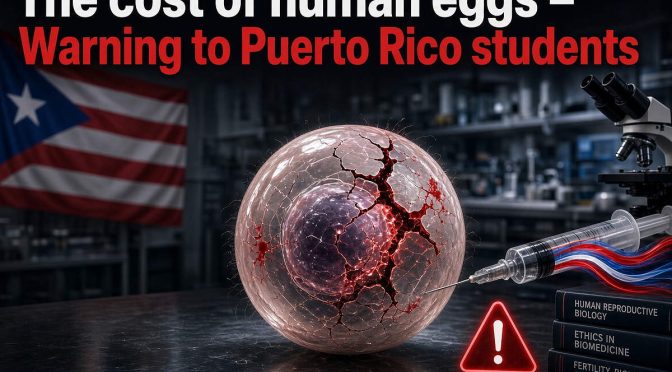
The cost of human eggs – Warning to Puerto Rico students

There is nothing so foolish that some philosopher has not said it, and there is nothing so evil that some bioethicist has not proposed it. — Anthony Daniels

A controversy has arisen in the local media concerning advertisements for egg donors which have appeared in “Diálogo” a University of Puerto Rico supported publication. The Interim Director of Diálogo, Sylvia Álvarez Curbelo, has claimed that these advertisements are not paid for using UPR funds. However, this is misleading since the UPR does heavily subsidize the running costs of this publication, and by acquiescing to such advertisements, the UPR is, in effect, using public funds to provide a platform for these advertisements. In doing so, the University completely ignores the fact that oocyte (egg) donation is an invasive, painful, and physically demanding procedure with dangerous side effects.

Continue reading The cost of human eggs – Warning to Puerto Rico students →

Unmasking the Strategy to Legalize Abortion throughout Latin America

Just a few hours before the vote by the Constitutional Court on a case which will legalize abortion in Colombia, the Documentation and Analysis team of HazteOir (HO), a web based civil association based in Madrid, issued an exhaustive report on the strategy being employed by a group of international organizations to legalize abortion throughout the continent. Experts in both Europe and Latin America point out that Colombia is merely the beach head for this strategy, and warn that the case before the Colombian Constitutional Court is intended as the key to what could be a cascade of similar legalizations.

The report, entitled “Harassment and Destruction of Life: The UN’s Astounding Gamble in favor of Abortion in Latin America”, aims to shed light upon the existence of a ten year old plan, jointly crafted by a number of international bodies, whose shared aim is the legalization of abortion throughout the region. The instigators of this scheme include the UN Committee on Human Rights [sic], the Ford and Rockefeller Foundations, and the International Planned Parenthood Federation (IPPF), an abortion business whose revenue from a global network of abortion clinics amounts to billions of dollars annually.

The document makes clear that the scheme, which involves High Impact International Litigation, is yet another attempt to impose certain global agendas on countries which would not otherwise accept them. These agendas include the legalization of abortion in Latin America and, in European countries in which abortion is already legal, the abolition of conscience clauses for doctors who refuse to carry out such operations.

The report points out that this strategy is one of many being employed to achieve a new international order, in which small, unelected groups of ideologues, unquestioned by anybody and answerable for their actions to nobody, impose their agendas on
entire countries by deception and control of the media.

According to HO, “for Latin America to promote legal abortion is a step backwards when in Spain, which, sadly, pioneered the legalization of abortion, there is now a consensus of public and political opinion that abortion is a tragedy for both mother and child, a tragedy that should be eliminated by offering positive alternatives to mothers who have unexpected pregnancies.

Source: “HazteOir.org unmasks the strategy to legalize abortion in Latin America” HazteOir.org, 9th of May 2006. —Translated by Philip Pennance for Human Life International.