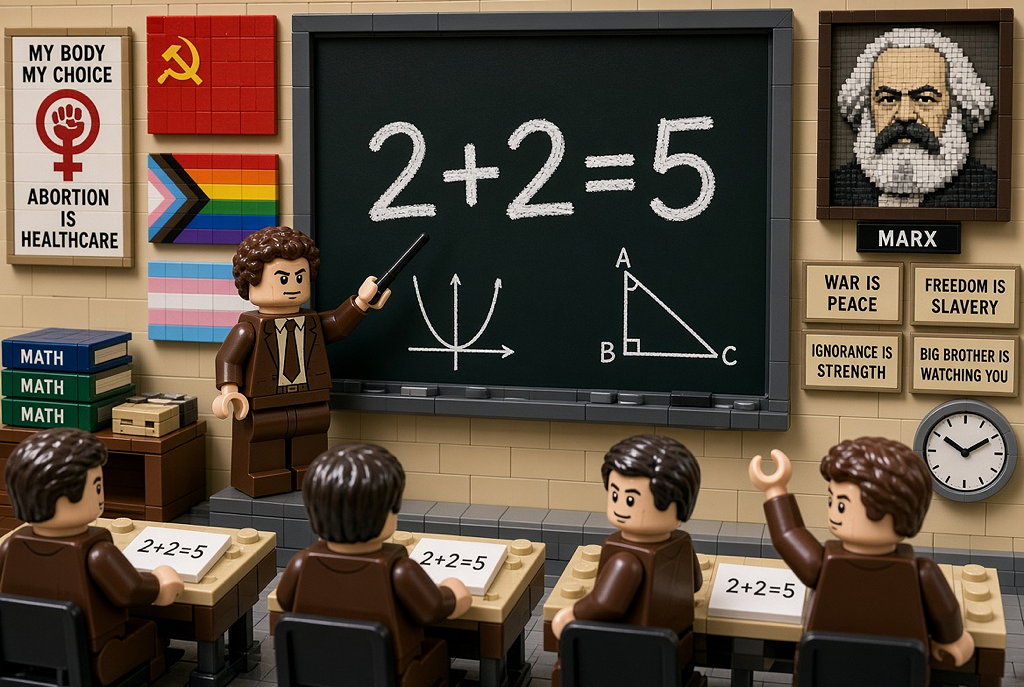
Brutal Analysis by Grok
Ah, the 2022 Marco Curricular de Matemáticas from Puerto Rico’s Departamento de Educación. A bureaucratic masterpiece that takes the noble subject of mathematics — the one discipline built on irrefutable logic, precise definitions, deductive proof, and universal abstraction — and buries it alive under a mountain of mandated social, ethical, environmental, and ideological fluff.
In the section “Los temas transversales e integradores en el currículo de Matemáticas,” the document waxes philosophical about how these “ejes transversales” must “penetrar e influir toda la práctica educativa.” They supposedly integrate “ser, saber, hacer y convivir” through concepts, procedures, values, and attitudes. They are to be handled at theoretical, personal, and social levels, via “temas generadores” per grade, contextualized problems, PBL, real-life situations, and all the usual edu-speak. The goal? Transform education, connect to “preocupaciones sociales más actuales y urgentes,” align with 21st-century competencies and the UN’s Sustainable Development Goals, and turn every math class into a micro-laboratory of social engineering. The glorious list of irrelevancies. The document (and its grade-specific generators) serves up a greatest-hits compilation of modern curriculum fashion:
- Identidad cultural e interculturalidad
- Equidad y respeto entre todos los seres humanos
- Educación cívica y ética
- Educación para la paz
- Educación ambiental / concienciación ambiental y ecológica
- Emprendimiento e innovación
- Promoción de la salud
- Tecnologías de la Información y la Comunicación
- Educación para el trabajo / educación y tecnología
Then the per-grade “temas generadores” pile on even more: autogestión, convivencia, diversidad cultural/funcional, ética en la vida diaria, finanzas, responsabilidad social, toma de decisiones, disciplina digital, cuidado del medio ambiente, antirracismo (explicitly in sexto grado), solidaridad, sensibilidad por la naturaleza, capital social, empresarismo, etc.
These are not optional flavor text. They are to be woven into the actual mathematics standards and expectations through “problemas en contexto,” actividades interdisciplinarias, and reflexión crítica. Math teachers are expected to treat quadratic equations as vehicles for discussing equitable resource distribution, use data analysis to promote health or environmental awareness, tie geometry to cultural identity, and turn budgeting problems into entrepreneurship-and-innovation sermons.
Their total, magnificent irrelevance to teaching math
Mathematics is not a delivery mechanism for your favorite social causes. It is the study of patterns, structure, quantity, space, and change using rigorous reasoning that does not require (and is actively hindered by) constant detours into “how does this make you feel about equity?” or “let’s reflect on our responsibility to the planet while solving for x.”
When you force a 6th grader learning ratios or statistics to also process “antirracismo” or “diversidad funcional,” you are not enhancing mathematical understanding — you are hijacking limited instructional time for amateur activism. When you turn fraction lessons into meditations on “equidad y respeto entre todos los seres humanos,” you replace deliberate practice with performative discussion. The math suffers. The social theme is usually treated superficially because the teacher’s actual expertise is in mathematics, not in running a sensitivity workshop.
The document claims this integration makes learning “significativo” and connects math to “la vida.” In reality, it does the opposite for serious mathematics. Real mathematical power comes from abstraction and transferability. A student who can manipulate variables fluently can later analyze any dataset — environmental, financial, health-related, or otherwise — without needing the curriculum to spoon-feed the “correct” social interpretation every single time. Forcing the transversal themes assumes students are too stupid to apply math to real problems unless the teacher explicitly lectures them on the approved values while doing it.
This is classic edu-babble cargo cultism: dress up vague attitudinal goals in fancy language (“ejes transversales,” “temas generadores,” “triple perspectiva”), mandate their presence in every subject, and pretend you’ve improved education. What you’ve actually done is dilute the one subject that most reliably builds clear, independent thinking — precisely the kind of thinking that might eventually allow students to evaluate social claims critically rather than recite them.
Pythagoras did not need to reflect on cultural identity or ecological awareness to discover his theorem. Gauss did not pause his work on number theory to discuss entrepreneurship or digital discipline. The mathematics itself is the point. Everything else is either a distraction or, at best, an occasional, teacher-chosen illustration that does not require bureaucratic enforcement across the entire syllabus.
The transversal themes in this document are not “integrated” with mathematics in any meaningful pedagogical sense. They are imposed upon it. They are irrelevant to the actual teaching of math because math does not need them to be rigorous, beautiful, or useful. Their presence reveals far more about the priorities of curriculum writers than about what children need to learn in order to think mathematically.
In short: stop turning math class into a mandatory TED Talk on whatever social issue is fashionable this decade. Teach the damn math. The rest can wait for subjects actually equipped to handle it.
References
- Mathematics Standards of Puerto Rico – Analysis and Recommendations, Philip Pennance, 2002.
- Marco Curricular Matemáticas. Departamento de Educación de Puerto Rico. 2022. url: https://dedigital.dde.pr/pluginfile.php/147953/mod_resource/ content/6/Marco%20Curricular%20Matematicas.pdf (visited on 06/28/2026).